
Screen Porch Natural Light Loss: Maryland & Virginia Reality
Screen porches don't have to make your house dark—and Montgomery County and Fairfax County homeowners are discovering smart design solutions that preserve natural light. Modern screening materials, strategic placement, and proper construction techniques minimize light loss while maximizing your outdoor living space. Learn what DMV homeowners really experience when they add a screen porch.
“How much light am I going to lose inside the house?”
At Design Builders, this is the most frequently asked question we get—by far. And it makes sense. Natural light changes how your home feels. It affects mood, comfort, and even how big the space feels day-to-day. Homeowners don’t want to invest in a beautiful new outdoor room… and then feel like they just dimmed the main level.

Here’s the honest truth after 20+ years of building screen porches across the DMV:
Most homeowners lose far less light than they expect—often so little they can’t tell the difference once the project is done.
And the “number one refrain” we hear when the roof goes up is some version of:“Wait… that’s it? I thought it was going to be way darker.”
Let’s break down why that happens, what actually affects interior light levels, and how we design screen porches in Maryland and Northern Virginia to keep homes bright.
Why losing light is the #1 screen porch concern
When homeowners picture a screen porch, they usually imagine a roof attached to the back of the house and immediately assume it will block sunlight from entering the interior windows and doors.
That’s a logical assumption— but it often doesn’t match real-world conditions in the neighborhoods where screen porches are most popular.
In many areas we build— Bethesda, Falls Church, Potomac, Chevy Chase, Howard County, and similar mature communities—most homes don’t have strong, direct sunlight streaming into the back of the house all day.
They have something else:
- Mature tree canopies
- Indirect, filtered daylight
- Shaded rear elevations
- Lots of “ambient brightness,” not harsh sunbeams
So when you add a porch roof, you’re often not blocking a strong shaft of direct light. You’re adding structure over an area that was already getting softer light.
That’s a big reason why the fear of losing light is usually larger than the actual change.
The biggest factor: are you getting direct sun or indirect light?
Mature, wooded neighborhoods inside the Beltway
In older, established neighborhoods—especially inside the Beltway—backyards tend to be wooded. That means your house is already living on indirect light for much of the day.
If you’re in:
- Bethesda or Chevy Chase (Montgomery County)
- Vienna (Northern Virginia)
- Potomac
- Older parts of Alexandria
…there’s a strong chance your “before” condition is already filtered light.
In those cases, a well-designed screen porch usually causes minimal perceived difference inside the home.
Clear lots, new neighborhoods, and southern exposure
On the other hand, if you’re in a newer neighborhood, on farmland, or in an area with minimal tree cover—parts of Frederick County, Loudoun County, or newer developments in Fairfax—you may get more direct sunlight.
And if your porch is on a south-facing rear elevation with no shade, then yes: it can be a “more direct-light” situation.
Even then, what we consistently find is:
Homeowners still tend to lose less light than they fear—especially when the porch is designed to protect sightlines and maximize openness.
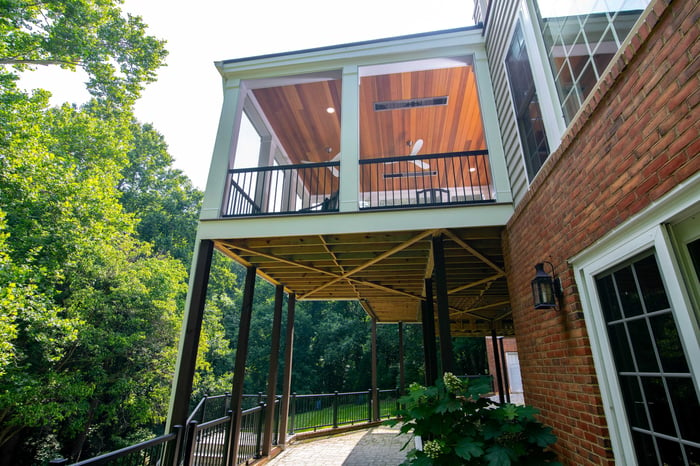
How we design screen porches to preserve natural light
A screen porch can be designed like a bulky add-on… or it can be designed like a bright outdoor room that feels like it was always part of the house.
If light is a priority (and it usually is), these are the biggest design levers.
Keep beams above windows and doors
This is one of the simplest concepts—and one of the most important.
When you’re inside the house looking out through the back door or windows, what “darkens” the view isn’t always the roof itself.
It’s structure crossing your sightline.
Our rule of thumb is straightforward:
- We push beams as high as physically possible
- We keep beams above window and door heads
- We avoid placing beams within the primary window view
In plain language: we don’t want you looking out your back windows and seeing a beam cutting across your view.
That’s often what makes a space feel “heavier,” even if the actual light level isn’t dramatically different.
Use high gable designs to bring light through the front
If light is a major concern, a gable roof often becomes the best design solution.
Why?
Because gable porches give you:
- A higher roofline
- More openness in the front wall
- A brighter, airier feeling from both inside and outside
And just as importantly, we typically avoid building closed gables unless a homeowner specifically requests it.
Instead, we keep the gable ends open with large triangular openings to let light pass through the porch volume.
The goal is simple:
When you’re looking out your door or windows, your view should feel as close as possible to the pre-porch view.
Space columns wide to eliminate visual “blocking”
Columns don’t just hold the roof—they define how “open” the porch feels from the inside of the home.
Tighter column spacing creates more visual interruptions, which can make the porch feel like a wall.
.jpg?width=700&height=467&name=screened_porch_with_high_performance_materials_and_deck_accessories_bethesda_maryland%20(11).jpg)
When we can, we’ll:
- Increase column spacing
- Use structural solutions that reduce the number of posts
- Align columns intentionally with window/door views
In some designs—especially more contemporary builds—we can use big-span beams to open the front of the porch dramatically.
Depending on engineering and layout, we’ve opened fronts as wide as:
- 16 feet
- 18 feet
- 20 feet
- and even 24 feet
Wide openings make a porch feel less like a barrier and more like a frame—something you see through, not at.
And with systems like ScreenEze, large screening sections can be handled cleanly, which supports that open, bright look.
Avoid “window-to-wall” mistakes (especially with bay windows)
One of the most overlooked design mistakes is when a screen porch lands in a way that causes an interior window to look out… directly into the side wall of the porch.
This happens a lot with:
- Bay windows
- Corner windows
- Homes with multiple rear elevations
Even if the porch is beautiful, if your favorite kitchen window now stares at the side of a screened structure, the space can feel darker and more closed-in.
During design, we’re very intentional about:
- Porch placement on the house
- Where walls begin/end relative to windows
- Column locations that enhance views rather than interrupt them
This is the kind of detail that doesn’t show up in a quick sketch—but it’s the difference between “we added a porch” and “this feels like it always belonged here.”
Ceiling color matters more than most people think
If you want a brighter porch and you want to protect the light inside your home, the easiest win is often the finish palette—especially the ceiling.
Here’s the reality:
- White ceilings reflect light
- Wood ceilings (especially medium/dark stain) absorb light
So if light is a big concern, we strongly recommend considering:
- White ceiling finish
- Lighter columns and trim
- Bright, reflective surfaces
A wood ceiling can be stunning—and in some homes it’s absolutely worth it—but it does change the brightness of the porch and can subtly change the “feel” of light near the rear doors and windows.
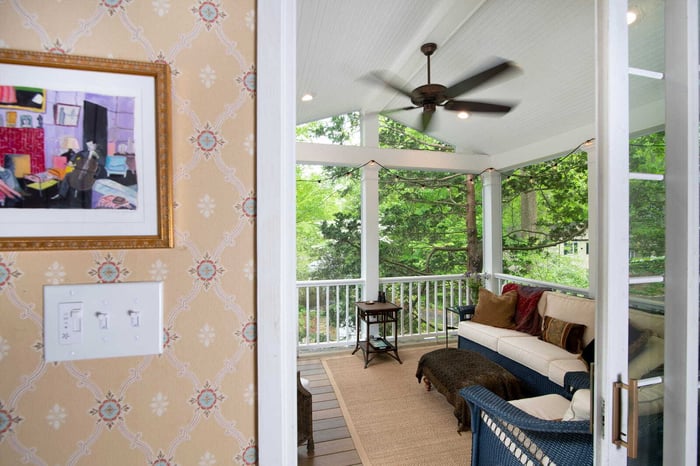
If your top priority is maximum light, bright finishes are your best friend.
Skylights: the “insurance policy” for light-sensitive homes
In the rare cases where a homeowner is extremely concerned—or a home has a unique orientation—we can design skylights into the porch roof.
Common sizes include:
- 2x4 skylights
- 4x4 skylights
And we can place them intentionally to:
- Push light toward the back door area
- Brighten the interior transition zone
- Add daylight exactly where you want it
Skylights aren’t necessary for most projects—but for the right home, they’re a smart way to eliminate doubt and deliver a brighter result.
What homeowners say when the roof goes up
This is the part we wish every homeowner could see in advance.
There’s a moment on almost every screen porch build:
- Framing is up
- The roof goes on
- Homeowners walk inside and look out
And what we hear—again and again—is:
“I thought we were going to lose way more light than this.”
That’s because the perceived loss of light is usually driven by fear, not reality—especially in wooded DMV neighborhoods where indirect light is already the norm.
And when the porch is designed correctly—with high beams, open gables, wide column spacing, thoughtful placement, and bright finishes—the interior still feels bright.
When you might notice more of a difference
To be fully transparent, there are situations where light loss can be more noticeable:
- South-facing rear elevation
- Minimal trees / open lot
- Large glass doors/windows relying on direct sun
- Low rooflines that force beams into the window view
- Dark ceiling/finishes combined with a deep porch footprint
Even in those cases, there are almost always design solutions to reduce impact—especially when light preservation is part of the plan from day one.
.jpg?width=700&height=467&name=screened_porch_with_high_performance_materials_and_deck_accessories_bethesda_maryland%20(12).jpg)
Best screen porch builder in Montgomery County, MD and Northern Virginia: design matters most
If you take one thing away from this, it’s this:
Light loss isn’t just about having a roof. It’s about how the porch is designed and detailed.
A screen porch can feel like a shaded tunnel… or it can feel like a bright outdoor room that barely changes your interior daylight.
The difference is:
- Beam height
- Roof style (gable vs. shed)
- Open gable detailing
- Column spacing and alignment
- Placement relative to windows
- Interior and ceiling color
- Skylight strategy (when needed)
These are design decisions—not afterthoughts.
Ready to design your screen porch without sacrificing natural light?
If you’re in the research phase and your biggest hesitation is, “I don’t want my house to get darker,” we can walk you through what to expect based on your lot, tree coverage, orientation, and home layout.
We’ll show you design options that preserve views, maximize openness, and keep natural light where it belongs—inside your home.
Book a Free Online Design Consultation and we’ll help you plan a screen porch that feels bright, intentional, and built for the way you actually live.