
 If you're a homeowner in Montgomery County, Maryland, and you've been thinking about adding an outdoor kitchen to your backyard, the first question on your mind is almost certainly about cost. Outdoor kitchens in this region involve a unique mix of material choices, utility connections, permitting requirements, and site conditions that national pricing guides cannot account for.

Design Builders helps Montgomery County homeowners navigate these variables every day through a design-build process that keeps pricing transparent from the start.
This guide covers everything you need to know about outdoor kitchen costs specific to Montgomery County. You'll find detailed breakdowns of materials, labor, appliances, and permitting, along with the installation factors that can shift your budget in ways you might not expect.
Key Takeaways: Outdoor Kitchen Costs in Montgomery County
- Outdoor kitchen costs in Montgomery County typically range from entry-level setups to fully custom entertainment spaces, depending on scope.
- Material choices for countertops, cabinetry, and the grill island structure are the largest cost drivers in any outdoor kitchen project.
- Montgomery County's 30-inch frost line and clay soil conditions require properly engineered footings that add to foundation costs.
- Utility connections for gas, electric, and water often represent a significant portion of the total budget.
- Design Builders provides transparent, itemized estimates so Montgomery County homeowners can plan confidently before construction begins.
What Determines Outdoor Kitchen Cost in Montgomery County?
Outdoor kitchen pricing is never a single number. It's the result of several interconnected decisions about layout, materials, appliances, utility routing, and site preparation. Understanding these categories up front gives you a realistic framework for budgeting your project.
Montgomery County adds a layer of complexity that you won't find in national cost calculators. Local soil conditions, permit requirements, frost depth regulations, and even your property's proximity to utility connections all influence the final investment. Each of these factors deserves a closer look.
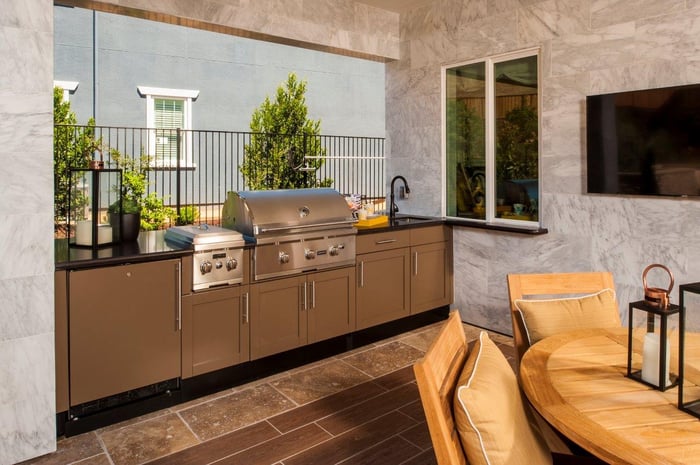
(photo courtesy Danver)
How Do Material Choices Affect Outdoor Kitchen Pricing?
Countertop Materials and Their Cost Impact
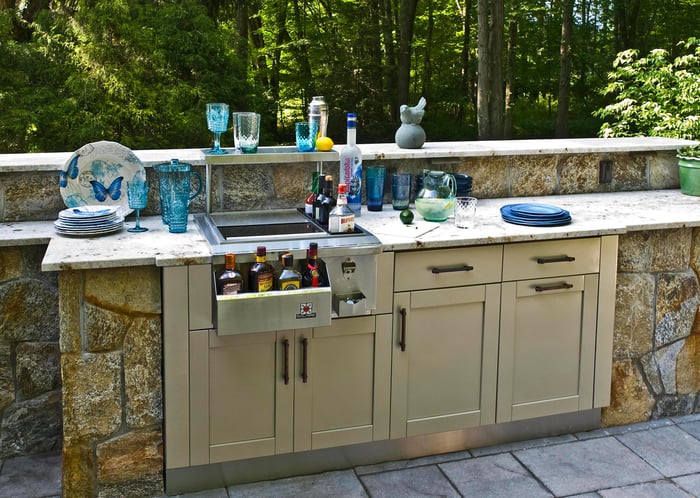
Your countertop selection is one of the most visible decisions and one of the most variable cost factors. Granite, natural stone, and porcelain slabs each carry different price points, and all of them need to withstand Montgomery County's freeze-thaw cycles without cracking or delaminating.
Granite remains a popular choice for outdoor kitchens because it handles temperature swings well and resists staining. Porcelain countertops have gained popularity in recent years for their low maintenance and resistance to UV fading. Concrete countertops offer a more budget-conscious option, though they typically require periodic sealing to perform well through Maryland winters.
Cabinetry: Stainless Steel vs. Polymer vs. Masonry
The material you choose for the body of your outdoor kitchen island is just as important as the countertop. Stainless steel cabinetry from manufacturers like Danver stands up to the mid-Atlantic climate year after year. It won't rot, warp, or attract insects.
Polymer and HDPE cabinets provide another weather-resistant option at a lower initial cost. Masonry islands built with concrete block and finished with stone veneer are a traditional approach and can accommodate a wide range of design styles. Each option carries distinct long-term maintenance considerations that affect your total cost of ownership.
Grill Island Structure and Framework
The structural framework of your grill island can be built from steel stud framing, concrete block, or prefabricated modular systems. Steel stud framing is lighter and faster to install, while concrete block provides a heavier, more permanent base. The choice between these options affects both material cost and labor hours.
What Appliances Should You Budget For?
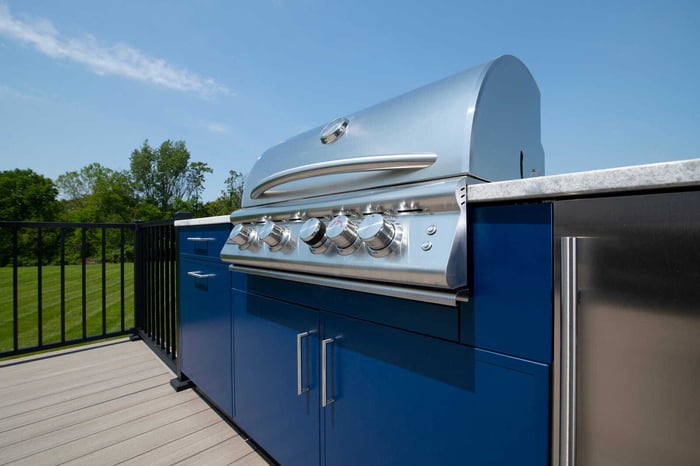
Appliance selection is where outdoor kitchen budgets can expand quickly. A built-in grill is the centerpiece of most outdoor kitchens, and the range of options spans from entry-level models to professional-grade units with multiple burners, rotisseries, and sear stations.
Beyond the grill, many Montgomery County homeowners include a refrigerator, sink, side burner, or ice maker in their outdoor kitchen design. Pizza ovens and smokers have become increasingly common additions. Each appliance requires its own utility connection, and the more appliances you add, the more complex the utility routing becomes.
When budgeting for appliances, consider the fuel source carefully. Natural gas connections require a dedicated gas line from your home's supply, which means trenching, a gas permit, and an inspection. Propane-fed appliances avoid the gas line cost but introduce the ongoing expense of tank refills and the space requirement for a storage tank.
How Do Utility Connections Affect the Budget?
Gas Line Installation in Montgomery County
Running a natural gas line to your outdoor kitchen involves trenching from your home's gas meter, installing the line, and obtaining a gas permit through Montgomery County's Department of Permitting Services. The distance between your home and the kitchen location is the primary variable.
A short run across a patio is a different job than a 60-foot trench across a landscaped yard.
Gas line installation also requires a licensed plumber and a county inspection before the line can be activated. These requirements protect your safety, but they add time and cost to the project that you should account for early in the planning process.
Electrical and Water Connections
Electrical work for an outdoor kitchen typically includes dedicated circuits for appliances, GFCI-protected outlets, and wiring for lighting. If you're adding a sink, you'll need both hot and cold water supply lines and a drain connection. In Montgomery County, plumbing and electrical work must meet code and pass inspection.
The complexity of these connections depends largely on your home's existing infrastructure and the distance to the outdoor kitchen site. A kitchen built adjacent to your home's exterior wall is significantly less expensive to connect than one positioned 40 feet away at the edge of your yard.
Why Does Montgomery County's Climate Affect Foundation Costs?
Montgomery County's frost line sits at 30 inches below grade, according to Maryland Building Performance Standards. Any permanent outdoor structure, including an outdoor kitchen island, needs footings that extend below this depth.
If the footings don't reach below the frost line, the freeze-thaw cycle in Montgomery County's clay-heavy soil can heave the structure, crack stone veneer, separate counter joints, and compromise gas connections.
This is one of the most important cost factors that national pricing guides miss entirely. A properly engineered foundation requires excavation, formed footings poured to the correct depth, and time for the concrete to cure. Helical pier foundations offer an alternative that can reduce excavation disruption, cure time, and landscaping damage.
Clay soil conditions vary across Montgomery County as well. Properties in Potomac, Bethesda, and Chevy Chase may have different soil bearing capacities than those in Olney or Clarksburg. A soil assessment early in the project helps avoid surprises during construction.
What Does the Permitting Process Look Like in Montgomery County?
Montgomery County's Department of Permitting Services (DPS) oversees construction permits for outdoor structures. Depending on the scope of your outdoor kitchen project, you may need building, electrical, plumbing, and gas permits. Each permit requires its own application, plan review, and field inspection.
If your property is in a historic district or subject to HOA architectural review, the approval process adds another layer of time and documentation. Properties in areas like Chevy Chase Village, Kensington, and parts of Bethesda may face additional design review requirements that affect both your timeline and your budget.
The permitting process is where working with a local design-build firm pays for itself. A contractor who regularly navigates Montgomery County permitting knows what the reviewers expect and how to avoid revision cycles that delay your project.
Design Builders manages the permitting process as part of every outdoor kitchen project in Montgomery County, so you don't have to coordinate multiple trades and permit applications on your own.

How Do Layout and Size Affect Total Cost?
Linear-Foot Pricing as a Starting Framework
Many contractors use a linear-foot measurement to estimate outdoor kitchen costs. This gives you a rough starting framework based on the total length of your counter run. An L-shaped or U-shaped layout will have more linear footage than a straight-line design, and each additional foot adds materials, labor, and potentially more utility connections.
Keep in mind that linear-foot pricing is a simplified estimate. It doesn't account for the specific materials, appliance cutouts, utility distances, or site conditions that ultimately determine your project cost. Use it as a conversation starter, not a final budget number.
Straight-Line, L-Shaped, and U-Shaped Configurations
A straight-line outdoor kitchen is the most compact and cost-efficient layout. It works well for smaller patios or deck spaces and typically accommodates a grill, a small prep area, and one or two additional appliances.
L-shaped kitchens add a corner section that creates a natural work triangle between cooking, prep, and serving areas. This layout works well for entertaining because it allows the cook to face guests.
U-shaped kitchens provide the most counter space and appliance capacity but require a larger footprint and a higher material investment.
What Site Preparation Factors Increase Costs?
Your property's specific conditions play a major role in outdoor kitchen costs that many homeowners don't anticipate. Grading, drainage, access, and existing landscaping can all influence the labor hours and equipment required before construction even begins.
Slope and Drainage Considerations
A flat yard adjacent to your home is the simplest scenario for an outdoor kitchen installation. A sloped yard may require retaining walls, grading work, or stepped construction to create a level platform.
Montgomery County's stormwater management regulations may also require specific drainage solutions if your project adds impervious surface area to your lot.
Access and Material Delivery
If your backyard is only accessible through a narrow side yard, a gate, or through the home itself, material delivery and equipment access become more complex and more expensive. Stone, concrete, and appliances are heavy, and getting them to the build site without damaging your home, landscaping, or driveway requires careful logistical planning.
This is exactly the kind of detail that separates experienced local contractors from national chains. Design Builders evaluates site access during the initial consultation so logistics costs are reflected in your estimate from the start, not added as a surprise change order halfway through the project.
How Can You Integrate Your Outdoor Kitchen With Other Outdoor Living Features?
An outdoor kitchen rarely exists in isolation. Most Montgomery County homeowners plan their kitchen as part of a larger outdoor living space that may include a patio with heating, a pergola for shade, or a screened porch for three-season use.
Integrating these features during the design phase is significantly more cost-effective than adding them as separate projects later.
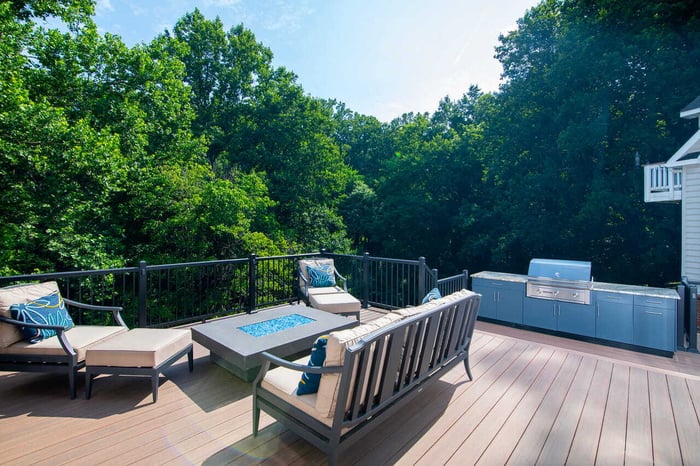
Building your outdoor kitchen on or adjacent to a new deck or patio allows you to share foundation work, utility routing, and labor mobilization costs across the larger project. A screened porch adjacent to the kitchen extends your usable season well into fall and protects your investment from debris and insects during meals.
Pergolas and shade structures over the cooking area reduce heat buildup and provide a defined architectural element that anchors the space visually. Adding outdoor lighting and infrared heaters at the same time as the kitchen build avoids the cost of running additional electrical circuits later.
What Should You Look for in an Outdoor Kitchen Contractor?
Choosing the right contractor for your outdoor kitchen project in Montgomery County matters more than any single material or appliance decision. An experienced design-build firm handles design, permitting, utility coordination, and construction under one contract, which reduces miscommunication and change orders between separate trades.
Ask for an itemized estimate that breaks out materials, labor, appliances, utility work, permitting fees, and site preparation as separate line items. This transparency lets you make informed trade-off decisions without guessing where your money is going.
If a quote for an outdoor kitchen project seems unusually low, that's a signal to look closely at what's been left out.
Verify that the contractor is licensed, bonded, and insured in Maryland, and confirm they have specific experience with Montgomery County permitting. Ask to see recent outdoor kitchen projects they've completed in the area, and check whether they handle gas, electrical, and plumbing coordination or subcontract those trades out.
How Does Design Builders Approach Outdoor Kitchen Projects in Montgomery County?
Design Builders takes a design-build approach to outdoor kitchen construction, which means your project is managed from concept through completion by one team. The process begins with a consultation where your goals, site conditions, and budget are discussed openly.
From there, the Design Builders team uses 3D visualization tools to develop a detailed design before any construction begins.
This approach eliminates the gap between what you imagined and what gets built. You see your outdoor kitchen in three dimensions, make material and layout adjustments, and approve a detailed, itemized estimate before the first shovel hits the ground.
Design Builders handles all Montgomery County permitting, utility coordination, and construction scheduling so you can focus on choosing how you want to use the space.
With premium material partnerships that include Danver stainless steel cabinetry, and deep local expertise in Montgomery County construction logistics, Design Builders delivers outdoor kitchens that are engineered for this region's climate and built to perform for decades.
Steps to Plan Your Outdoor Kitchen Budget in Montgomery County
Step 1: Define How You'll Use the Space
Start by clarifying what you want your outdoor kitchen to do. Are you primarily grilling for your family a few nights a week, or are you hosting large gatherings that need a full prep, cook, and serve workflow? Your answer shapes every downstream decision about layout, appliances, and utilities.
Step 2: Assess Your Site Conditions
Walk your yard with a critical eye. Note the slope, drainage patterns, distance from the house, access paths for materials, and proximity to existing utility connections. These factors directly impact your project cost, and identifying them early prevents budget surprises.
Step 3: Prioritize Your Must-Have Features
Separate your wish list into must-haves and nice-to-haves. A built-in grill and counter space might be non-negotiable, while a pizza oven or ice maker could be added in a future phase. Phasing your project lets you build the core kitchen now and expand later without reworking the foundation or utilities.
Step 4: Schedule a Professional Consultation
A professional site evaluation from an experienced Montgomery County design-build firm gives you the most accurate picture of what your project will cost. During this consultation, your contractor should assess soil conditions, utility distances, permit requirements, and design possibilities specific to your property.
Step 5: Review an Itemized Estimate
Before signing a contract, you should have a line-by-line breakdown of every cost category. Materials, labor, appliances, permits, utility connections, and site prep should each appear as separate items. This level of transparency protects your budget and gives you the information you need to make confident decisions.
Long-Term Value of an Outdoor Kitchen in Montgomery County
An outdoor kitchen is a significant investment, and Montgomery County homeowners are right to consider the long-term return. According to the National Association of Realtors' 2025 Remodeling Impact Report, outdoor living features consistently rank among the projects that deliver both high homeowner satisfaction and meaningful cost recovery at resale.
Beyond resale value, an outdoor kitchen changes how you use your property on a daily and seasonal basis. It extends your entertaining space, reduces wear on your indoor kitchen during warmer months, and creates a dedicated gathering point that draws your household outdoors more frequently.
In Montgomery County's competitive housing market, a well-designed outdoor kitchen also serves as a differentiator if you decide to sell. Buyers in this region expect high-quality outdoor living amenities, and a custom kitchen built with durable materials and proper permitting stands out.
Common Mistakes That Increase Outdoor Kitchen Costs
Knowing what not to do is just as valuable as knowing the right approach. Here are the mistakes that most frequently push outdoor kitchen costs higher than they need to be in Montgomery County.
Choosing materials based on appearance alone, without considering how they perform through Maryland's freeze-thaw cycles, often leads to early replacement costs. Underestimating utility routing distances forces mid-project change orders. Skipping a soil assessment can result in foundation problems after construction is complete.
Starting construction without confirmed permits creates legal liability and can result in stop-work orders that extend your timeline and increase labor costs. Hiring a general contractor who subcontracts the specialized trades introduces coordination gaps where errors and delays are most likely to occur.
In Conclusion: How to Budget for Your Outdoor Kitchen in Montgomery County
An outdoor kitchen in Montgomery County is a project where local knowledge directly affects both the quality of the result and the accuracy of your budget. Frost line requirements, clay soil conditions, permit complexity, and utility routing distances all contribute to costs that generic pricing guides cannot capture.
The most reliable path to an accurate budget starts with a professional consultation from a design-build firm that works in Montgomery County every day. Design Builders brings the regional expertise, transparent pricing, and end-to-end project management that give you confidence in both your investment and the finished result.
When you're ready to move forward, request a consultation and see your outdoor kitchen take shape in 3D before construction begins.
FAQs About Outdoor Kitchen Cost in Montgomery County
What is the typical cost range for an outdoor kitchen in Montgomery County?
Outdoor kitchen costs in Montgomery County vary widely based on materials, appliances, utility connections, and site conditions. Entry-level projects with a built-in grill and basic counters cost significantly less than fully custom entertainment kitchens with multiple appliances and premium finishes.
Do I need a permit for an outdoor kitchen in Montgomery County, MD?
Most outdoor kitchen projects in Montgomery County require at least a building permit, and many also need gas, electrical, and plumbing permits. Montgomery County's Department of Permitting Services reviews plans and conducts field inspections. Design Builders manages the entire permitting process as part of its design-build service.
How deep do footings need to be for an outdoor kitchen in Montgomery County?
Footings for permanent outdoor structures in Montgomery County must extend at least 30 inches below grade to clear the frost line. This protects the structure from heaving caused by the region's clay soil and freeze-thaw cycles. Design Builders uses engineered foundation solutions, including helical piers, to meet this requirement efficiently.
What materials hold up in Montgomery County's climate for outdoor kitchens?
Stainless steel cabinetry, granite or porcelain countertops, and steel-framed island structures perform well through Montgomery County's hot summers and cold winters. These materials resist moisture, UV exposure, and temperature cycling. Design Builders partners with Danver for stainless steel cabinetry that is specifically engineered for outdoor use.
How long does it take to build an outdoor kitchen in Montgomery County?
Timeline depends on project complexity, permit approval speed, and weather conditions. A straightforward outdoor kitchen on an existing patio may take several weeks from permit approval to completion. Larger projects integrated with decks, patios, or screened porches require additional time for design, permitting, and construction phasing.
Can I add an outdoor kitchen to my existing deck in Montgomery County?
Adding an outdoor kitchen to an existing deck is possible in many cases, but it requires a structural evaluation to confirm the deck can support the additional weight. Gas lines, electrical circuits, and plumbing may also need to be routed through or under the deck structure.
Design Builders assesses existing deck conditions and designs integration solutions that protect structural integrity.