
The Definitive Guide to Luxury
Screened Porches in the DMV: 2027
Strategic Planning Hub
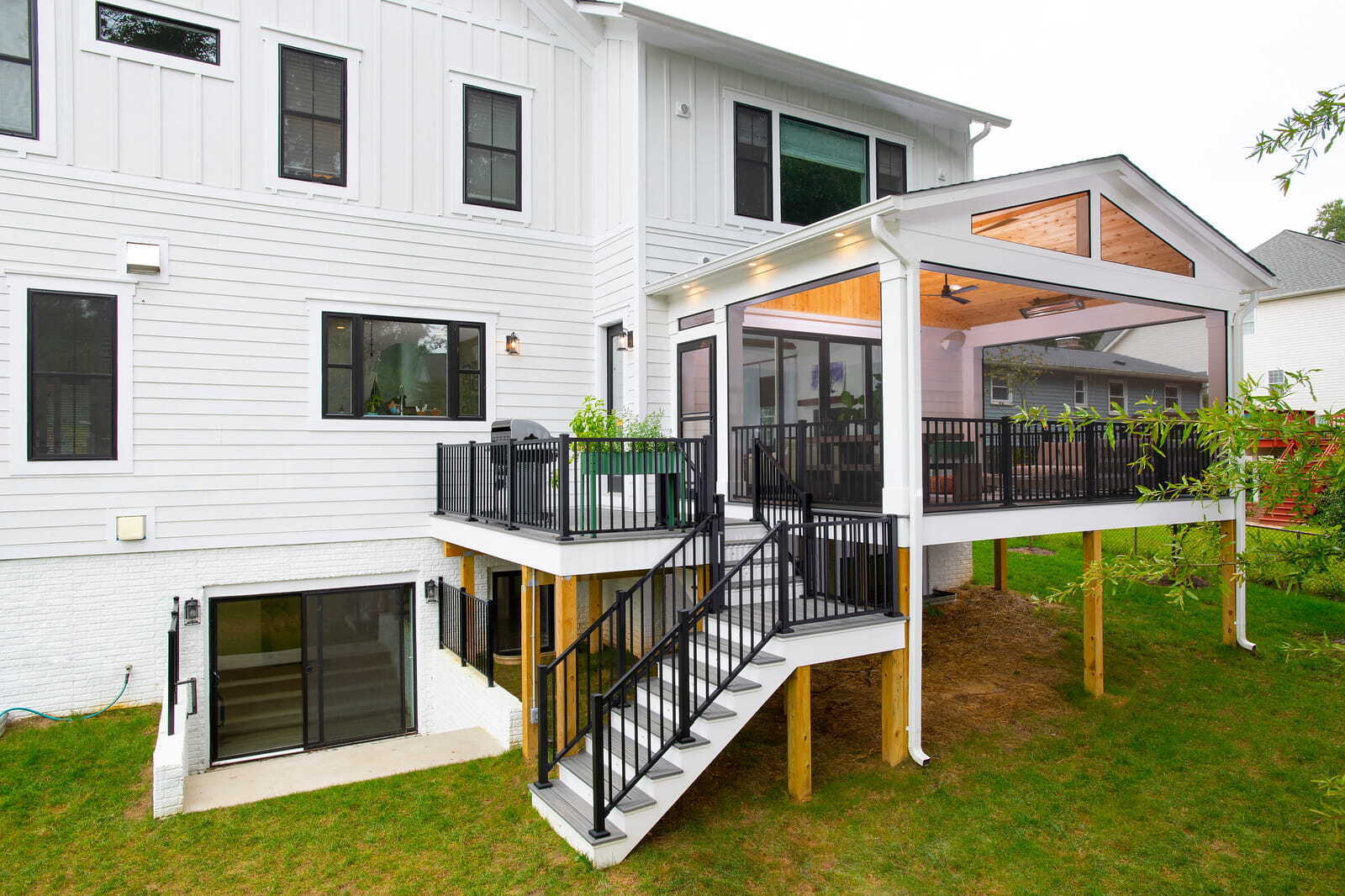
Screened porches in Fairfax, Loudoun, Montgomery, Howard, Anne Arundel, Arlington, and Prince George's counties are no longer simple add-ons. They are the centerpiece of how affluent homeowners in Northern Virginia and Maryland are choosing to live — extending their homes outward, blurring the line between inside and outside, and creating spaces that rival anything a boutique hotel could offer. This guide covers everything: design philosophy, structural engineering, materials, county-specific permitting, project economics, and the real-world projects Design Builders has built across the region over the past 20 years. Whether you are in the early stages of imagining a space or ready to break ground, this is the only resource you need.

Let's Talk About Your Project
At Design Builders, every initial consultation starts with a real conversation — not a sales pitch. Tell us what you want to build, and we'll tell you honestly what it costs, how long it takes, and whether we're the right fit for your home.
What's Inside This Guide
.jpg "zuri_screened_porch_design_potomac (4)")
Architectural Integration and Design Philosophies for the Mid-Atlantic
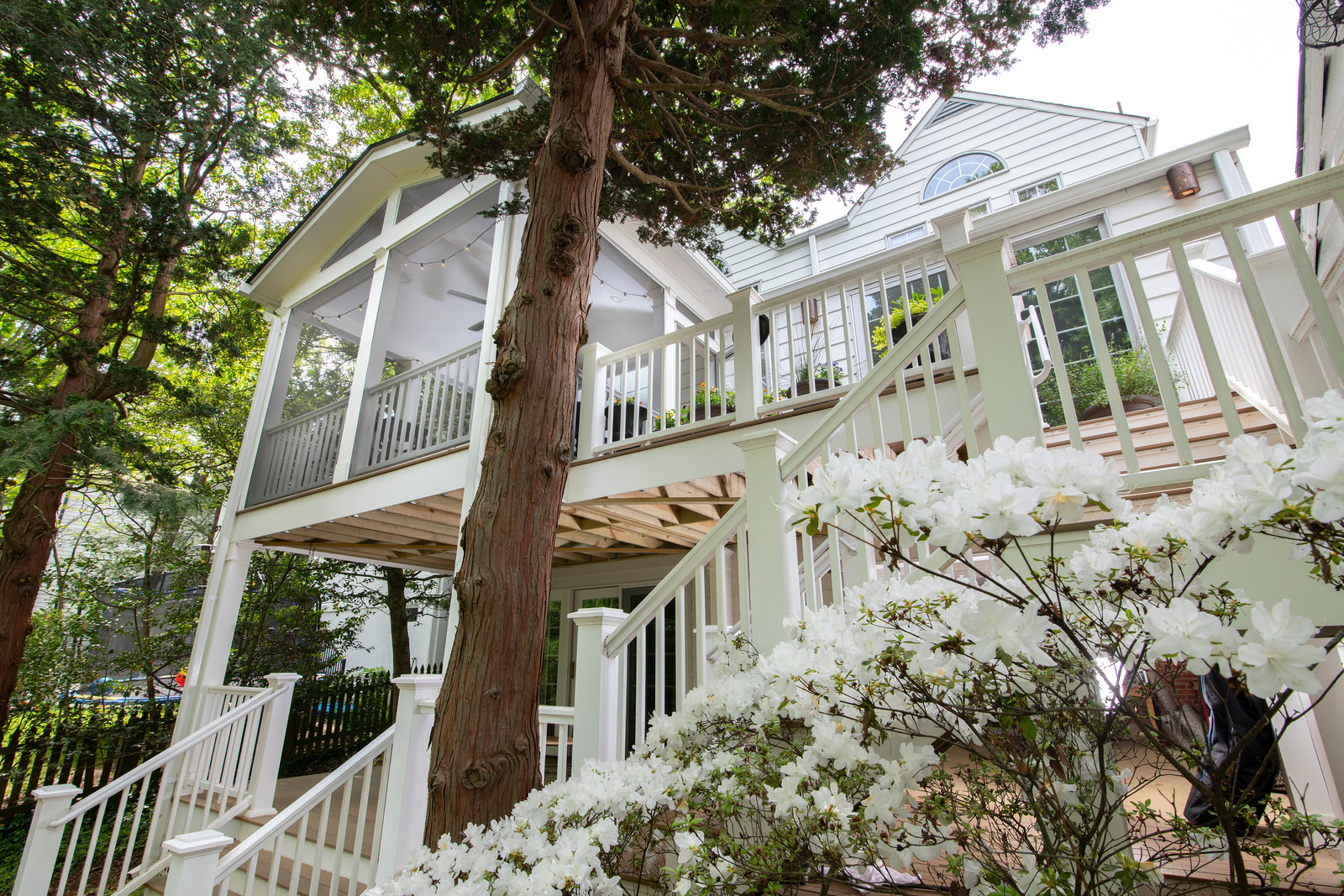
A well-designed screened porch in Fairfax, Montgomery, or Loudoun County is not an addition — it is an extension of the home's architecture. Roof pitch, ceiling material, column profile, and screen system selection all determine whether the porch reads as intentional design or a visible afterthought attached to the back of the house.
.jpg "sykesyville-screened-in-porch (9)")
Roof Styles
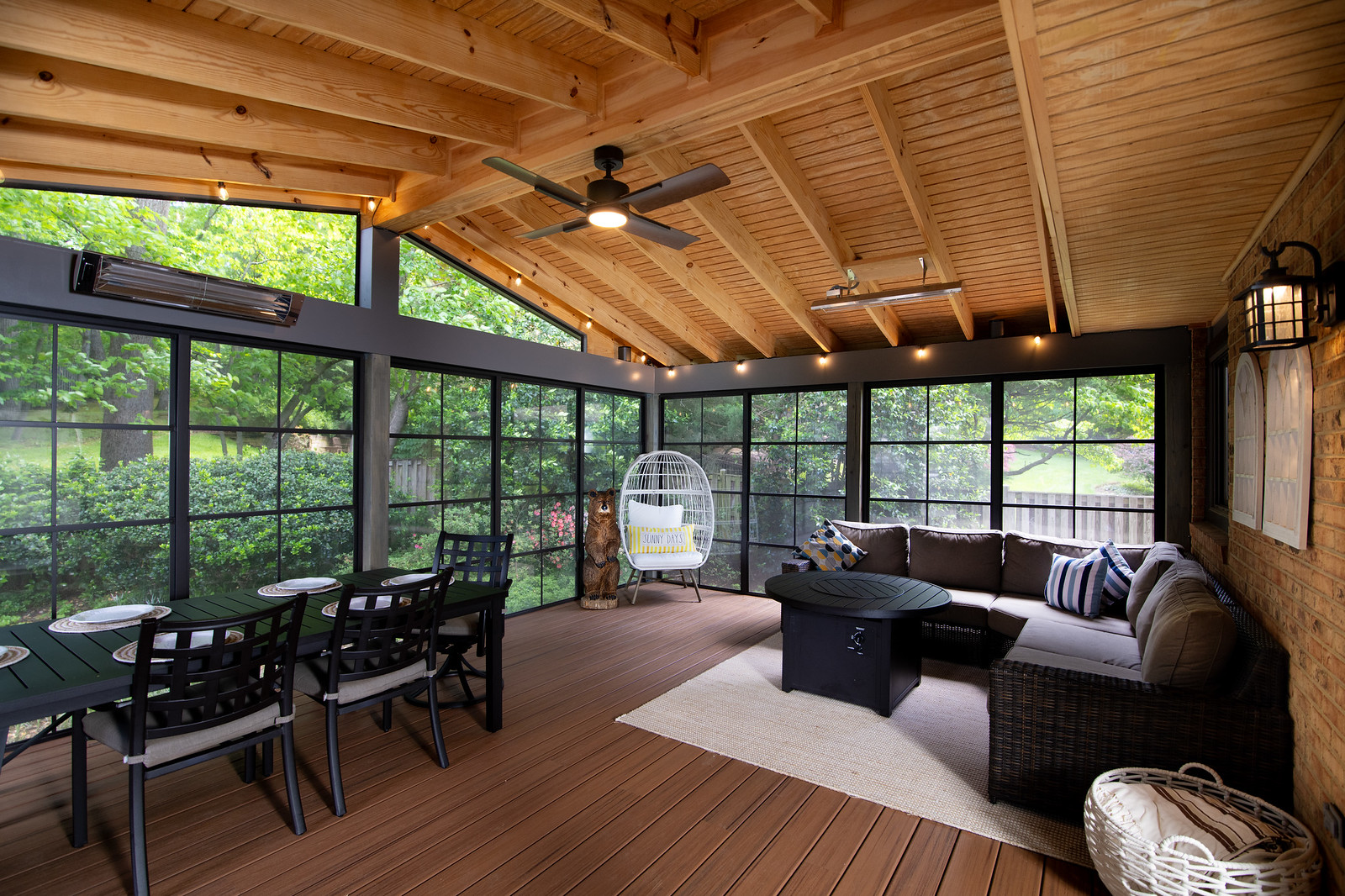
The roof determines everything about how a porch feels. A gable roof creates volume and drama. A hip roof wraps all four sides — ideal for detached pavilions. A shed roof ties into the existing roofline with minimal disruption. Each works, but only when matched to the right house.
Ceiling Systems
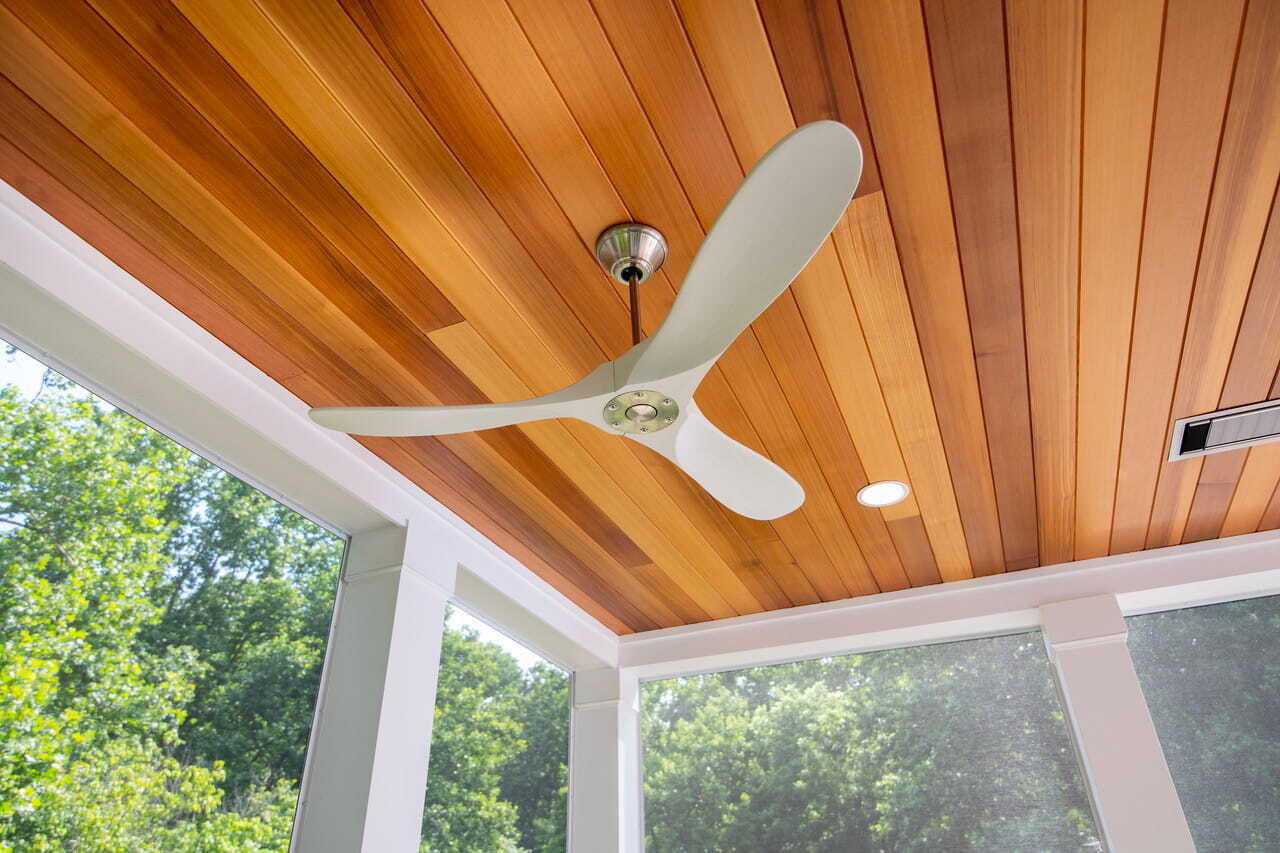
Tongue-and-groove cedar is warm and rich — right for craftsman and colonial homes. Painted beadboard is clean and low-maintenance — right when you want the porch to feel like an indoor room. Exposed timber frame is the most architectural choice — dramatic, photogenic, and high resale appeal.
The Transition
A single hinged door creates a hard stop. A sliding door softens it. A folding glass wall eliminates it entirely — turning the porch and interior into one continuous living space. The door system you choose determines how the porch actually gets used every day.
Beyond the Add-On — Creating Seamless Indoor-Outdoor Transitions
The defining question of any screened porch project is not "what do we build?" It is "where does the inside end?" For homeowners in Arlington, Falls Church, and Bethesda, that transition moment — the threshold between conditioned interior space and the screened exterior — is the most important design decision on the entire project.
Get it right and the porch feels like a natural extension of the kitchen, the family room, or the primary living space. Get it wrong and you have a beautiful room that nobody uses because it feels disconnected from how the family actually moves through the house.
Design Builders approaches every project by mapping interior traffic patterns first. Where do people naturally flow at the end of the workday? Where does the family gather on a Saturday morning? Where does the entertaining happen? The answers to those questions determine where the porch connects, how wide the opening needs to be, and what kind of door or transition system makes that connection feel effortless.
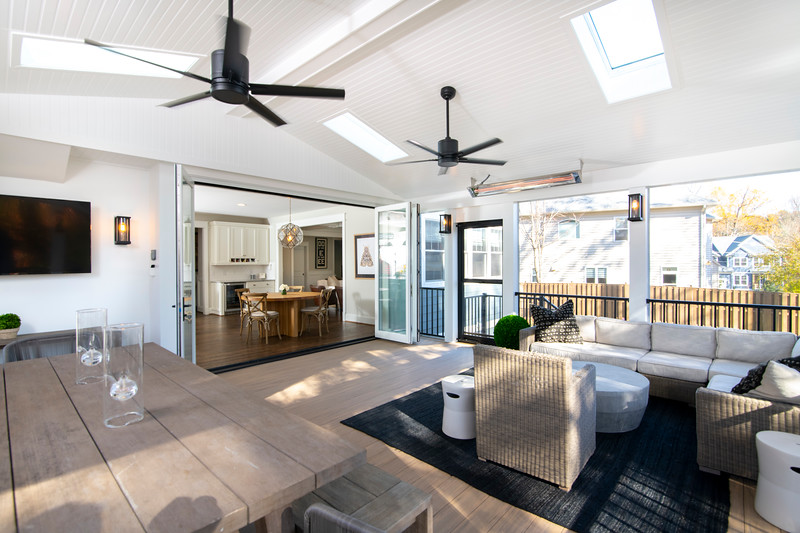
In Falls Church, Virginia, one Arlington County homeowner had a specific vision: the transition from kitchen to screened porch had to feel like opening a room, not stepping through a door. Design Builders solved it with a Lincoln 4-panel folding door system that opens to a full 12-foot span — the entire wall effectively disappearing when the weather invites it, and sealing tight against winter cold when it does not. A custom structural beam was engineered above the opening to carry the load cleanly, with no visual interruption. The result is a kitchen that, on a warm Montgomery County evening, simply becomes larger.
That project illustrates a principle Design Builders applies across every county in its service area: the transition is structural before it is aesthetic. Before you choose a door style or a screen system, you need to know what the framing can carry, how the roofline connects, and whether the floor levels align. Those are engineering questions first. The beauty follows.
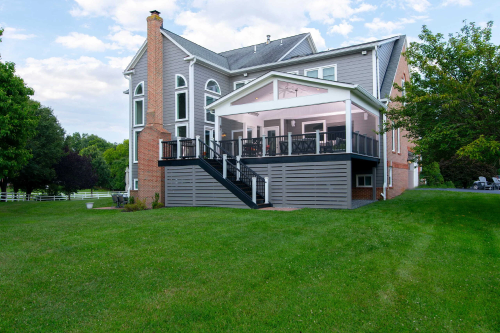
.jpg?width=1800&name=zuri_deck_and_hardwood_screened_porch%20(4).jpg "zuri_deck")
Aesthetic Alignment with DMV Regional Architecture
Northern Virginia and Maryland are among the most architecturally diverse suburban markets in the country. A single street in Potomac might include a Georgian Colonial, a mid-century modern ranch, a craftsman bungalow, and a contemporary new build. Each of those homes demands a different screened porch response — not because of stylistic preference, but because a porch that fights its host structure will always look like what it is: an afterthought.
Design Builders works across three primary architectural vocabularies that define the luxury market in Fairfax, Loudoun, Montgomery, Howard, and Anne Arundel counties.
Colonial and Traditional homes — which dominate established neighborhoods in Bethesda, McLean, Great Falls, and Vienna — call for symmetry, formal rooflines, and material continuity with the existing brick, stone, or painted wood exterior. Gable roofs with proper pitch, beadboard ceilings, and painted trim details are the language of these homes. The screened porch should look like it was drawn by the original architect.
Craftsman and transitional homes — increasingly prevalent in newer developments across Loudoun County, Howard County, and the Route 7 corridor — reward exposed timber, natural cedar or tongue-and-groove ceilings, and horizontal lines that echo the home's own detailing. These porches lean warmer, more tactile, more connected to the landscape around them.
Contemporary and modern homes — found throughout Arlington, Alexandria, and the newer custom build pockets of Fairfax and Montgomery counties — demand clean geometry, minimal ornamentation, and materials that read as intentional rather than decorative. Metal rooflines, glass railings, and large-format porcelain pavers like Archatrak complement these homes without competing with them.
In every case, Design Builders begins with the home's existing exterior palette — siding color, trim profile, roofline pitch, window style — before a single product recommendation is made. That discipline is what separates a screened porch that adds genuine resale value from one that simply adds square footage.
Falls Church, VA — Arlington County
The Disappearing Wall
The homeowners wanted a screened porch that connected directly to their kitchen with the widest possible opening — something that would feel like an outdoor room rather than an enclosed porch. The solution required a load-bearing beam across a 12-foot span, enabling a Lincoln folding door system with no center post interrupting the opening. Helical pier foundations, Windsor One beadboard ceiling, Velux skylights, AZEK decking, and Infratech heaters complete a space that reads as original to the home.
Bowie, MD — Prince George's County
Design Built Around a Centerpiece
This project started with art. The homeowners had acquired a custom sculptural piece before hiring a builder and wanted their screened porch designed around it — hung from the center of the ceiling as the visual anchor of the entire space. A hip roof with clear cedar ceiling, Zuri decking, dual Phantom retractable screens, and a SunBrite outdoor television create a full entertainment environment that tells a story uniquely specific to the family who lives there.
.jpg "Bowie, MD screened porch")
Urbana, MD — Montgomery County
The Full Outdoor Living Complex
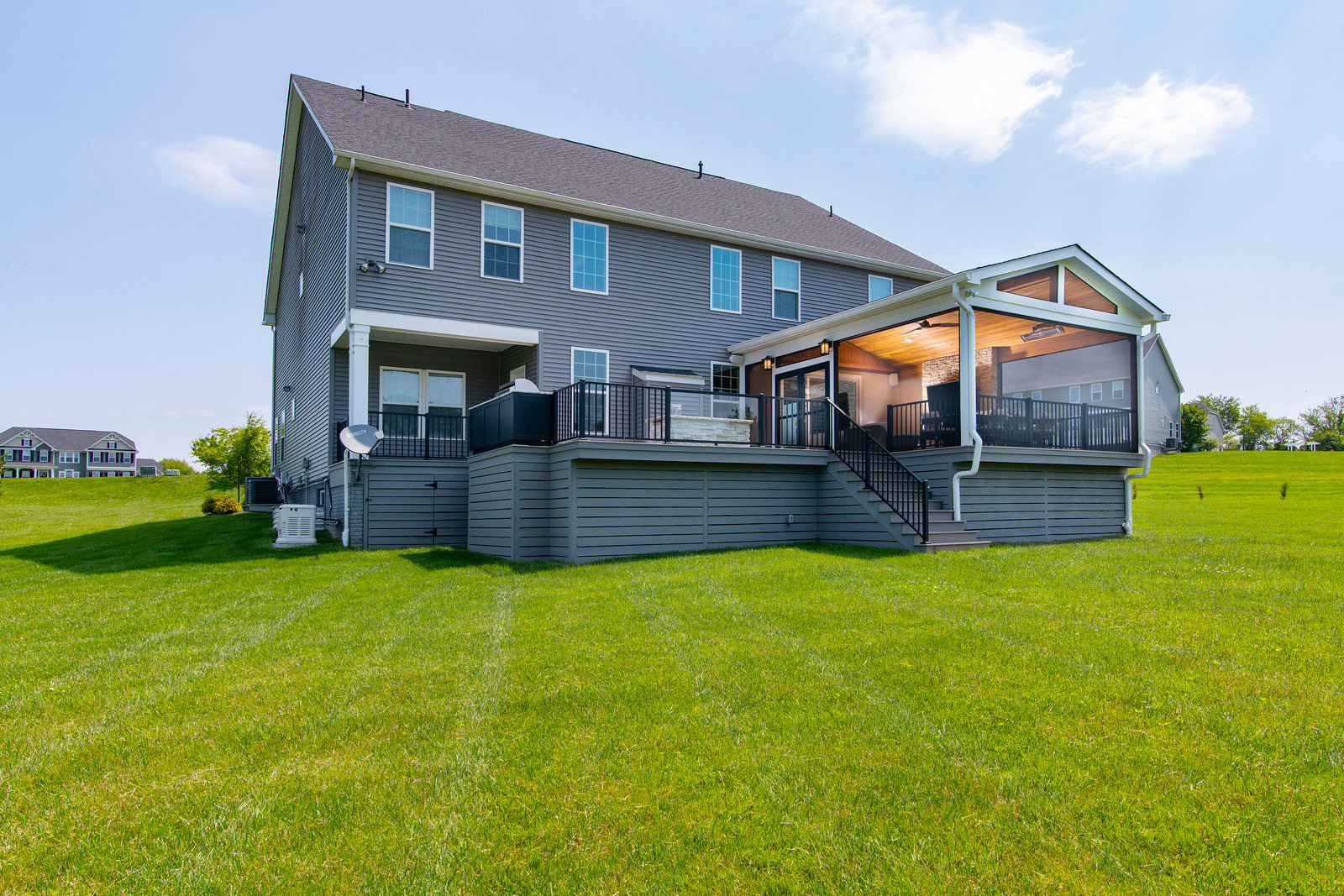
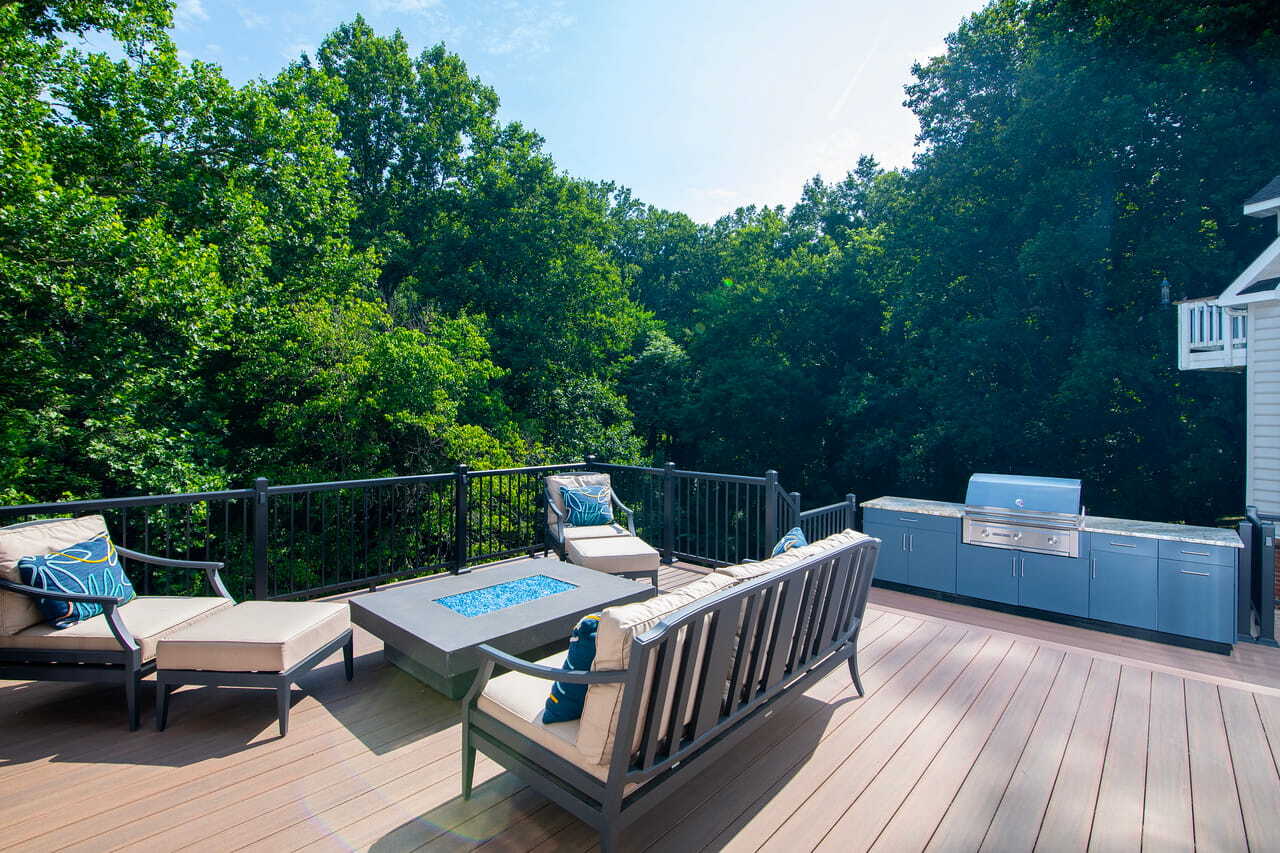
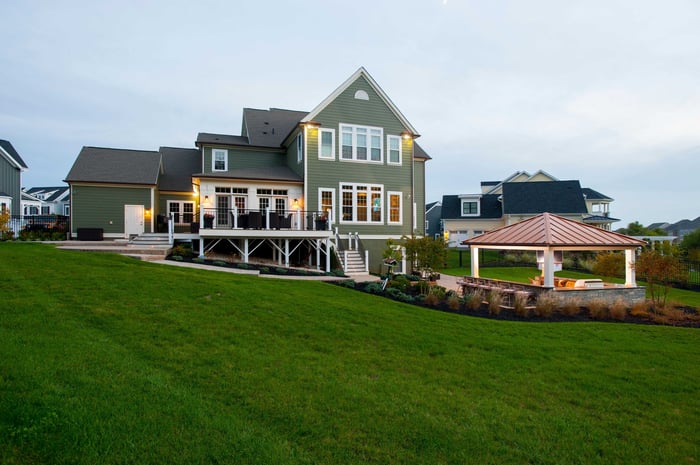
Not a single structure — a coordinated outdoor living ecosystem. A 22x18 screened porch integrated with a 20x16 deck, Danver outdoor kitchen with Blaze grill, gas fire pit, and fire wall — all under a clear cedar ceiling with Screeneze screening and Infratech heaters. The screened porch anchors the complex, providing a protected gathering point that functions in every season.
Fulton, MD — Howard County
Multi-Level Living with the Landscape
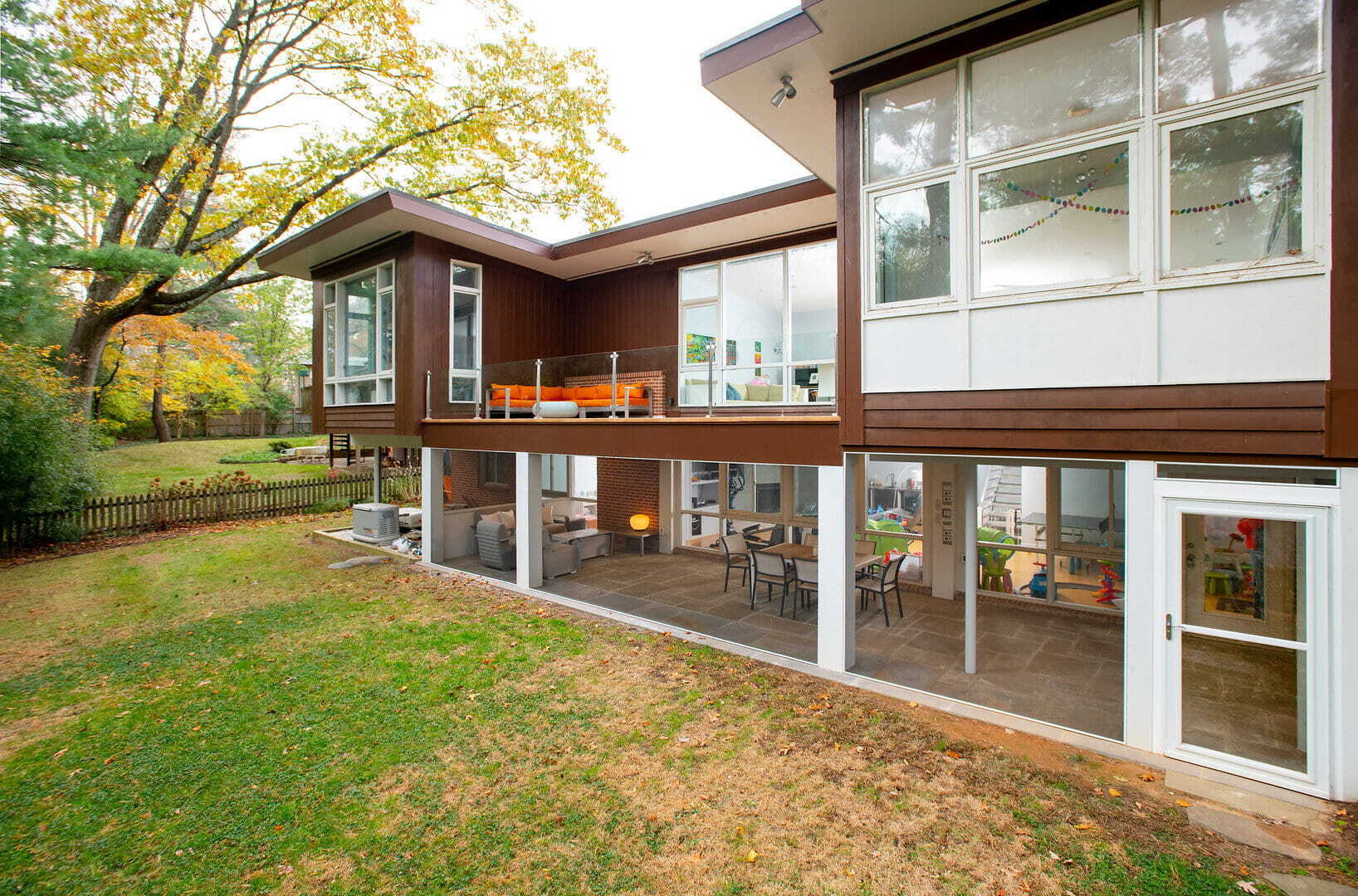
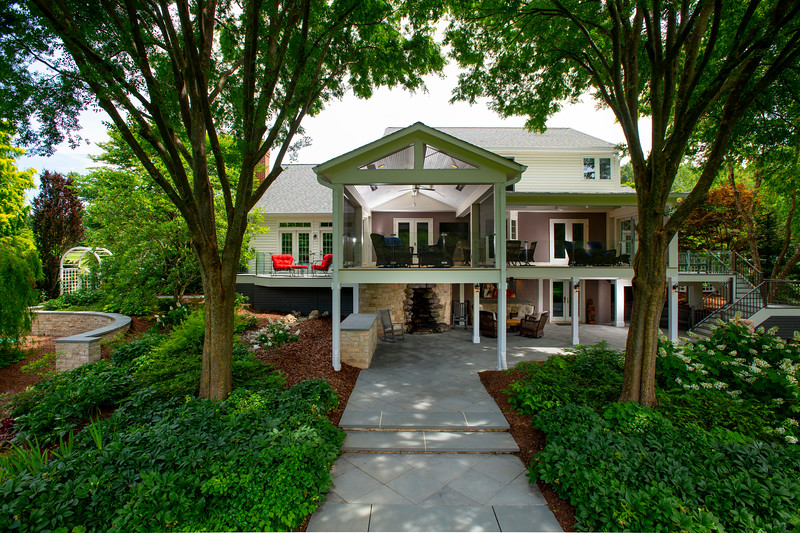
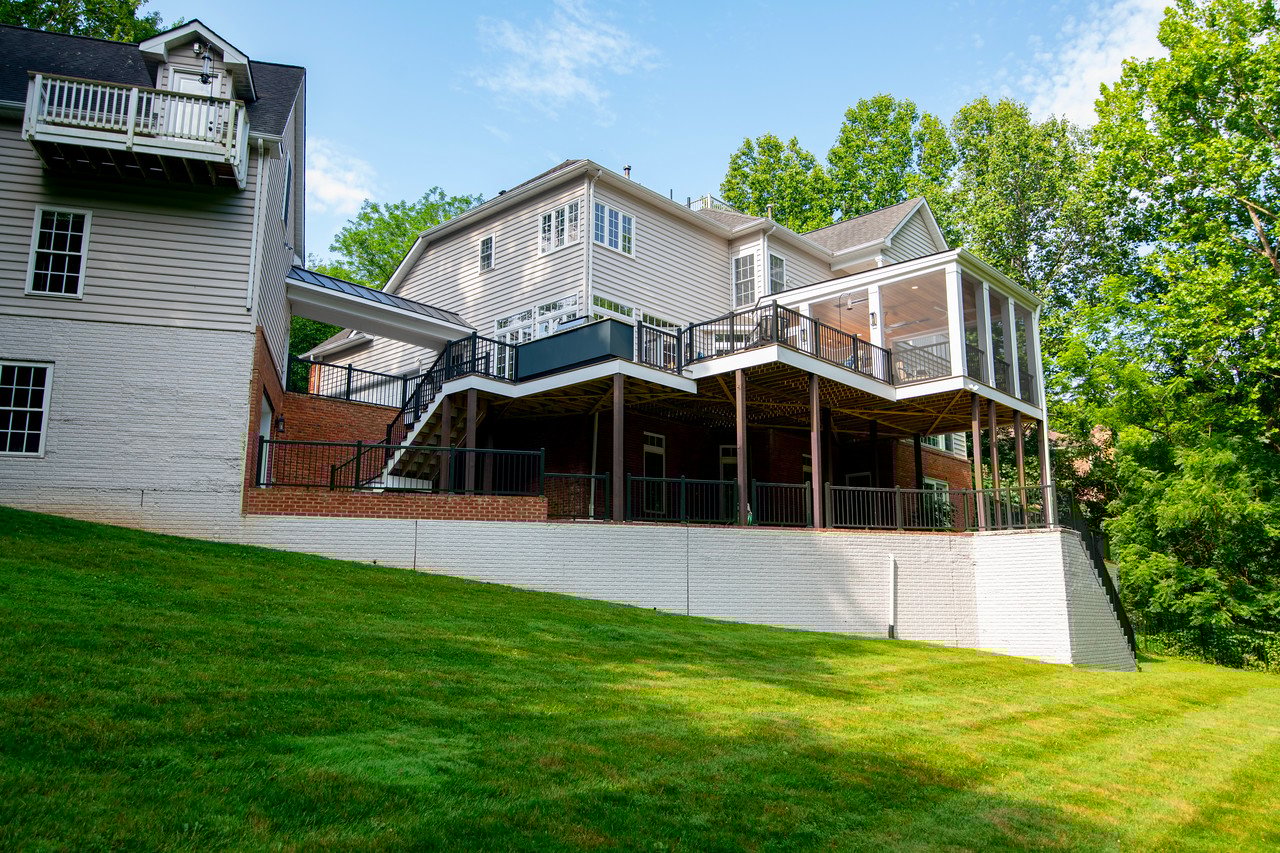
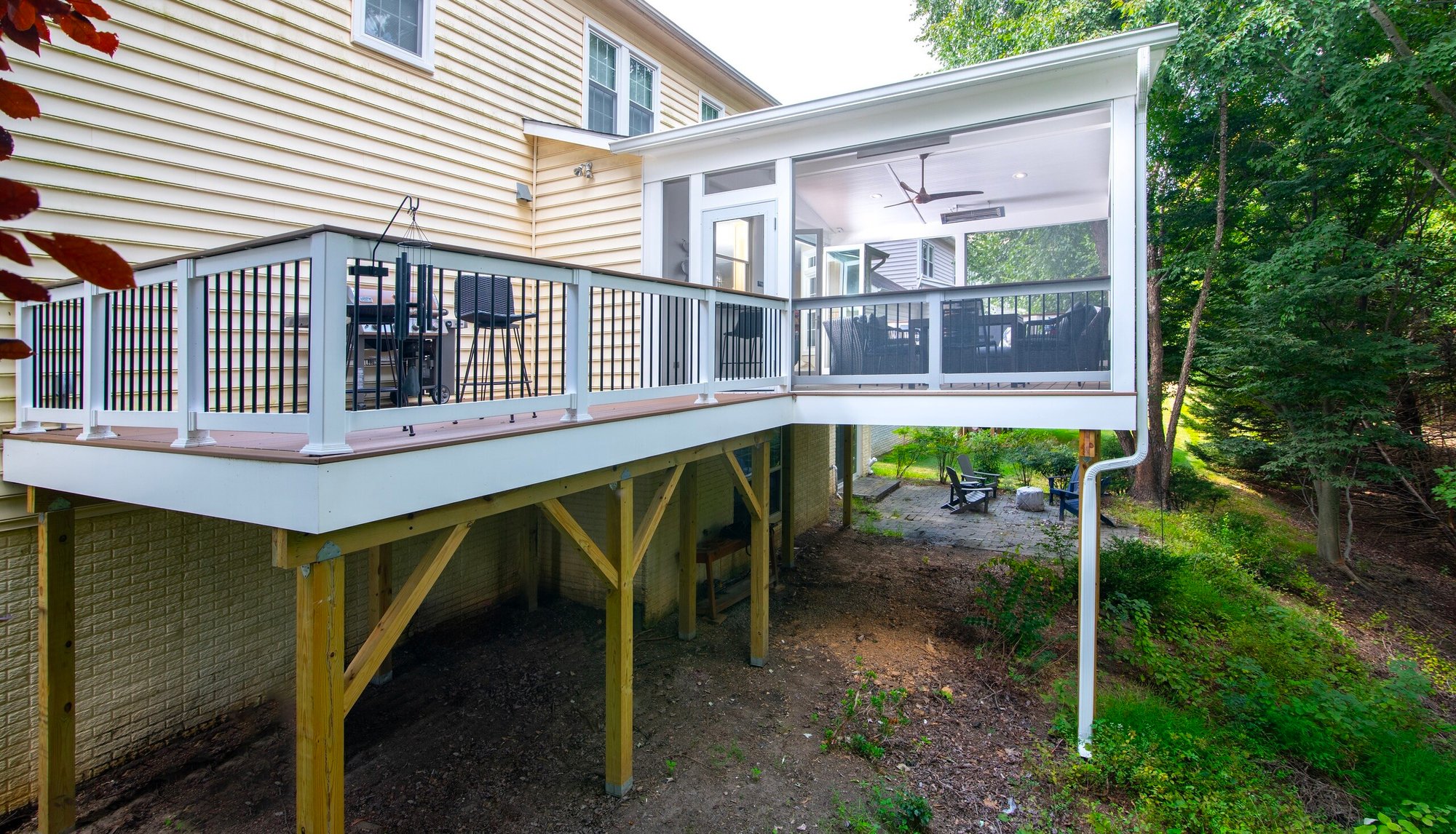
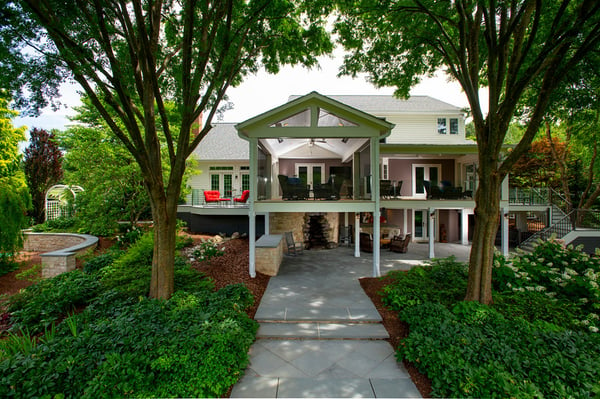
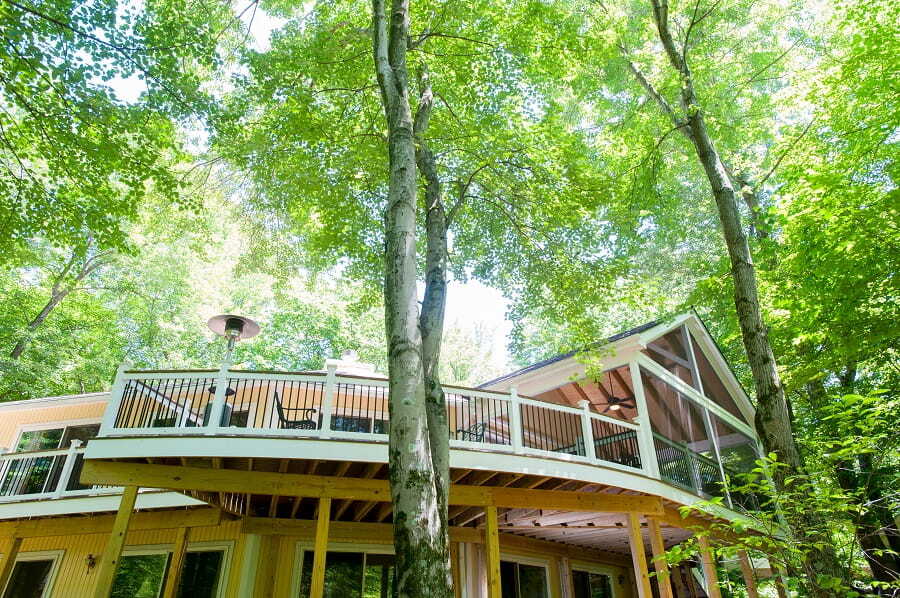
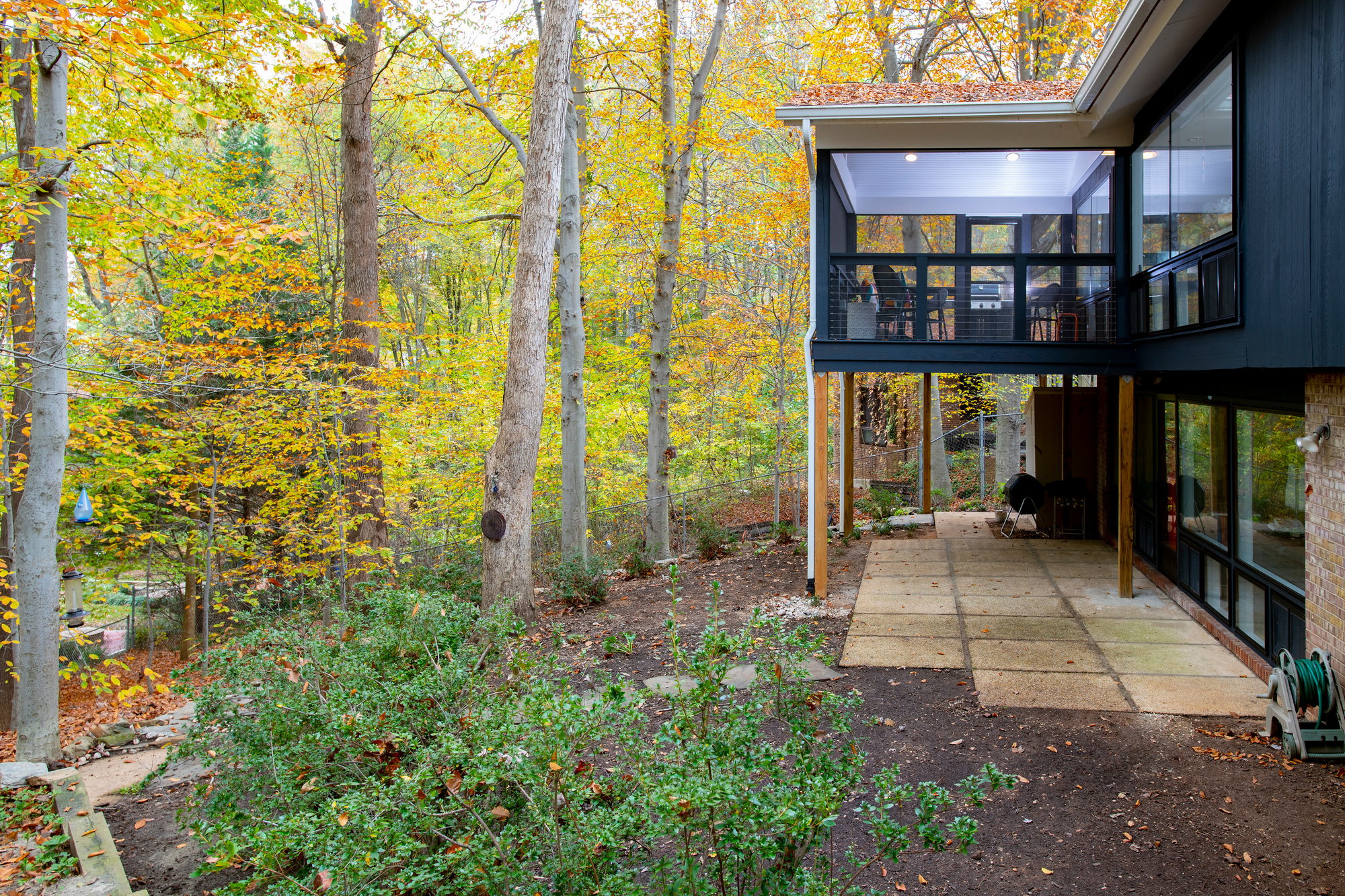
A significant grade change became a design asset — a two-story structure with an L-shaped screened porch on the upper level, a large deck on the second level, and a full patio below with an under-deck dry system. The gable open cathedral ceiling, glass railings, metal roof, and Trex outdoor lighting package complement the mature trees surrounding the property. Infratech heaters extend the season for a family that wanted maximum year-round use.
Let's Talk About Your Project
At Design Builders, every initial consultation starts with a real conversation — not a sales pitch. Tell us what you want to build, and we'll tell you honestly what it costs, how long it takes, and whether we're the right fit for your home.
Structural Engineering — The Critical Role of Helical Pier Foundations
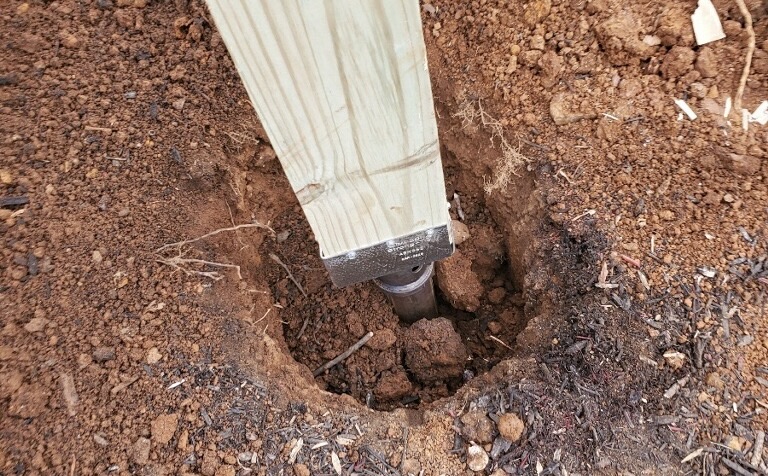
Helical pier foundations are steel shafts with helical plates that are mechanically screwed into the ground until they reach load-bearing soil or bedrock — typically 15 or more feet below the surface. Unlike traditional concrete footings, which rest on near-surface soil that is vulnerable to frost heave and moisture movement, helical piers anchor below the frost line and below the unstable clay layers that define much of the soil profile across Fairfax, Montgomery, and Howard counties. Load capacity is verified in real time through torque monitoring during installation.
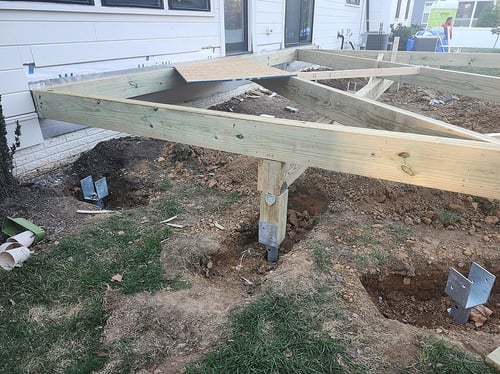
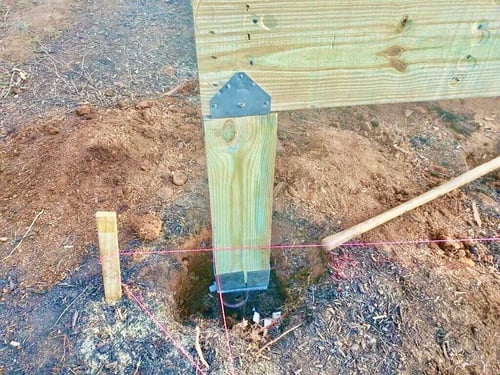
Why Concrete Footings Fail Here
The soil profile across Fairfax, Loudoun, and Montgomery County is predominantly expansive clay — soil that swells when wet and shrinks when dry. Add a freeze-thaw cycle that can push frost 18 to 24 inches deep, and traditional poured concrete footings are working against the ground itself. Over time, that means heaving, settling, and cracked structures. Most porch failures that look like a carpentry problem started six feet underground.
How Helical Piers Work
A helical pier is a steel shaft with helical plates — essentially a giant precision screw — driven hydraulically into the earth until it reaches stable, load-bearing soil or bedrock. The critical difference: installation torque is monitored in real time, giving the engineer mathematical confirmation of load capacity before a single board goes down. No curing. No excavation. No waiting on weather. The build starts the same day the piers go in.
What Torque Monitoring Actually Means
Every helical pier Design Builders installs is torque-monitored using PierTech systems — the same technology used in commercial foundation work. As the pier is driven, a calibrated hydraulic motor measures resistance in real time. When torque reaches the engineered threshold, installation stops. That reading becomes part of the project record — and in Fairfax and Montgomery County, it's the documentation that satisfies structural inspection without a separate footing pour and re-inspection cycle.
Why Traditional Concrete Footings Fail in DMV Clay and Freeze-Thaw Cycles
The Mid-Atlantic region presents a specific and well-documented set of challenges for traditional foundation systems. Northern Virginia and Maryland soils are heavily clay-based — particularly in Fairfax, Loudoun, and Montgomery counties — and clay soil behaves in ways that concrete footings are fundamentally not designed to handle.
The clay problem. Clay expands when wet and contracts when dry. Over the course of a single year in Northern Virginia and Maryland — with wet springs, humid summers, dry falls, and freezing winters — a clay-rich soil profile goes through repeated cycles of expansion and contraction. A concrete footing sitting in that soil moves with it. Over time that movement manifests as settling, shifting, and in the worst cases, structural failure of whatever is built above.
The frost heave problem. Frost heave occurs when moisture in the soil freezes, expands, and pushes upward against whatever is in its path. In Fairfax and Montgomery counties, ground frost can penetrate 18 to 24 inches below the surface in a hard winter. A concrete footing that does not extend below that frost line — and many residential footings do not — is vulnerable to being pushed upward by that freeze-thaw cycle every single year. Each cycle causes incremental movement. That movement accumulates. A screened porch that was level in year one develops a noticeable pitch by year five.
The moisture problem. Traditional footer systems often incorporate pressure-treated wood — either as posts set in concrete or as wood footers placed in the ground directly. Pressure-treated wood in contact with soil and concrete absorbs moisture from both sources simultaneously. The East Coast has seen consistently increasing rainfall over the past decade, and the region is no exception. Design Builders has received calls from homeowners across Montgomery and Fairfax counties reporting rotting footers in structures that are less than ten years old. The wood simply cannot handle the sustained moisture exposure that the regional climate delivers.
The verification problem. When a contractor pours a concrete footing, there is no real-time confirmation that the footing has achieved the load capacity required for the structure above it. The contractor digs to a specified depth, pours concrete, and waits. Whether the soil at that depth is actually capable of carrying the load is largely assumed rather than confirmed. If the assumption is wrong, the problem does not reveal itself until the structure above starts to move.
These are not theoretical concerns. They are the daily reality of building outdoor structures in Fairfax, Loudoun, Montgomery, Howard, and Anne Arundel counties — and they are the reason Design Builders moved away from traditional concrete footings as a standard practice.
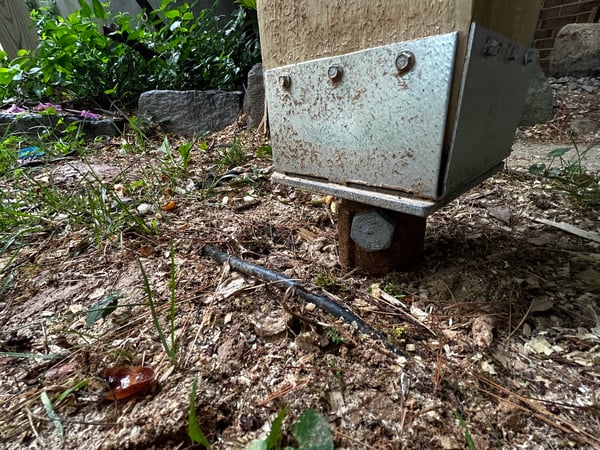
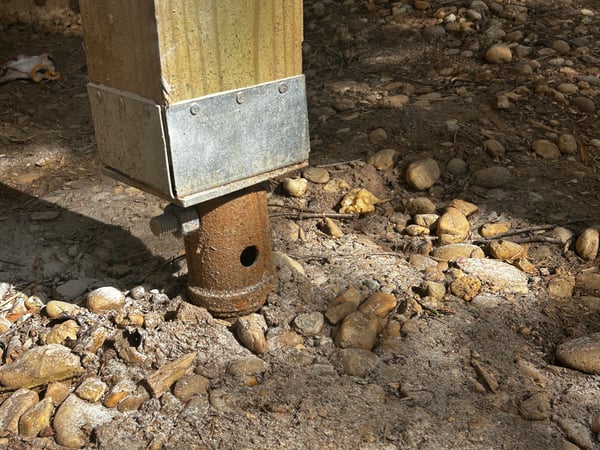
The Engineering Advantage — Torque-Monitored Load Capacity in Real Time
Helical piers solve every one of the problems described above — not through material substitution alone, but through a fundamentally different engineering approach to how a foundation works.
A helical pier is an all-steel shaft with helical plates welded at specific intervals along its length. A hydraulic torque motor drives the shaft into the ground, rotating it like a large screw. As the shaft advances, the helical plates cut through soil layers — through topsoil, through clay, through subsoil — until they reach stable load-bearing material or bedrock. In Fairfax, Loudoun, and Montgomery counties that is typically 15 feet or more below the surface, well below the frost line and well below the unstable near-surface clay layers that cause traditional footings to move.
The torque monitoring advantage is what separates helical pier installation from every other foundation method available for residential construction. As the hydraulic motor drives the pier into the ground, it continuously measures the torque resistance the soil is providing. Torque resistance is a direct, real-time proxy for load capacity. When the torque reading reaches the value specified in the engineering calculations for that structure, the installer stops. The pier has achieved its required load capacity. This is not an assumption — it is a measurement.
This means that when Design Builders installs helical piers for a screened porch in Great Falls, Potomac, McLean, or Fulton, the load capacity of every single pier is verified before a single post, beam, or joist is placed above it. No concrete footing system in residential construction can make that claim.
The PierTech system specifically adds a patented Cross-Lock Connection that provides instant alignment and full steel-on-steel loading transfer. All torque is contained within the connection, eliminating hole deformation and ensuring no torque or compression loads reach the bolts. The result is a foundation connection that is mechanically verified, structurally precise, and immediately load-bearing — the structure above can be built the same day the piers are installed.
Additional engineering advantages of the PierTech helical system:
- Depth. Traditional concrete footings typically reach approximately 10 feet. PierTech helical piers drill until they hit rock — typically 15 feet or more. Rock is a categorically more stable base than soil at any depth.
- Frost immunity. Because helical piers anchor below the frost line, freeze-thaw cycles that move surface soil have no effect on the pier or the structure above it.
- Immediate load bearing. Concrete requires a minimum of 24 hours to cure before any load can be placed on it. Helical piers are load-bearing the moment installation is complete. The project moves forward the same day.
- All-weather installation. Concrete cannot be poured in freezing temperatures without significant risk of compromised strength. Helical piers can be installed in rain, cold, and freezing conditions without any effect on performance.
- Longevity. PierTech helical piers are manufactured from high-tensile, high-yield strength domestic steel. They do not rot, they do not crack, and they are not susceptible to the moisture and freeze-thaw degradation that shortens the lifespan of concrete and wood systems. PierTech estimates a 150-year lifespan for their helical pier system in normal soil conditions and backs that with a 75-year limited warranty.
In Fairfax, Montgomery, and Howard counties, helical pier foundations outperform traditional concrete footings because they anchor below the frost line into stable load-bearing soil or bedrock, typically 15 or more feet deep. Real-time torque monitoring during PierTech installation mathematically confirms load capacity pier by pier — a verification standard that no concrete footing system can match. Design Builders has installed thousands of helical piers across the region since 2006.
When a Sloped Lot Changes the Entire Conversation
The most dramatic helical pier applications in our portfolio aren't flat-lot retrofits — they're the massively elevated structures on sloped Darnestown grades, wooded Clifton lots, and steep rear yards in Potomac and Great Falls. On these sites, a concrete footing approach requires excavation equipment that can't access the yard, soil disturbance that triggers sediment control review in Montgomery County, and weeks of cure time before framing begins. Helical piers go in with compact equipment, leave the landscaping intact, and have the structure framing-ready the same week. On a hillside in Loudoun or a tight side-yard in Fairfax, that's not a premium option — it's the only practical path to a high-quality result.
Installation Mechanics — How a Single Day Changes Your Project Timeline
A traditional concrete footing project unfolds over multiple days. First the excavation — one to two days of digging with heavy machinery, leaving significant soil displacement, open holes, and disruption to the existing landscape. Then the pour — concrete placed and left to cure for a minimum of 24 hours, longer in cold or wet conditions. Then the inspection, which in Montgomery County and Fairfax County involves a separate footing inspection before framing can begin. The total timeline from excavation to framing-ready foundation is typically three to five days under ideal conditions — longer when weather intervenes, longer still when the inspection schedule creates delays.
A PierTech helical pier installation on the same project requires one piece of equipment — typically a Bobcat or skid steer with a hydraulic torque motor attachment — and one day. The operator drives the pier, monitors torque, confirms load capacity, moves to the next location. When the last pier is installed, the foundation is complete, verified, and immediately ready to accept the structural framing above it.
There is no excavation. There are no piles of displaced soil. There are no open holes. There is no curing period. There is no separate footing inspection delay in most county jurisdictions. The landscape around the installation points is essentially undisturbed — a narrow shaft entry point at each pier location, nothing more.
For a homeowner in Potomac with mature landscaping they want to protect, or a homeowner in Great Falls with a sloped lot and tight equipment access, or a homeowner in Loudoun County managing a project timeline around a specific event or season — the difference between a three-to-five day concrete footing process and a one-day helical pier installation is not a minor convenience. It is a fundamentally different project experience.
The slope and access advantage. Sloped lots present a specific challenge for traditional concrete footing installation. Excavation on a significant grade requires more equipment, more time, more soil management, and more risk of landscape disruption. On lots in Fairfax Station, Great Falls, Potomac, and the hillier sections of Howard and Montgomery counties, the equipment access required for traditional footing excavation can be difficult or in some cases impossible without removing trees, fencing, or other permanent landscape features. A skid steer with a helical pier attachment can work on grades and in access conditions that would stop a traditional excavation crew entirely.
The sensitive site advantage. Many of the most valuable properties in Fairfax, Loudoun, Montgomery, and Howard counties sit near stream buffers, Resource Protection Areas, or other environmentally sensitive zones where soil disturbance is regulated. Traditional concrete footing excavation creates significant soil disturbance — exactly the kind of activity that can trigger additional review requirements in Fairfax County's RPA regulations or Montgomery County's sediment control provisions. Helical pier installation creates minimal soil disturbance by definition. The shaft is drilled, not excavated. That distinction matters both regulatorily and practically for homeowners on sensitive sites.
When an Existing Deck Can and Cannot Support a Screened Porch
One of the most common questions Design Builders receives from homeowners across Fairfax, Montgomery, and Howard counties is whether an existing deck can simply be enclosed to create a screened porch. The answer depends entirely on what is underneath it.
A screened porch adds structural load that a deck was not necessarily designed to carry. The roof — whether gable, hip, or shed — adds dead load, wind load, and in Northern Virginia and Maryland, snow load. Those forces transfer down through the posts to the foundation. If the existing deck foundation was designed for a deck and nothing more, it may not have the capacity to carry a roofed structure above it.
The evaluation Design Builders performs on every existing deck conversion:
First, what is the existing foundation? Concrete footings — their depth, diameter, and condition — determine whether they have the capacity to carry the additional roof load. In many cases, particularly on older decks in Montgomery County and Fairfax County, the existing footings are undersized, deteriorating, or both.
Second, what is the structural condition of the existing framing? Ledger connections, beam sizing, joist spacing, and post conditions all factor into whether the existing structure can be upgraded or needs to be replaced.
Third, what does the county require? Both Fairfax and Montgomery counties treat a screened porch addition differently from a deck. The permit path changes, the plan requirements change, and the inspection changes.
Let's Talk About Your Project
At Design Builders, every initial consultation starts with a real conversation — not a sales pitch. Tell us what you want to build, and we'll tell you honestly what it costs, how long it takes, and whether we're the right fit for your home.
2026 Innovation — The Micro-Resort Living Experience
Micro-resort living is the design philosophy of transforming a residential backyard into a multi-zone outdoor environment that delivers the comfort, amenities, and aesthetic quality of a boutique resort property. In Fairfax, Montgomery, and Loudoun counties, the most sophisticated versions combine a screened porch anchor space, an outdoor kitchen, entertainment technology, year-round climate control, and wellness features like fire elements or hot tubs — all designed as one cohesive environment rather than a collection of separate additions.
Defining the Micro-Resort — What It Is and Why DMV Homeowners Are Building It
The micro-resort concept starts with a simple but powerful idea — that your backyard should compete with anywhere you would go on a long weekend away. Not approximate it. Not gesture toward it. Actually compete with it.
That means thinking about the backyard the way a hospitality designer thinks about a hotel property. There is a space for every mood and every moment. A covered, climate-controlled gathering space for evenings with friends. An outdoor kitchen that makes cooking outside as capable and enjoyable as cooking in. A fire element — fireplace, fire pit, or fire wall — that creates warmth and atmosphere simultaneously. A wellness zone, whether that is a recessed hot tub, a quiet seating area screened from neighbors, or simply a beautifully landscaped corner designed for decompression. And lighting, audio, and technology woven throughout so the space performs as well at 10pm as it does at 2pm.
The screened porch is the anchor of every micro-resort Design Builders builds. It is the space that makes everything else work — the protected, climate-controlled hub from which every other zone radiates. Without it, the outdoor kitchen is exposed to weather. The entertaining area has no reliable shelter. The season ends in October. With a properly designed and built screened porch at the center, the entire outdoor environment becomes usable across every season the Mid-Atlantic offers.
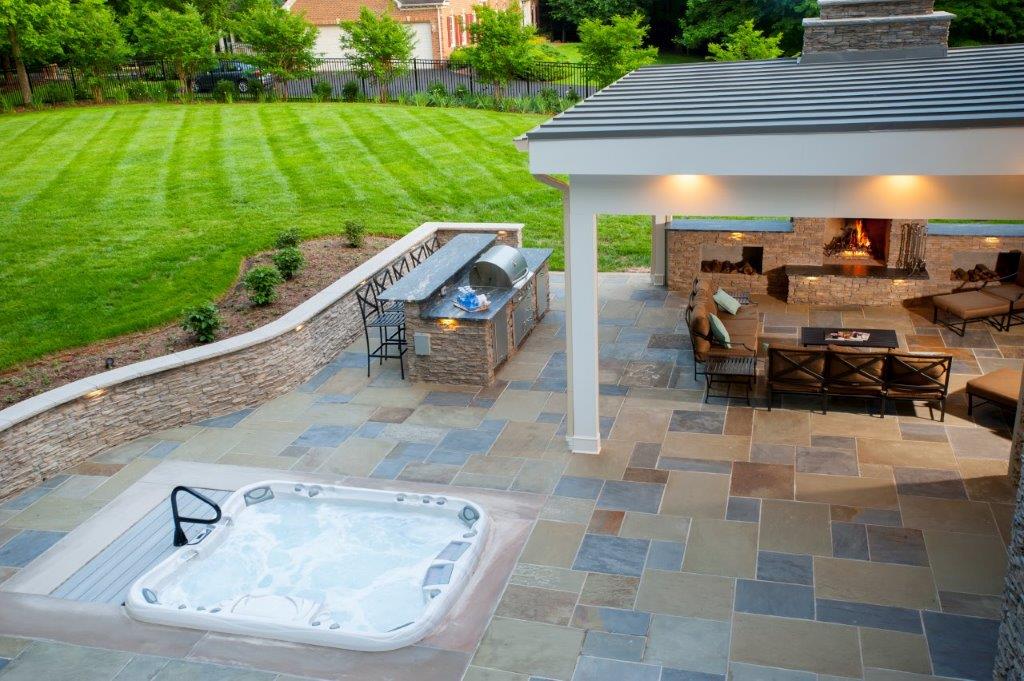
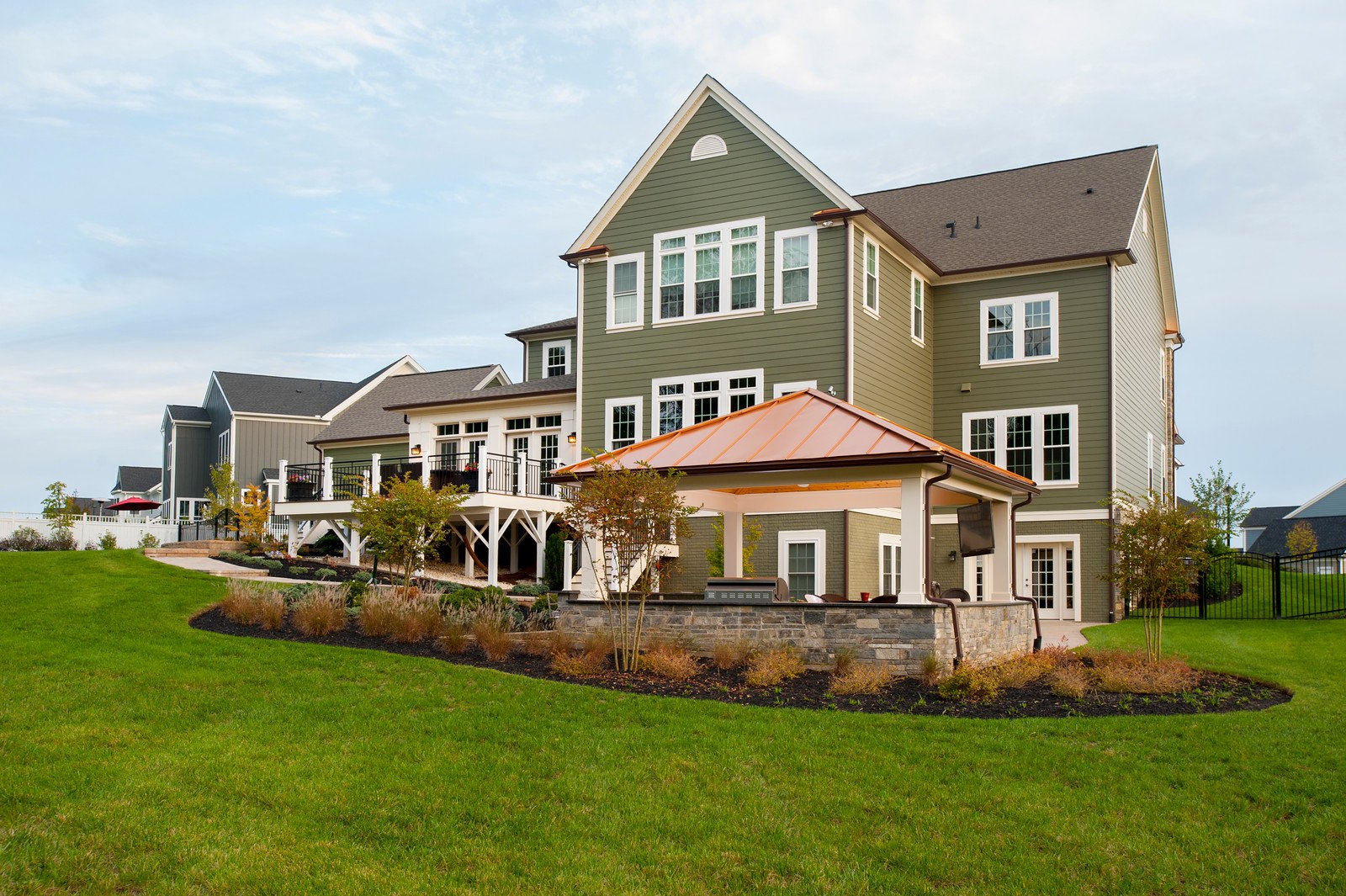
In Fairfax County, the Clifton project Design Builders completed represents the micro-resort concept executed at its fullest expression. The property was reimagined from front to back as a single cohesive environment. A flagstone pathway with a Trex 25-piece lighting package welcomed visitors from the street. A custom round portico with a cedar tongue-and-groove ceiling and Key-Link aluminum rails framed the front entrance. In the backyard, the design unfolded across multiple distinct zones — each one purposeful, each one connected to the others, none of them feeling like an add-on.
The elevated sun deck provided a dining and sitting area with long views over the property. Below it, the outdoor kitchen anchored the cooking and casual gathering zone — Blaze grill, outdoor refrigerator, Eldorado stone cabinetry with stainless steel inserts and dark granite countertops, built around a custom fireplace that served as both heat source and focal point. The covered sitting area wrapped around a Samsung outdoor television with integrated audio speakers, Infratech infrared heaters, and Phantom motorized retractable screens that opened for fair-weather evenings and sealed for bug season, cold nights, and privacy. A recessed hot tub, protected from neighbor sightlines by the elevated deck on one side and the outdoor kitchen and retaining wall on the other, completed the wellness zone. The existing fountain on the property was preserved and integrated into the new design rather than removed — a detail that speaks to the level of design thinking this kind of project demands.
This is not a deck with some extras. This is a resort that happens to be attached to a house in Fairfax County.
.jpg "Bowie MD screened porch")
Biophilic Design Principles — Connecting the Space to the Landscape Around It
The word biophilic gets used loosely in design circles. In the context of luxury screened porches and outdoor living spaces in the Mid-Atlantic, it has a specific and practical meaning — designing spaces that feel genuinely connected to the natural environment they occupy rather than imposed upon it.
For homeowners in wooded communities like Great Falls, Potomac, Clifton, and the rural residential corridors of Loudoun and Howard counties, this means working with the existing landscape rather than clearing it. The mature trees, the natural grade, the existing vegetation — these are assets, not obstacles. A screened porch designed with biophilic principles uses those assets intentionally. The ceiling height and roof pitch are calibrated to frame the tree canopy above rather than block it. The floor plan orients primary sightlines toward the most compelling views on the lot. Material choices — cedar ceilings, timber posts, natural stone — echo the materials of the landscape and create a sensory continuity between inside and outside.
The Fulton, Howard County project Design Builders completed demonstrates this principle clearly. The two-story structure was designed to play with the mature trees surrounding the property rather than compete with them. The gable open cathedral ceiling draws the eye upward into the canopy. The glass railings on the deck levels maintain unobstructed sightlines through the trees. The metal roof and clean contemporary geometry complement the natural setting without overwhelming it. The result is a space that feels embedded in its landscape — which is exactly what biophilic design is supposed to achieve.
Airflow is the first consideration. A screened porch that traps heat in July is not a comfortable space regardless of how beautifully it is designed. Ceiling height, screen placement, ceiling fan specification, and roof ventilation all factor into how well a porch moves air in the Mid-Atlantic summer. Design Builders sizes ceiling fans for the actual square footage of the space — not the nearest standard size — and positions them to create cross-ventilation rather than simple downdraft.
Natural light is the second consideration. Roof design, skylight placement, and the orientation of screened openings determine whether a porch feels bright and alive or dim and enclosed. The Falls Church project included Velux skylights specifically to bring natural light into a porch that would otherwise have been shaded by its gable roof. That single decision changed the quality of the space entirely.
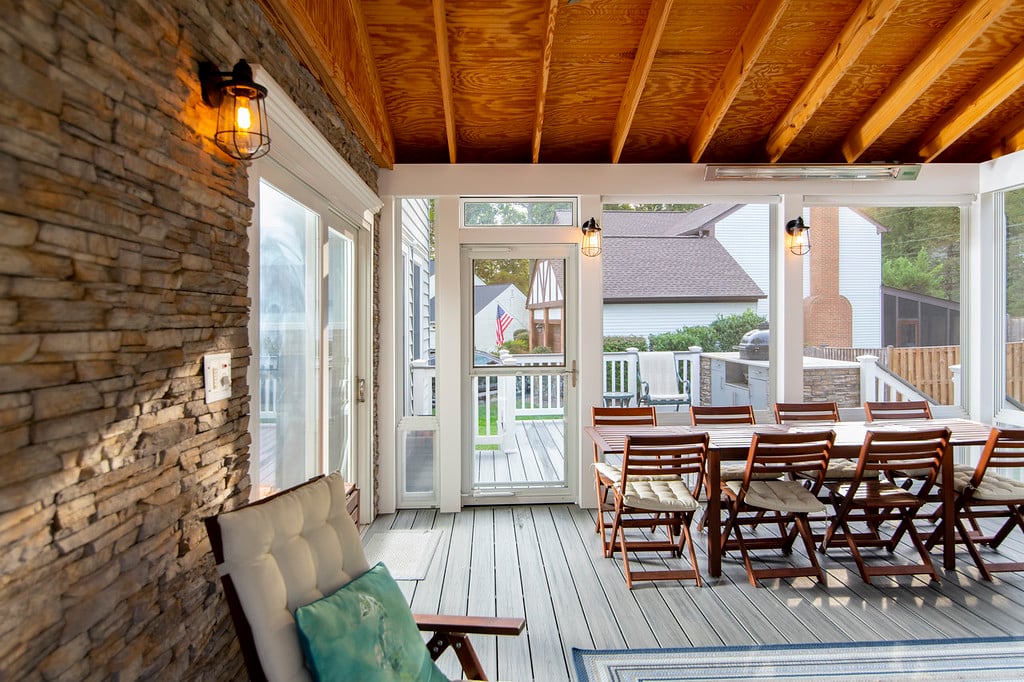
Material warmth is the third consideration. Clear cedar ceilings, knotty pine tongue-and-groove, timber posts, and natural stone elements create a tactile warmth that connects the space to its natural surroundings. In the Urbana, Montgomery County project, the clear cedar ceiling across the 22x18 screened porch established the sensory quality of the entire outdoor complex — warmer and more natural than any painted surface could deliver.
Technological Amenities — Year-Round Comfort Through Smart Design
The 2026 luxury screened porch is not just a beautifully designed space. It is a technically capable one. The homeowners Design Builders works with in Fairfax, Montgomery, Loudoun, and Howard counties expect their outdoor spaces to perform with the same reliability and intelligence as the interiors of their homes. That expectation shapes every technology decision on a luxury project.
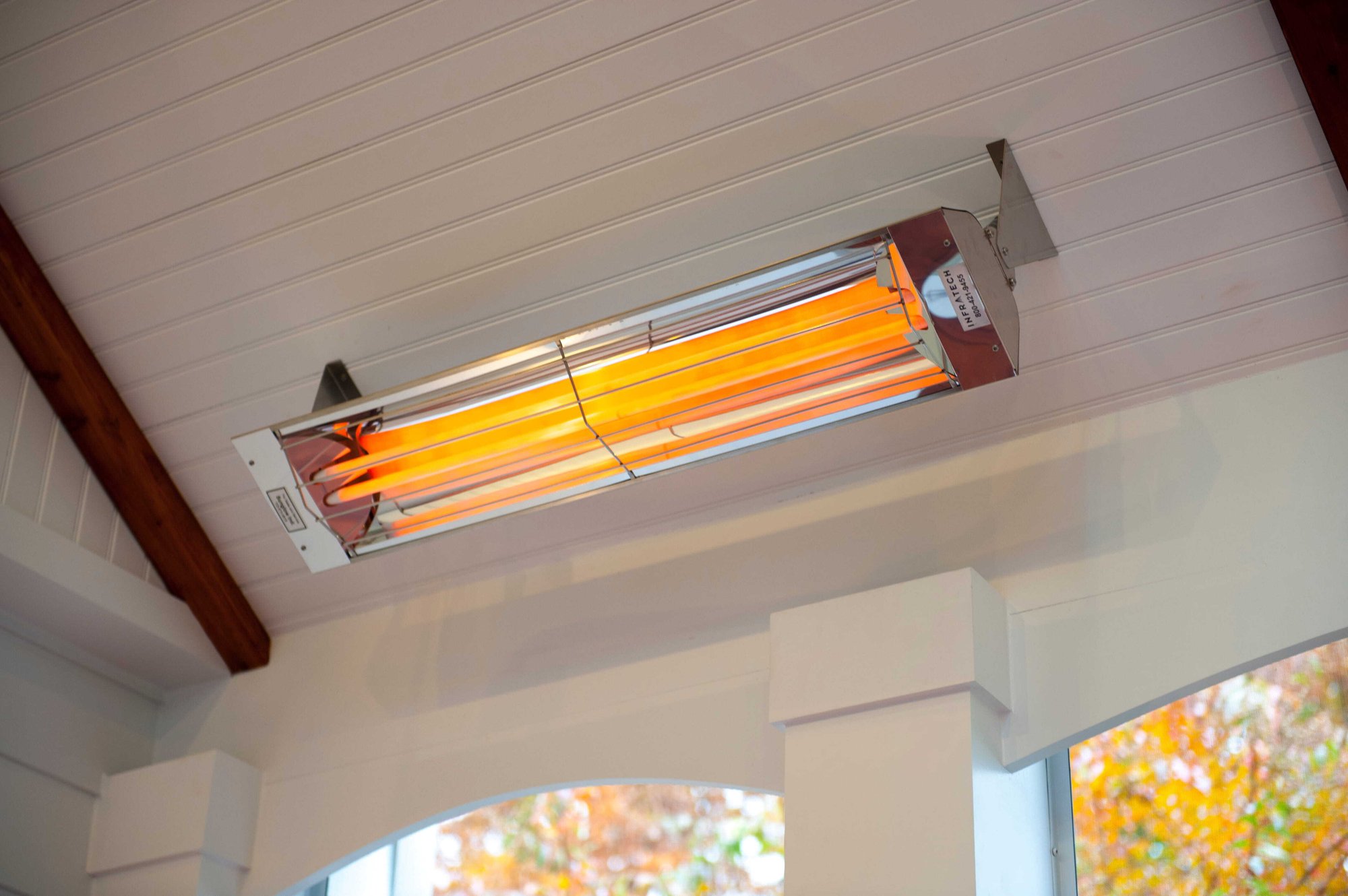
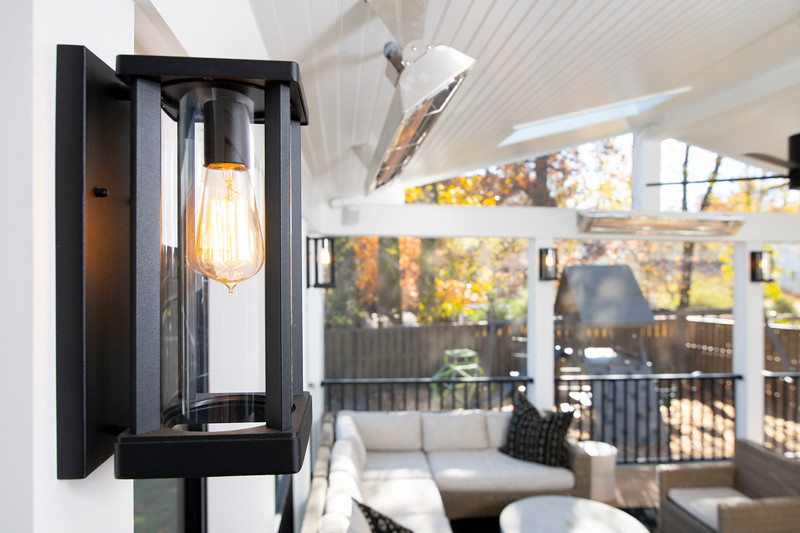
Infrared heating is the foundation of year-round porch usability in the Mid-Atlantic. Infratech infrared heaters — the brand Design Builders specifies on virtually every project — work on a fundamentally different principle than forced-air or convective heating systems. They heat objects and people directly through infrared radiation rather than heating the air around them. In an outdoor or semi-outdoor environment where heated air simply dissipates, this distinction matters enormously. An Infratech heater mounted at the correct height above a seating area delivers immediate, targeted warmth that makes a screened porch comfortable on a 35-degree November evening in Montgomery County. The heat feels like sunlight — immediate, directional, and effective regardless of ambient air temperature.
Motorized screening systems represent the most significant technology advancement in screened porch design over the past decade. Traditional fixed screens are permanent — they define the porch as either open or closed with no middle option. Motorized retractable screen systems like the Phantom screens Design Builders installs change that equation entirely. At the touch of a button or a smartphone command, the screens deploy or retract — converting an open deck or patio into a screened enclosure in seconds, or opening a screened porch to the full outdoor environment when conditions are perfect.
Sunspace WeatherMaster windows take the technology further still. Where motorized screens provide bug and debris protection, Sunspace WeatherMaster windows provide full weather protection — converting a screened porch into a three-season or effectively four-season room. The North Potomac project tells this story perfectly. The homeowner started with a screened porch featuring Screeneze screens — an excellent screening system that delivered years of spring, summer, and fall enjoyment. When the family decided they wanted to use the space year-round, Design Builders returned and installed Sunspace WeatherMaster windows throughout the porch. The transformation was complete — a space that was previously weather-limited became usable in every month of the year.
Outdoor entertainment integration has moved from luxury feature to baseline expectation on premium projects. SunBrite and Samsung outdoor televisions — built to withstand temperature extremes, humidity, and UV exposure that would destroy a standard indoor set — are now standard specification items on Design Builders entertainment-focused projects.
Outdoor lighting design is the element that most dramatically changes the character of a micro-resort space after dark. A Trex outdoor lighting package — which Design Builders specifies across decking, railings, stairs, and landscape elements — does not simply illuminate a space. It creates layers of light at different heights and angles that make a backyard feel intentional and alive at night rather than simply lit.
In Fairfax and Montgomery counties, year-round screened porch usability depends on three technology systems working together — infrared heating for cold-weather comfort, motorized or convertible screening for weather and insect protection, and integrated lighting for evening ambiance. Design Builders specifies Infratech infrared heaters, Phantom or Sunspace WeatherMaster enclosure systems, and Trex lighting packages as the standard technology layer on luxury outdoor living projects across the region.
The Evolution Strategy — Building Your Micro-Resort in Phases
One of the most important conversations Design Builders has with homeowners across Fairfax, Montgomery, and Howard counties is about phasing. A fully realized micro-resort backyard — screened porch, outdoor kitchen, deck, fire elements, entertainment technology, lighting, wellness features — represents a significant investment. Most families do not build it all at once. They build it intentionally over time.
The key to a successful phased outdoor living strategy is designing the full vision first and building the phases in the right sequence. The foundation — literally and figuratively — has to be engineered for the complete plan from day one. Helical pier foundations sized for the eventual full structural load. Electrical rough-in that anticipates future heaters, lighting, and entertainment systems. Deck framing designed to support a future screened porch roof. Outdoor kitchen rough plumbing and gas lines stubbed in even if the kitchen itself comes in phase two.
The North Potomac project illustrates this perfectly. The homeowner built the screened porch and deck first — beautifully executed, immediately functional, exactly what the family needed at that stage. Years later, when the family wanted more from the space, Design Builders returned and upgraded theScreeneze screens to Sunspace WeatherMaster windows — effectively extending the season and transforming the space without touching the underlying structure. That return engagement was possible because the original structure was built right.
This is how Design Builders thinks about every project. Not just what you need today. What you might want five years from now. And whether the structure we build today will support that future without having to be rebuilt from the ground up.
Let's Talk About Your Project
At Design Builders, every initial consultation starts with a real conversation — not a sales pitch. Tell us what you want to build, and we'll tell you honestly what it costs, how long it takes, and whether we're the right fit for your home.
Material Science — Climate-Resilient Decking, Enclosure Systems, and the DMV Bug Problem
Luxury screened porch materials in Fairfax, Montgomery, and Howard counties must perform across four genuinely different seasonal stress conditions — spring pollen and moisture, summer heat and humidity, fall debris and wind, and winter freeze-thaw cycles. Design Builders specifies Trex and TimberTech AZEK composite decking, Screeneze fixed screening, Sunspace WeatherMaster windows, and SunPro motorized systems as the core material stack for climate-resilient outdoor living across the region.
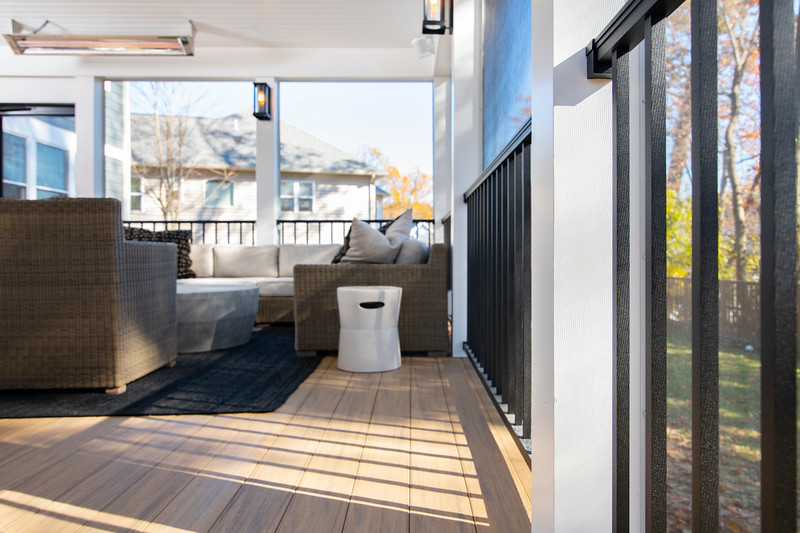
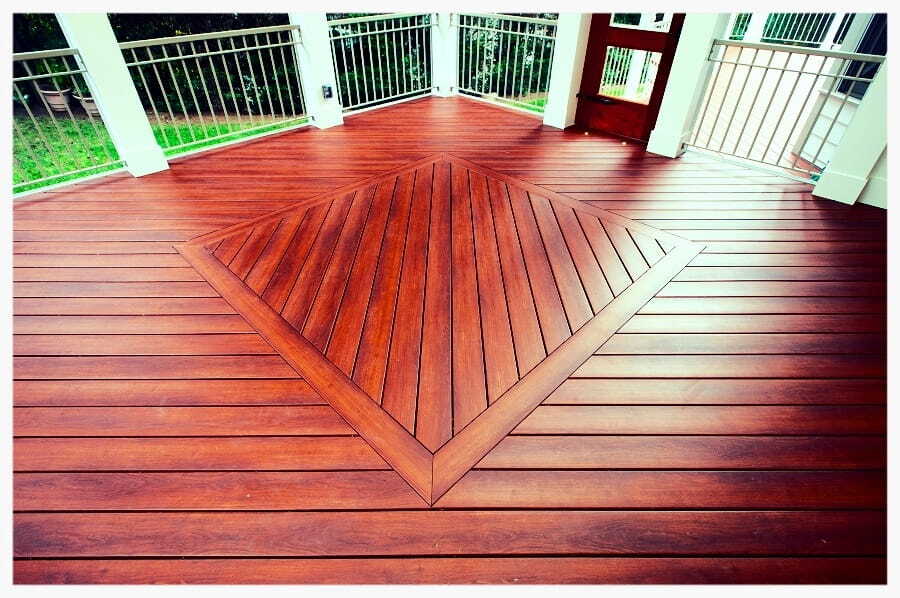
The DMV Bug Problem — Why Enclosure Is the First Design Decision
Ask any homeowner in Potomac, Great Falls, Vienna, or Bethesda what drives them to call a screened porch contractor and the answer is almost always the same. The bugs.
The Mid-Atlantic insect calendar is relentless and well-documented by anyone who has tried to enjoy a backyard in this region. Mosquitoes arrive with the first warm evenings in late April and stay through October. May flies and gnats emerge in spring. Stink bugs become a fall nuisance. Japanese beetles, cicadas in their cycle years, and the general abundance of flying insects that a humid, heavily wooded suburban landscape produces — all of it conspires to make an unprotected outdoor space genuinely uncomfortable for a significant portion of the year.
This is not a minor inconvenience. For homeowners investing $80,000 to $200,000 or more in a luxury outdoor living environment, the ability to actually use that space comfortably — without retreating inside the moment the sun goes down or the temperature climbs — is the fundamental value proposition of the entire project. The enclosure system is not an accessory. It is the point.
Design Builders approaches enclosure as a spectrum rather than a binary choice. The right system depends on how you use the space, what seasons matter most to you, and how much flexibility versus permanence you want in your outdoor environment. There are four primary enclosure solutions in the Design Builders material stack, each solving a different version of the same problem.
Screeneze — The Fixed Screening Standard
Screeneze is Design Builders' standard specification for fixed exterior screening on screened porches across Fairfax, Montgomery, Howard, and Anne Arundel counties. The defining feature of the Screeneze system is its no-spline installation method. Traditional screening systems use a vinyl spline pressed into a channel to hold the screen in place — a method that limits how far the screen can span without sagging and requires intermediate posts or framing members at relatively short intervals. Screeneze uses a patented aluminum base channel and cap system that locks the fiberglass screen under tension without any spline. The result is a screen installation so taut and precise that it is nearly invisible from a distance — the view through a Screeneze screen feels like looking through open air rather than through a screen.
More practically, the no-spline system allows spans of up to 20 feet without a center post. On a 20-foot wide screened porch, that means the entire screened wall is a single uninterrupted opening — no post interrupting the view, no visual break in the screen plane. The porch feels dramatically larger and more open than a traditional screened enclosure of identical dimensions.
Sunspace WeatherMaster Windows — Converting Screens to Seasons
Screeneze solves the bug problem. Sunspace WeatherMaster windows solve the season problem. Where a fixed screen enclosure keeps insects out while allowing air to flow freely, Sunspace WeatherMaster windows allow the homeowner to choose — open for ventilation and connection to the outdoors when conditions are perfect, closed against rain, cold, wind, and pollen when they are not. The result is a screened porch that functions as a three-season or effectively four-season room rather than a warm-weather-only space.
The WeatherMaster system uses ViewFlex vinyl glazing rather than glass — more impact-resistant, does not shatter, and maintains clarity without the weight or fragility concerns that come with glass panels in an outdoor structure. Individual panels slide or pivot to provide 50 to 75 percent ventilation when open, giving the homeowner precise control over airflow and temperature in the space.
SunPro Motorized Screens — Flexibility on Demand
SunPro motorized screens deploy at the touch of a button or a smartphone command, dropping from a concealed housing to create a fully screened enclosure of any opening. When retracted, the screens disappear completely into their housing, leaving no visual trace of the enclosure system and restoring the open-air character of the space entirely. SunPro screens address three distinct protection categories — insect protection, solar protection, and privacy — with UV and privacy filtration ratings ranging from 50 percent to 99 percent depending on the screen fabric selected.
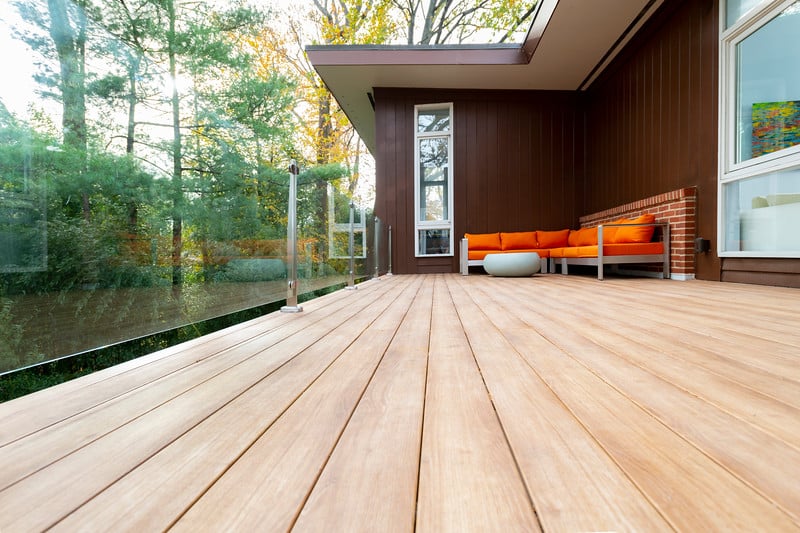
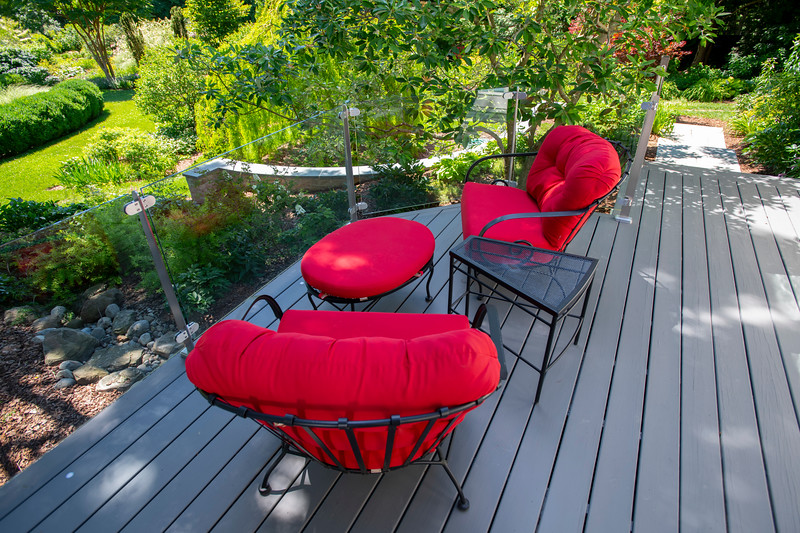
Composite Decking — Choosing the Right Material for the DMV Climate
The decking surface of a screened porch or adjacent deck is one of the highest-touch elements of the entire outdoor space. It is underfoot every time the space is used, exposed to every weather condition the season delivers, and one of the most visible material choices in the finished project. Getting it right matters both aesthetically and practically.
Design Builders works primarily with two composite decking platforms — Trex and TimberTech AZEK. Both are premium products that dramatically outperform traditional pressure-treated wood in the Mid-Atlantic climate. Both are low-maintenance, long-lasting, and available in a wide range of colors and finishes. They differ in their core material composition and in specific performance characteristics that matter for different project conditions.
Trex is the market-leading composite decking brand and the product Design Builders has specified and installed across hundreds of projects in Fairfax, Montgomery, Howard, Arlington, and Prince George's counties since 2006. Trex boards are manufactured from 95 percent recycled materials and the full Trex ecosystem extends beyond decking to include railing systems, lighting packages, drainage systems, and patio furniture, allowing Design Builders to create a fully coordinated outdoor environment from a single product family.
The Trex Transcend Lineage line introduces SunComfortable technology — specialized pigments in the board's cap stock that reflect infrared radiation and keep surface temperatures measurably lower than standard composite boards. On south and west-facing decks in Fairfax County and Montgomery County where afternoon sun exposure is intense, this technology makes a meaningful difference in barefoot comfort and material longevity. Trex backs its premium boards with a 25-year fade and stain warranty.
TimberTech AZEK takes a different material approach — 100 percent PVC with no wood fiber content whatsoever. This distinction matters in the DMV climate for one specific reason: wood fiber absorbs moisture. In a region with heavy rainfall, high summer humidity, and the moisture-cycling that comes with clay-rich soils, any composite board with wood fiber content will eventually experience some degree of moisture-related performance degradation over time. AZEK eliminates that variable entirely. AZEK boards are capped on all four sides with a polymer shell — meaning moisture cannot penetrate the board from any direction. TimberTech backs AZEK with a limited lifetime structural warranty — the strongest warranty in the composite decking category.
It is worth noting that Trex and TimberTech AZEK are Design Builders' primary specifications — the products the team knows most deeply, installs most consistently, and stands behind most confidently based on 20 years of performance data across Fairfax, Montgomery, Howard, and surrounding counties. They are not the only options. Design Builders works with natural wood decking, pressure-treated lumber, and other composite decking brands when a client has a specific product preference, a design requirement that calls for a different material, or a budget that points in a different direction. The goal is always the right material for the specific project, client, and site.
In the Mid-Atlantic climate, composite decking selection for screened porches in Fairfax, Montgomery, and Howard counties comes down to two primary considerations — heat performance on sun-exposed surfaces and moisture resistance over the long term. Trex Transcend Lineage with SunComfortable technology addresses heat on south and west-facing applications. TimberTech AZEK's 100 percent PVC, four-sided capped construction addresses moisture with a limited lifetime structural warranty and zero wood fiber content.
Durability and Warranty — What the Numbers Actually Mean
The warranty language on premium outdoor building products can be confusing. A 25-year fade and stain warranty sounds impressive until you understand what it covers and what it does not. A limited lifetime structural warranty sounds comprehensive until you read the fine print on what constitutes a warranted structural defect.
Design Builders has been specifying and installing these products since 2006 — 20 years of real-world performance data across hundreds of projects in Fairfax, Montgomery, Howard, Anne Arundel, and surrounding counties. That experience informs how we translate warranty claims into honest expectations for our clients.
What composite decking warranties actually cover: Fade and stain warranties cover color performance — the board should not fade beyond a defined delta-E color measurement over the warranty period and should not permanently stain under normal use conditions. They do not cover surface wear from furniture, grills, or heavy traffic. They do not cover color variation between boards from different manufacturing runs. They do not cover damage from improper cleaning products. Read the warranty document before selecting a product — not the marketing summary.
What they tell you about product confidence: A manufacturer willing to offer a 25 or 50-year fade warranty is making a statement about confidence in their cap stock chemistry and UV resistance. Trex's 25-year fade and stain warranty on Transcend Lineage and TimberTech's Limited Lifetime on AZEK are both credible commitments backed by product chemistry that Design Builders has observed performing as warranted across its entire project history in the region.
The Screeneze warranty covers the aluminum extrusion system against defects in materials and workmanship. Design Builders installs Screeneze with fiberglass screen fabric as the standard specification, which outperforms aluminum in longevity and dimensional stability in the DMV climate.
The Sunspace WeatherMaster warranty covers the ViewFlex vinyl glazing and the aluminum extrusion system. The single-moving-part design — the spring clip — means there is very little mechanical complexity to fail, which is exactly why Design Builders recommends the system. The fewer moving parts in an outdoor environment, the more reliable the long-term performance.
The honest summary for homeowners planning luxury screened porches in Fairfax, Loudoun, Montgomery, Howard, or Anne Arundel County: buy the warranty that covers the performance characteristic you care most about. If color permanence on a south-facing deck is the concern, Trex Transcend Lineage with its 25-year fade warranty is the right specification. If long-term moisture immunity is the concern, TimberTech AZEK's lifetime structural warranty backed by 100 percent PVC construction is the stronger choice. If year-round enclosure and low maintenance are the priorities, Sunspace WeatherMaster's single-part simplicity delivers the most reliable long-term performance in the enclosure category.
Let's Talk About Your Project
At Design Builders, every initial consultation starts with a real conversation — not a sales pitch. Tell us what you want to build, and we'll tell you honestly what it costs, how long it takes, and whether we're the right fit for your home.
Navigating the 2026 Permitting and Regulatory Environment — County by County
In Fairfax, Loudoun, Montgomery, Howard, and Anne Arundel counties, screened porches with roofs require full building permits — not the simplified permit path available for open decks. Each county treats a roofed screened porch as a residential addition requiring structural plan review, zoning compliance, and in many cases Health Department approval for well and septic properties. Design Builders manages the complete permit process as part of every project.
Every luxury screened porch in Fairfax, Loudoun, Montgomery, Howard, and Anne Arundel County has one thing in common before a single board is cut or a single pier is installed. It needs a permit. This is not a formality. In the counties Design Builders serves, the permitting process for a roofed, enclosed outdoor structure is a substantive regulatory review involving multiple county departments, structural plan review, zoning compliance verification, and in many cases Health Department sign-off for properties on well and septic systems. The timeline from permit application to permit in hand can range from two weeks to six weeks or more depending on the county, the completeness of the submission, and whether the project triggers any of the environmental, drainage, or setback complications that are common on the kinds of premium properties where Design Builders works.
Understanding what each county requires — and where the friction points are — is not something homeowners should have to figure out on their own. Design Builders has been pulling permits across this entire service area since 2006. The permitting process is integrated into every project timeline from the first consultation, not treated as a separate problem to solve after the design is done.
Fairfax County — The PLUS System, RPA Realities, and Why Clean First Submissions Matter
Fairfax County operates one of the most detailed and well-documented residential permitting systems in the region through its online Planning and Land Use System — PLUS. Every permit application, plan submission, and review status update flows through this system, which means the process is transparent and trackable but also unforgiving of incomplete or inaccurate submissions.
A screened porch in Fairfax County is classified as a residential Addition/Alteration — specifically Additional Square Footage, with Screened Porch as its own named project type in the PLUS system. This is the same permit category as a room addition or a sunroom — not the simplified path available for an open deck. The application requires a detailed site plan showing setbacks and lot coverage, structural drawings for the roof framing and foundation, zoning review confirming the project meets setback and lot coverage requirements, and a building review confirming structural compliance with the 2021 Virginia Residential Code, which became the mandatory standard for all Fairfax County permit applications as of January 2025.
If the project includes electrical work — Infratech heaters, lighting, outlets, outdoor audio, or a ceiling fan — a separate electrical permit is required as a child permit related to the main building permit. The electrical permit cannot be issued until the building permit is in hand. This sequencing matters for project timelines, particularly on projects where the electrical scope is significant.
Where Fairfax projects get complicated: The most common sources of complexity on Fairfax County screened porch permits are site-specific rather than project-specific. They are conditions of the lot, not conditions of the design.
Resource Protection Areas are the most significant. Fairfax County designates RPAs along streams, shorelines, and water features across the county. Great Falls, Fairfax Station, Clifton, and many of the higher-value properties in the county sit near stream corridors that may be subject to RPA designation. If any part of a proposed screened porch, its footings, or associated grading falls within an RPA, a separate county approval is required before the building permit can be issued.
Sloped lots and grading. Fairfax County requires a site-related permit when land disturbance exceeds certain thresholds. On steeply sloped lots — common in the wooded residential corridors of western Fairfax County — even a relatively modest screened porch project can trigger a grading review if the construction disturbance area is significant. This is one of the reasons helical pier foundations matter in Fairfax County permitting specifically. Because helical pier installation creates minimal soil disturbance compared to traditional concrete footing excavation, it can keep a project below the threshold that triggers a separate grading permit requirement.
Septic and well lots. Properties in Fairfax County that are not served by public water and sewer require specific clearances between footing locations and the drainfield and well. These clearances must be documented in the permit application and verified during inspection.
The clean first submission imperative: Fairfax County's PLUS system means that an incomplete or inaccurate first submission triggers a correction cycle that restarts internal review timelines. Design Builders submits complete, accurate permit packages on the first attempt — one of the most concrete ways that experience translates to a better project outcome for the homeowner.
Timeline: 3 to 6 weeks for a well-prepared screened porch permit application in Fairfax County under normal seasonal conditions. Projects involving RPA review, grading permits, or significant electrical scope take longer.
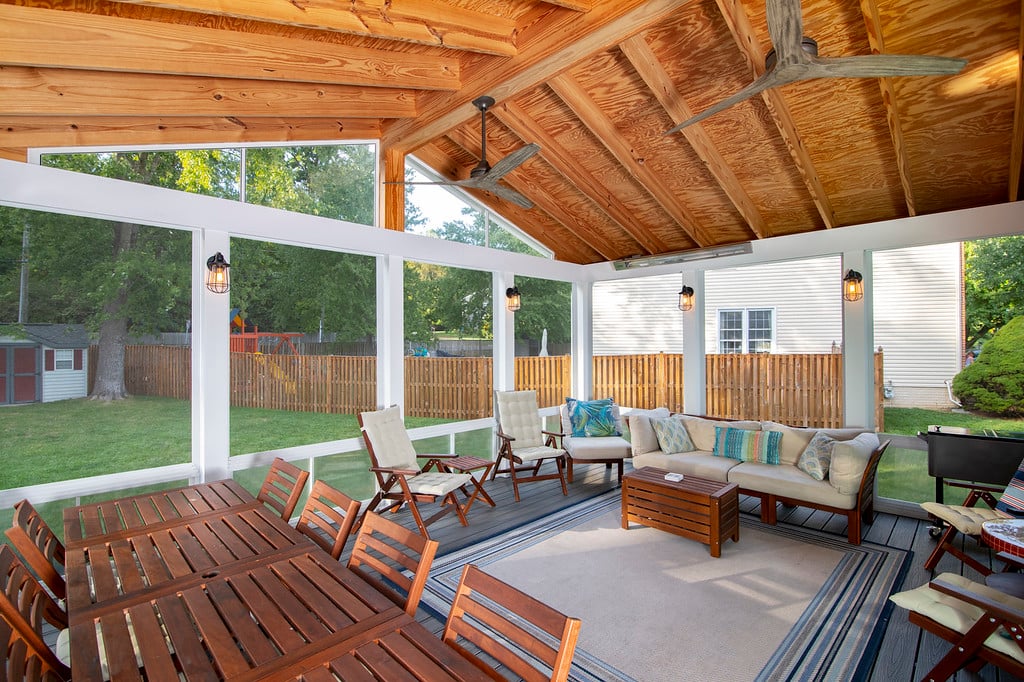
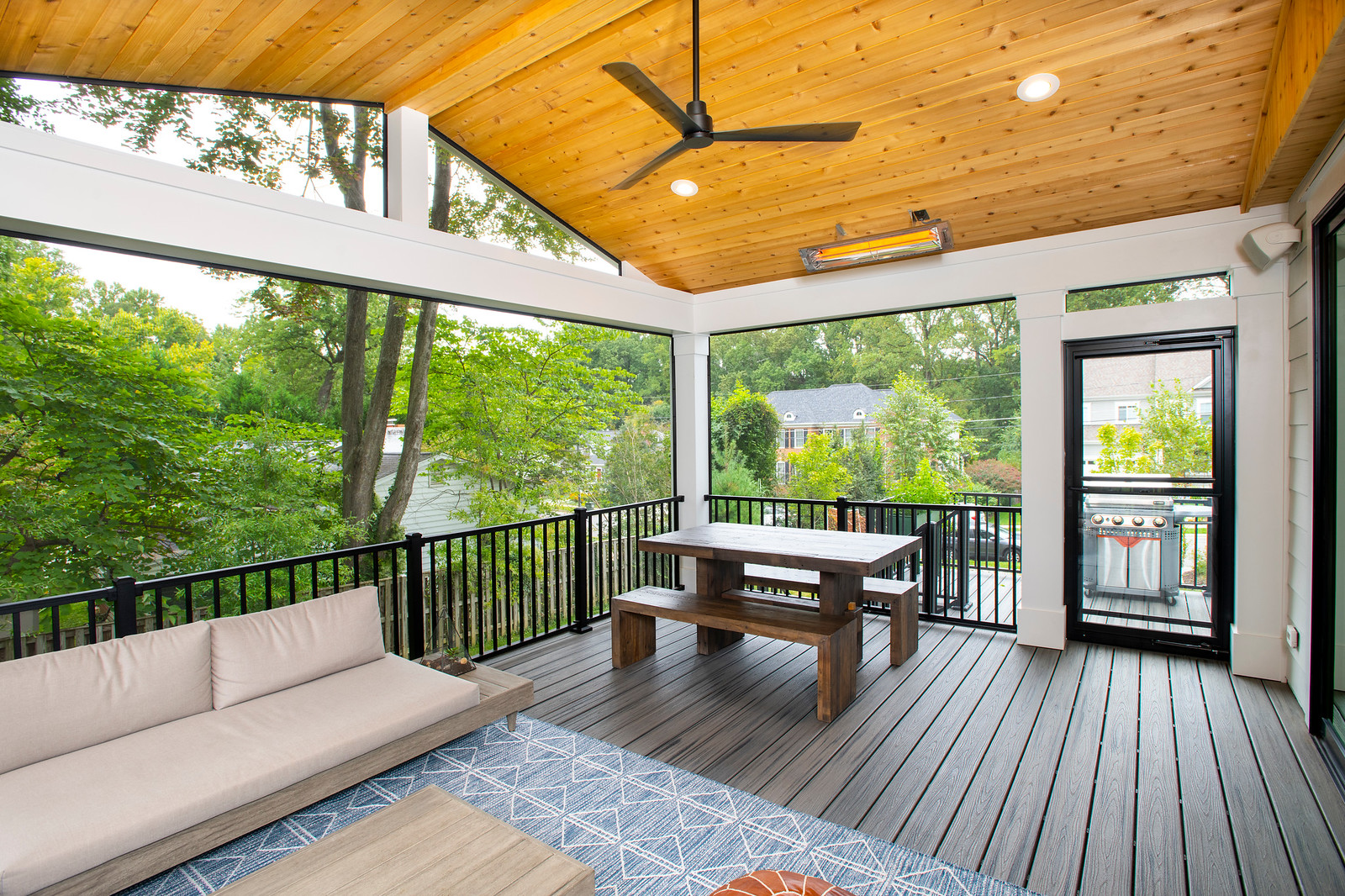
Loudoun County — Additions Not Decks, Incorporated Towns, and the LandMARC System
Loudoun County is growing faster than almost any county in Virginia, and its permitting infrastructure has been evolving to keep pace. For homeowners planning screened porches in Ashburn, Leesburg, Purcellville, South Riding, and the estate communities along the Route 9 and Route 15 corridors, the key permitting reality in Loudoun is one that surprises many homeowners who have built decks there before.
Screened porches are not decks in Loudoun County. This distinction is explicitly stated in Loudoun County's official permitting guidance and it has significant practical implications. Loudoun County's Typical Deck Detail — a simplified pre-engineered plan set that allows straightforward open decks to be permitted without custom structural drawings — explicitly cannot be used for decks with roofs, screened porches, hot tubs, or other additional loads. If your project is a screened porch, you need a full set of engineered construction plans regardless of size. Three sets of plans are required for all submissions. Those plans must include foundation plan, floor framing plan, roof framing plan, wall sections, floor plans, and elevations.
This requirement exists because a roofed screened porch adds structural loads — dead load, wind load, snow load — that a standard deck is not designed to carry. A homeowner or contractor who attempts to use the standard deck path for a screened porch project will have the application rejected and will restart the process — adding weeks to the project timeline.
The permit application for residential additions in Loudoun County goes through LandMARC — Loudoun County's online permitting platform. Required documents include a signed building permit application, a plat of property showing the existing structure and proposed addition with all setback measurements, and a complete set of construction plans. The plat requirement is critical — Loudoun County requires a current plat showing actual setback measurements, not simply a reference to recorded plat dimensions.
Incorporated towns — the step that many homeowners miss: Loudoun County contains several incorporated towns — Leesburg, Purcellville, Hillsboro, Hamilton, Middleburg, and Round Hill among them. If a property is located within the limits of an incorporated town, the homeowner must obtain approved zoning clearance from the town before the Loudoun County building permit application can be accepted. Town zoning requirements may differ from county requirements — setbacks, lot coverage limits, and architectural compatibility standards can all vary. Skipping the town zoning step and applying directly to the county results in an incomplete application that cannot be processed.
Well and septic, conservation easements, and stormwater: Properties served by well and septic in Loudoun County require Health Department approval before applying for the building permit. Properties with conservation easements — common on larger rural parcels in western Loudoun — may be restricted from certain types of construction regardless of county zoning approval. Properties with stormwater easements must contact the county's Stormwater Team before permit submission.
Timeline: 2 to 4 weeks for well-prepared screened porch permit applications in Loudoun County. Projects in incorporated towns, on well and septic lots, or with conservation easement complications take longer and require additional coordination steps before the building permit can even be applied for.
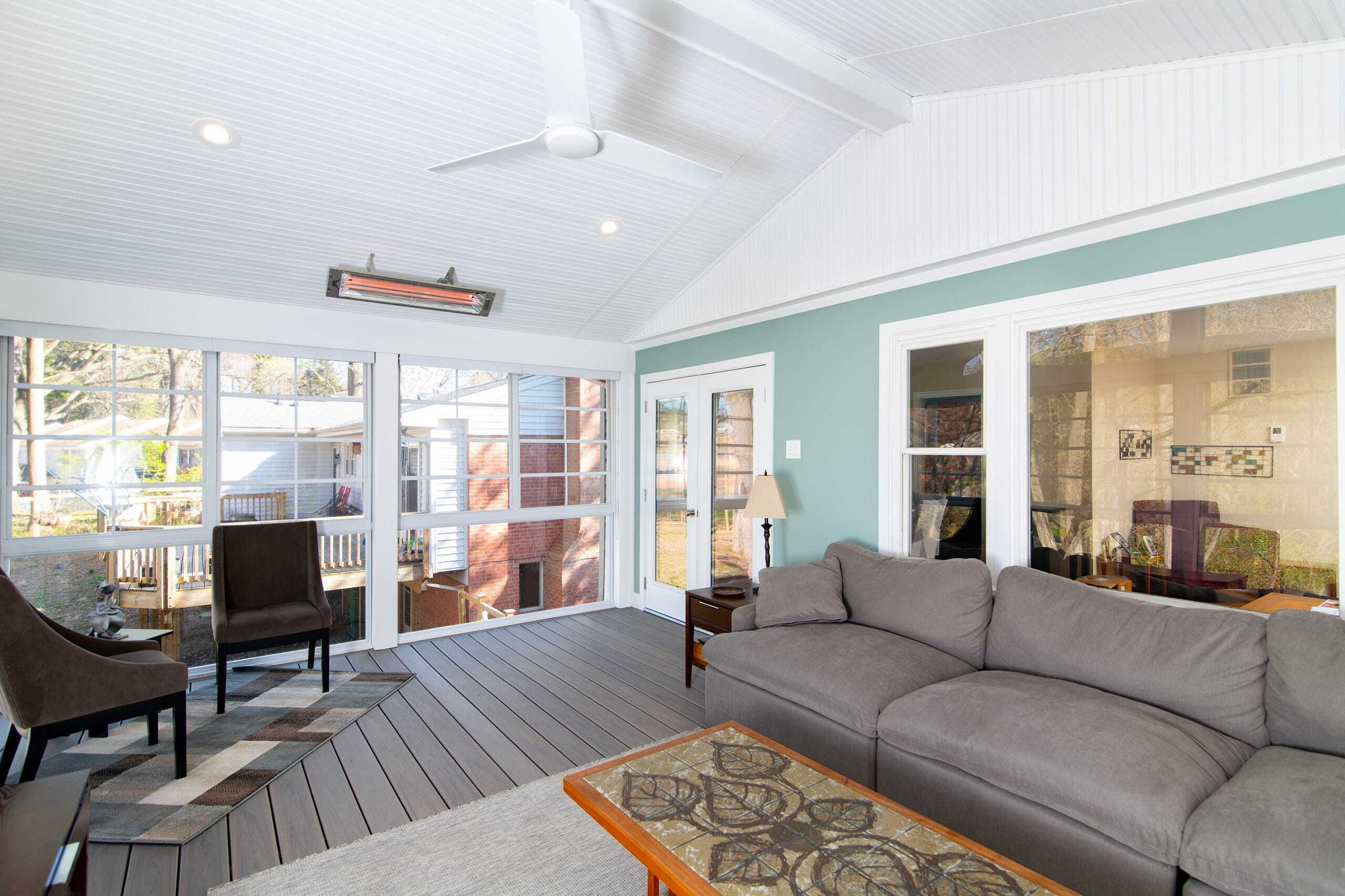
Montgomery County — Why Standard Deck Details Don't Work and What Actually Does
Montgomery County operates one of the most comprehensive residential permitting systems in Maryland — and for homeowners planning screened porches in Bethesda, Potomac, Rockville, Chevy Chase, Silver Spring, and the surrounding communities, it is important to understand from the outset that a screened porch is categorically different from a deck in Montgomery County's regulatory framework.
The standard deck detail limitation: Montgomery County publishes Residential Deck Details — a pre-engineered plan set for simple, single-span, single-level decks that allows qualifying projects to move through a faster review path. The county's own documentation states this explicitly and without ambiguity: these details cannot be used for decks constructed with roofs, screened porches, hot tubs, or other additional loads. A screened porch in Montgomery County is a residential addition. It goes through the residential additions permit path through the Department of Permitting Services — DPS — not the simplified deck path.
The application requires full construction drawings, a current survey showing setbacks and lot coverage, zoning review, structural plan review, and in many cases review by WSSC — Washington Suburban Sanitary Commission — if the project affects or is near public water or sewer infrastructure.
The review sequence matters: Montgomery County's permit review for residential additions proceeds in a specific sequence. Zoning reviews and approves the site plan first. If the property is on well and septic, the Well and Septic section reviews and approves the plat for clearances to existing systems. Building Plan Review signs off only after all other required reviews are complete. A problem identified at the zoning stage holds up the entire application until it is resolved.
HOA covenants — the parallel approval process: Montgomery County contains hundreds of planned communities and subdivisions with private HOA covenants that regulate construction. The county does not enforce these covenants. But a homeowner who obtains a county permit without HOA approval can find their project stopped by the HOA after construction has begun. Design Builders strongly advises all Montgomery County clients to obtain written HOA approval before submitting the permit application, not after.
Making changes resets the clock: Any significant design change after initial submission — a modified footprint, a revised roof design, a changed setback calculation — restarts the review process. The application returns to the back of the queue. Design Builders builds this reality into the project planning process by investing significant upfront effort in getting the design and documentation right before the permit application is submitted.
Timeline: 3 to 6 weeks for adequately prepared applications when WSSC review and zoning review are factored in.
Montgomery County — Why Standard Deck Details Don't Work and What Actually Does
Montgomery County operates one of the most comprehensive residential permitting systems in Maryland — and for homeowners planning screened porches in Bethesda, Potomac, Rockville, Chevy Chase, Silver Spring, and the surrounding communities, it is important to understand from the outset that a screened porch is categorically different from a deck in Montgomery County's regulatory framework.
The standard deck detail limitation: Montgomery County publishes Residential Deck Details — a pre-engineered plan set for simple, single-span, single-level decks that allows qualifying projects to move through a faster review path. The county's own documentation states this explicitly and without ambiguity: these details cannot be used for decks constructed with roofs, screened porches, hot tubs, or other additional loads. A screened porch in Montgomery County is a residential addition. It goes through the residential additions permit path through the Department of Permitting Services — DPS — not the simplified deck path.
The application requires full construction drawings, a current survey showing setbacks and lot coverage, zoning review, structural plan review, and in many cases review by WSSC — Washington Suburban Sanitary Commission — if the project affects or is near public water or sewer infrastructure.
The review sequence matters: Montgomery County's permit review for residential additions proceeds in a specific sequence. Zoning reviews and approves the site plan first. If the property is on well and septic, the Well and Septic section reviews and approves the plat for clearances to existing systems. Building Plan Review signs off only after all other required reviews are complete. A problem identified at the zoning stage holds up the entire application until it is resolved.
HOA covenants — the parallel approval process: Montgomery County contains hundreds of planned communities and subdivisions with private HOA covenants that regulate construction. The county does not enforce these covenants. But a homeowner who obtains a county permit without HOA approval can find their project stopped by the HOA after construction has begun. Design Builders strongly advises all Montgomery County clients to obtain written HOA approval before submitting the permit application, not after.
Making changes resets the clock: Any significant design change after initial submission — a modified footprint, a revised roof design, a changed setback calculation — restarts the review process. The application returns to the back of the queue. Design Builders builds this reality into the project planning process by investing significant upfront effort in getting the design and documentation right before the permit application is submitted.
Timeline: 3 to 6 weeks for adequately prepared applications when WSSC review and zoning review are factored in.
Howard County and Anne Arundel County
Howard County has a reputation among builders as one of the more straightforward permitting environments in the Maryland suburban market. The county uses an online application and digital submission system, and its building department is generally responsive to well-prepared submissions. That said, all structural and enclosed exterior additions — including screened porches — require full building permits with structural plan review. The Howard County permitting timeline for a screened porch runs approximately 2 to 5 weeks for clean submissions. Plan revisions after initial submission restart the review period. Design Builders' Howard County projects — including the Fulton two-story deck and screened porch — navigate this system routinely.
Anne Arundel County introduces an additional layer of complexity for properties near the Chesapeake Bay or its tributaries — which includes a significant portion of the county's premium residential market. Anne Arundel's Critical Area Buffer rules restrict development within a defined distance of tidal waters, meaning that setbacks, lot coverage calculations, and stormwater management requirements are more stringent for waterfront and near-water properties. Grading permits may be required in addition to the building permit. Environmental site design considerations affect how foundations can be constructed and what disturbance is permitted during construction. The timeline for Anne Arundel County screened porch permits runs 4 to 8 weeks under normal conditions — longer for properties in the Critical Area. Helical pier foundations are particularly valuable in Anne Arundel County Critical Area projects because their minimal soil disturbance profile aligns directly with the county's environmental disturbance restrictions.
How Permitting Affects Your Project Sequence — What Homeowners Need to Plan For
The most common mistake homeowners make in planning a screened porch project in any of these counties is treating the permit as something that happens after the design is done. In reality, the permit application is the design checkpoint — the moment when the project's compliance with setbacks, lot coverage limits, structural requirements, and environmental restrictions is formally verified. Getting to that checkpoint with a complete, accurate, and county-ready package is what determines whether the project breaks ground on schedule or waits in a revision cycle.
Design for the lot first
Before any product is selected or any aesthetic decision is made, the site is evaluated for the constraints that will shape the permit application — setbacks, lot coverage, RPA designation in Fairfax, incorporated town boundaries in Loudoun, HOA covenant restrictions in Montgomery. These constraints define what can be built before design preference enters the conversation.
Permit-ready drawings from the start
Design Builders produces construction drawings that meet the specific submission requirements of the county where the project is located. A Fairfax County submission and a Montgomery County submission are different documents — different format requirements, different content requirements, different review sequences. Generic drawings submitted to the wrong county format create correction cycles that add weeks to the timeline.
Trade permits sequenced correctly
Electrical, plumbing, and mechanical permits are child permits that cannot be issued until the parent building permit is in hand. On a project with significant electrical scope — Infratech heaters, outdoor lighting, entertainment systems — the electrical permit timeline needs to be factored into the construction sequence so that rough-in inspection can be scheduled at the right moment rather than holding up framing or ceiling installation.
HOA coordination in Montgomery County
This is non-negotiable. A county permit does not override HOA restrictions. The HOA approval process runs in parallel with the county permit process — not after it.
Screened porch permitting timelines in Fairfax, Loudoun, Montgomery, Howard, and Anne Arundel counties range from two to eight weeks depending on project complexity, lot conditions, and submission completeness. The single most reliable way to stay on schedule is to submit a complete, accurate, county-specific permit package on the first attempt. Design Builders integrates permitting into the project timeline from the first consultation, producing county-ready construction documents and managing the review process as part of every project.
Let's Talk About Your Project
At Design Builders, every initial consultation starts with a real conversation — not a sales pitch. Tell us what you want to build, and we'll tell you honestly what it costs, how long it takes, and whether we're the right fit for your home.
Project Economics — What a Luxury Screened Porch Actually Costs and What It Returns
At some point in every screened porch conversation, the question that has been forming since the first page finally gets asked out loud. What is this going to cost?
It is the right question. A luxury screened porch in Fairfax, Loudoun, Montgomery, Howard, or Anne Arundel County is a significant investment — one that deserves a straight, informed answer rather than a vague range designed to get someone on the phone. Design Builders has been having this conversation with homeowners across the region for 20 years. What follows is the most honest framework we can offer for understanding what screened porch projects cost, what drives those costs, and what the investment returns over time.
The short version: screened porches are among the highest-ROI home improvement investments available to homeowners in the Mid-Atlantic suburban market. They add usable square footage, extend the selling season of a home, and deliver lifestyle value that homeowners consistently report as exceeding their expectations. But getting to that return requires making the right decisions at the design stage — not the cheapest decisions, and not the most expensive ones either. The right ones.
Luxury screened porch costs in Fairfax, Loudoun, Montgomery, Howard, and Anne Arundel counties typically range from $40,000 for a basic attached structure to $250,000 or more for a fully appointed luxury porch with fireplace, outdoor kitchen integration, premium materials, and helical pier foundation. The most significant cost variables are not square footage — they are roof tie-in complexity, foundation requirements, site access, electrical scope, and county permit path.
The Real Cost Drivers — What Actually Moves the Number
Square footage is the most intuitive way to think about screened porch pricing but it is rarely the most accurate predictor of final cost. Two porches of identical square footage can differ by $50,000 or more depending on the roof structure, the foundation conditions, the materials specified, and the electrical and mechanical scope. Understanding the real cost drivers helps homeowners make better decisions earlier in the process.
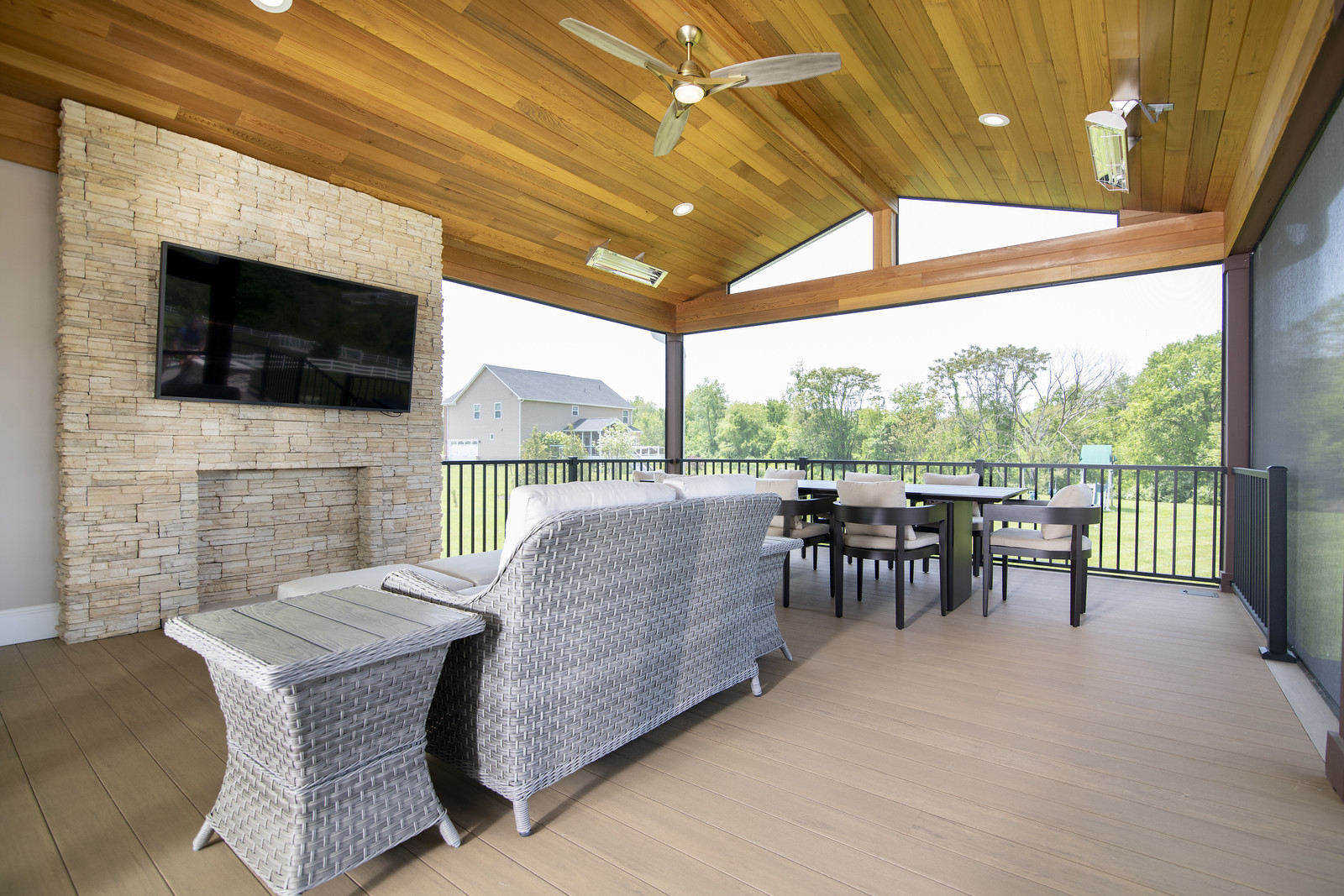
Basic Porch
$40,000 – $70,000
A straightforward attached porch with shed or simple gable roof, standard composite decking, Screeneze fixed screening, basic electrical for lighting and ceiling fans, and a concrete or helical pier foundation on a flat lot. Solves the bug problem, extends the season, integrates cleanly with the home.
Mid-Size Family Porch
$60,000 – $120,000
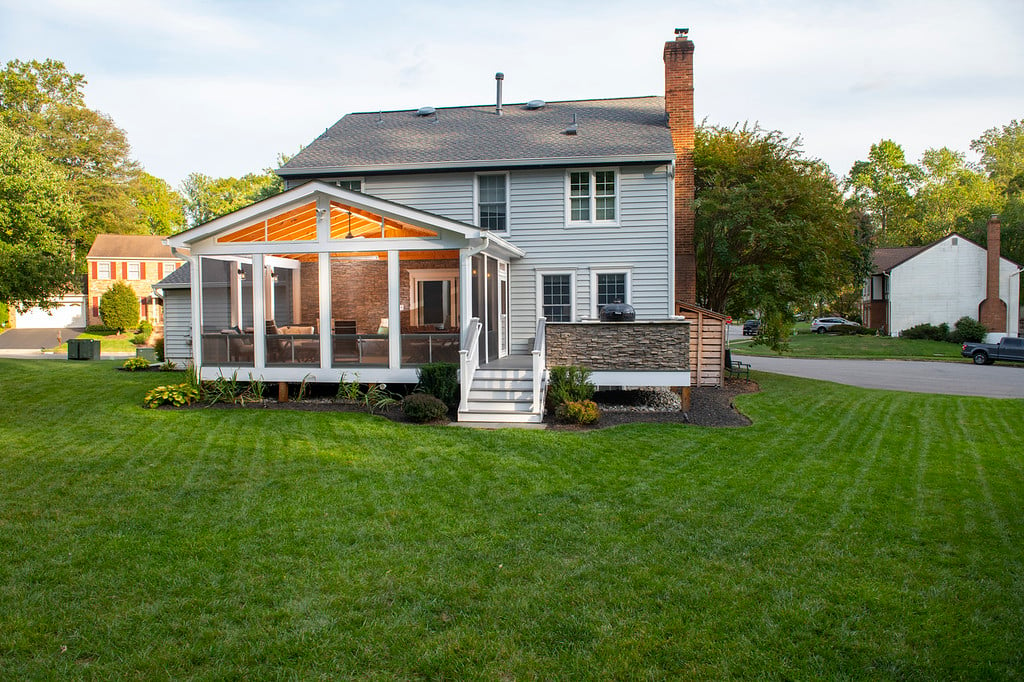
A larger footprint — 200 to 400 square feet — with a full gable roof, beadboard or cedar ceiling, Trex Transcend or TimberTech AZEK decking, Infratech heaters, comprehensive lighting, and an engineered foundation. Often includes one defining premium feature — fireplace, skylights, or a sliding door system.
Luxury Porch
$100,000 – $250,000
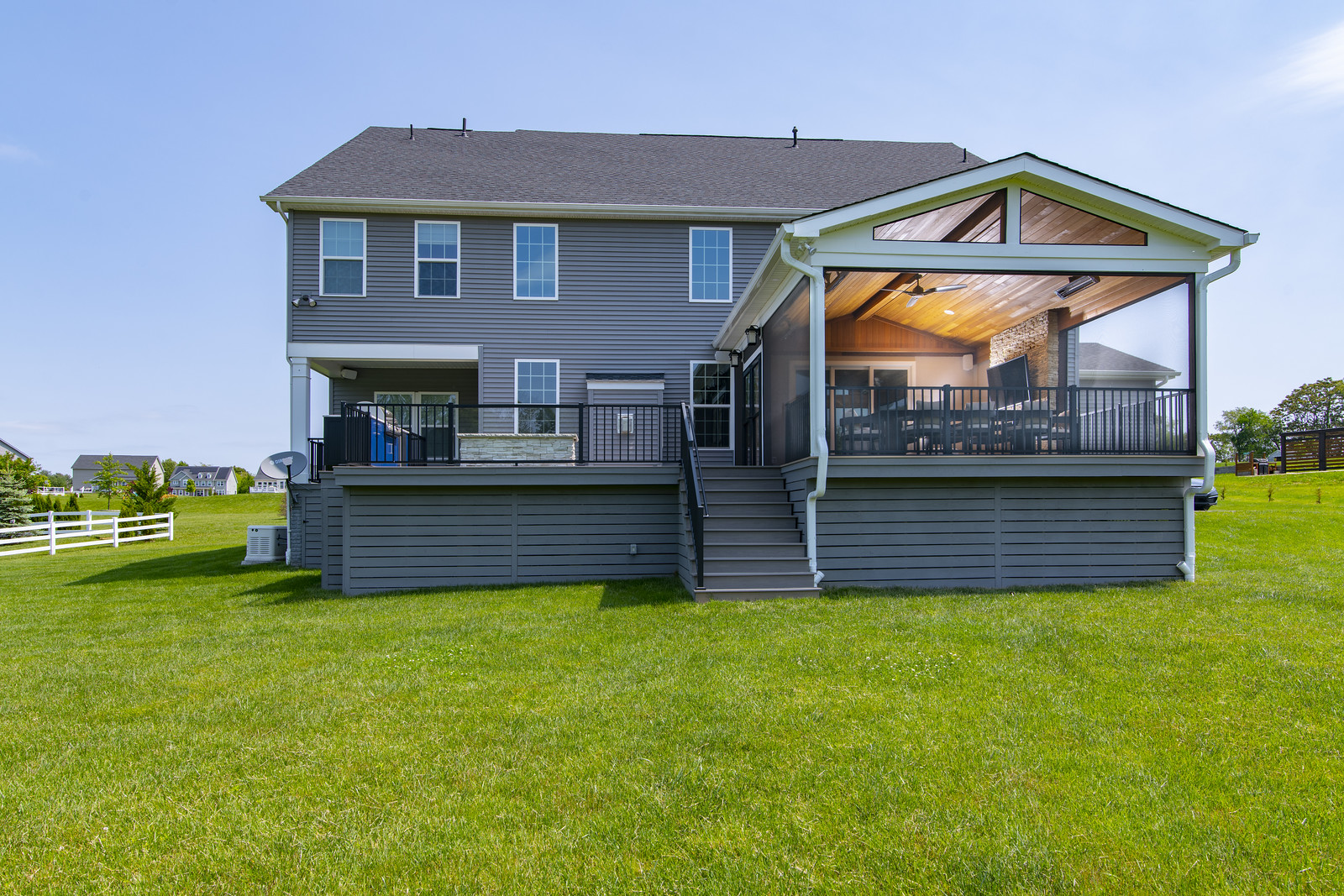
400+ square feet with complex roof structures, architectural ceiling treatments, full premium material packages, helical pier foundations, comprehensive electrical, and integration with outdoor kitchen, fireplace, or fire element. The $250,000+ end represents full micro-resort complexes — porch, deck, outdoor kitchen, and fire element as one cohesive environment.
.jpg "bethesda-maryland")
.jpg "sykesyville-screened-in-porch (7)")
Case Studies
Every outdoor living project starts the same way: a homeowner with a specific space, a specific budget, and a specific vision. See how those visions became decks, screened porches, pavilions, and outdoor kitchens across Montgomery County, MD and Fairfax County, VA — with real project costs, design challenges, and ROI broken down for each one. Browse our case studies to see the full story, or schedule a free online design consultation to start planning yours.How Much Will Your Screened Porch Cost? Use Our Interactive Estimator.
Every screened porch project is different. The estimator below gives you a personalized cost range based on your specific inputs — porch size, desired features, material preferences, and county location. It is not a quote. It is an informed starting point that gives you a realistic planning number before you pick up the phone.
What the estimator includes: Structural framing and roof, foundation type, decking material, screening system, basic electrical for lighting and fans, and standard permit allowance for your county.
What the estimator does not include: Outdoor kitchen integration, fireplace or fire pit, motorized screen systems, Sunspace window upgrades, entertainment technology, custom ceiling treatments, or site-specific complications such as steep grades, tight access, or RPA setbacks.
What can change your final number: Site access and slope, county permit complexity, electrical scope beyond basic, material upgrades, and integration with adjacent deck or outdoor kitchen scope.
Roof Structure
The single largest variable after square footage. A simple shed roof is most economical. A gable roof matching the home's pitch requires more material and precision. A hip roof — right for traditional homes in Bethesda, McLean, and Great Falls — involves the most complex framing. Ceiling treatment adds cost but delivers significant aesthetic return.
Foundation & Site Access
On a flat lot with easy access, foundation cost differences are modest. On a sloped lot in Potomac, Great Falls, or Howard County — or where tight access prevents excavation — helical piers may be the only practical option. Foundation engineering on challenging sites adds cost but far less than excavation, soil management, and landscape restoration.
Electrical Scope
The most consistently underestimated variable. Basic lighting and fans add relatively little. A comprehensive scope — dedicated circuits for Infratech heaters, structured wiring for outdoor audio, conduit for a future television, and recessed lighting on dimmers — can add $8,000 to $15,000 or more. Plan for it upfront. Adding it after the ceiling is closed costs significantly more.
County Permit Costs
Permit fees in Fairfax, Loudoun, Montgomery, Howard, and Anne Arundel counties are calculated as a percentage of project valuation — typically 1 to 3 percent. On a $150,000 luxury screened porch, permit fees alone can run $2,000 to $4,500 before plan preparation costs are factored in. Design Builders includes permit cost estimates in every project budget from the first consultation.
Home Value Impact and ROI — What the Investment Returns
The return on investment question for luxury screened porches in the Mid-Atlantic market has a more favorable answer than most homeowners expect — particularly in the affluent suburban zip codes where Design Builders works.
75–90% Cost Recoup at Resale
Industry research consistently places screened porch additions among the highest-ROI home improvement categories available. Screened porch additions in the Mid-Atlantic region recoup approximately 75 to 90 percent of their cost at resale — comparing favorably to kitchen remodels, bathroom additions, and most other home improvement categories.
Buyer Expectation in Affluent ZIP Codes
In Potomac, Great Falls, McLean, Bethesda, Vienna, and Leesburg, outdoor living capability has moved from a differentiating feature to a baseline buyer expectation. A home at a $1.5 million price point that lacks a quality outdoor living space is increasingly perceived as incomplete — which means the investment holds its value more reliably than in markets where outdoor living is still considered optional.
The Micro-Resort Multiplier
When a screened porch is part of a fully integrated outdoor living complex — porch plus deck plus outdoor kitchen, all designed as a cohesive environment — the value impact at resale exceeds what the individual components would deliver separately. Buyers respond to a complete outdoor living environment as a finished, move-in-ready amenity. The whole is worth more than the sum of its parts.
What a Budget-Smart Scope Looks Like
The most expensive screened porch is not always the best screened porch. The best screened porch is the one that delivers the most value — in daily use, in long-term performance, and at resale — for the investment made.
Invest in Structure First
The foundation, roof framing, and structural tie-in to the existing home determine everything else about long-term performance. Cutting corners on foundation engineering in Montgomery County or Fairfax County is a false economy — the cost of structural problems discovered five or ten years later is almost always greater than the savings achieved at the design stage. Helical pier foundations, properly engineered roof structures, and correctly specified ledger connections are the places to spend confidently.
Rough-In for the Future You Want
Electrical rough-in is inexpensive at construction time and expensive to add after the ceiling is closed. If there is any possibility that the porch will eventually have a television, a sound system, additional Infratech heaters, or an outdoor kitchen connection, the conduit and circuit capacity should be roughed in at construction even if the final devices are not installed until phase two.
Choose Materials for the Climate
The Mid-Atlantic climate is unforgiving of materials not specified for its specific conditions. Trex Transcend or TimberTech AZEK on the decking surface, Screeneze on the screens, and Infratech on the ceiling are not premium indulgences — they are the correctly specified products for how this climate performs.
Work With a Design-Builder Who Understands Permitting Upfront
Permit fees, plan preparation costs, and the potential for permit-related design changes are real budget items. A contractor who does not factor these into the initial budget conversation is not giving you a complete picture. Design Builders includes permit cost estimates, plan preparation, and county-specific compliance requirements in every project budget from the first consultation — because surprises at the permit stage are avoidable when the project is planned correctly from the beginning.
Let's Talk About Your Project
At Design Builders, every initial consultation starts with a real conversation — not a sales pitch. Tell us what you want to build, and we'll tell you honestly what it costs, how long it takes, and whether we're the right fit for your home.
Real Projects Across Northern Virginia and Maryland
Design Builders has completed luxury screened porch, deck, and outdoor living projects across Fairfax County and the Falls Church area in Northern Virginia, and across Montgomery County, Prince George's County, and Howard County in Maryland — with active service extending into Loudoun County, Arlington, Alexandria, and Anne Arundel County. Every project in this portfolio was permitted, engineered, and built to the specific requirements of its jurisdiction.
The six projects below represent the range of what's possible across the region — from elevated second-floor porches on helical pier foundations in Falls Church to full outdoor kitchen and entertainment complexes in Clifton, from hillside deck-and-porch combinations in Darnestown to Sunspace window upgrades that convert a Potomac screened porch into a true three-season room. Every project started with a conversation about how the homeowners actually wanted to live. The structure, materials, and details followed from there.
Northern Virginia Projects
Fairfax County is Design Builders' most technically demanding Virginia market — between Resource Protection Area setbacks, steep lot conditions, and the engineering complexity of second-floor additions, almost every Fairfax project requires more planning below grade than it does above. Loudoun County homeowners in Ashburn, Leesburg, and Purcellville increasingly bring similar complexity — sloped lots, incorporated town zoning approvals, and the specific Loudoun County Typical Deck Detail requirements that apply whenever a roofed structure like a screened porch is added. The three projects below reflect how Design Builders approaches Northern Virginia builds at the county level.
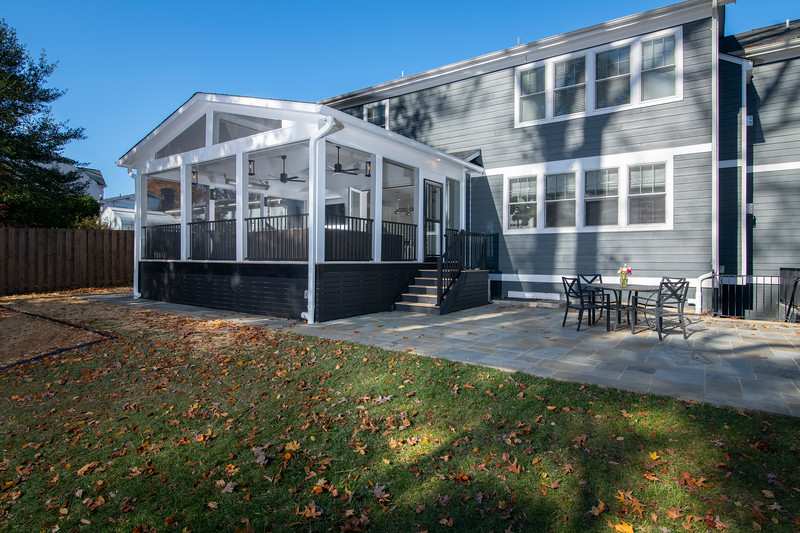
Falls Church, VA — Gable Roof Screened Porch with Helical Pier Foundation
One non-negotiable requirement: the kitchen and porch had to feel like one continuous space. A Lincoln Folding Patio Door creates a 12-foot unobstructed opening — the entire wall disappears when the weather invites it. PierTech helical piers went in one day with no excavation disruption. The porch features a gable roof, Windsor One beadboard ceiling, AZEK decking, Infratech heaters, Velux skylights, and Screeneze screening.
Key specs: PierTech helical piers · Gable roof · Velux skylights · Windsor One beadboard · AZEK decking · Screeneze · Infratech heaters · Lincoln Folding Door
Falls Church, VA — Second-Floor Screened Porch with Grilling Deck
Not every screened porch sits at grade. This Falls Church home features a second-floor screened porch paired with an attached grilling deck — accessible directly from the main living level. The 20-foot unobstructed screen span was achieved through deliberate framing decisions that prioritized the view over structural convenience.
Knotty cedar ceiling brings natural warmth that holds up to Mid-Atlantic humidity far better than painted alternatives. Trex Transcend decking, Infratech heaters, and Screeneze screening complete a space designed as a system — not an addition.
Key specs: Second-floor configuration · Screeneze 20-foot span · Gable roof · Knotty cedar ceiling · Trex Transcend decking · Infratech heaters
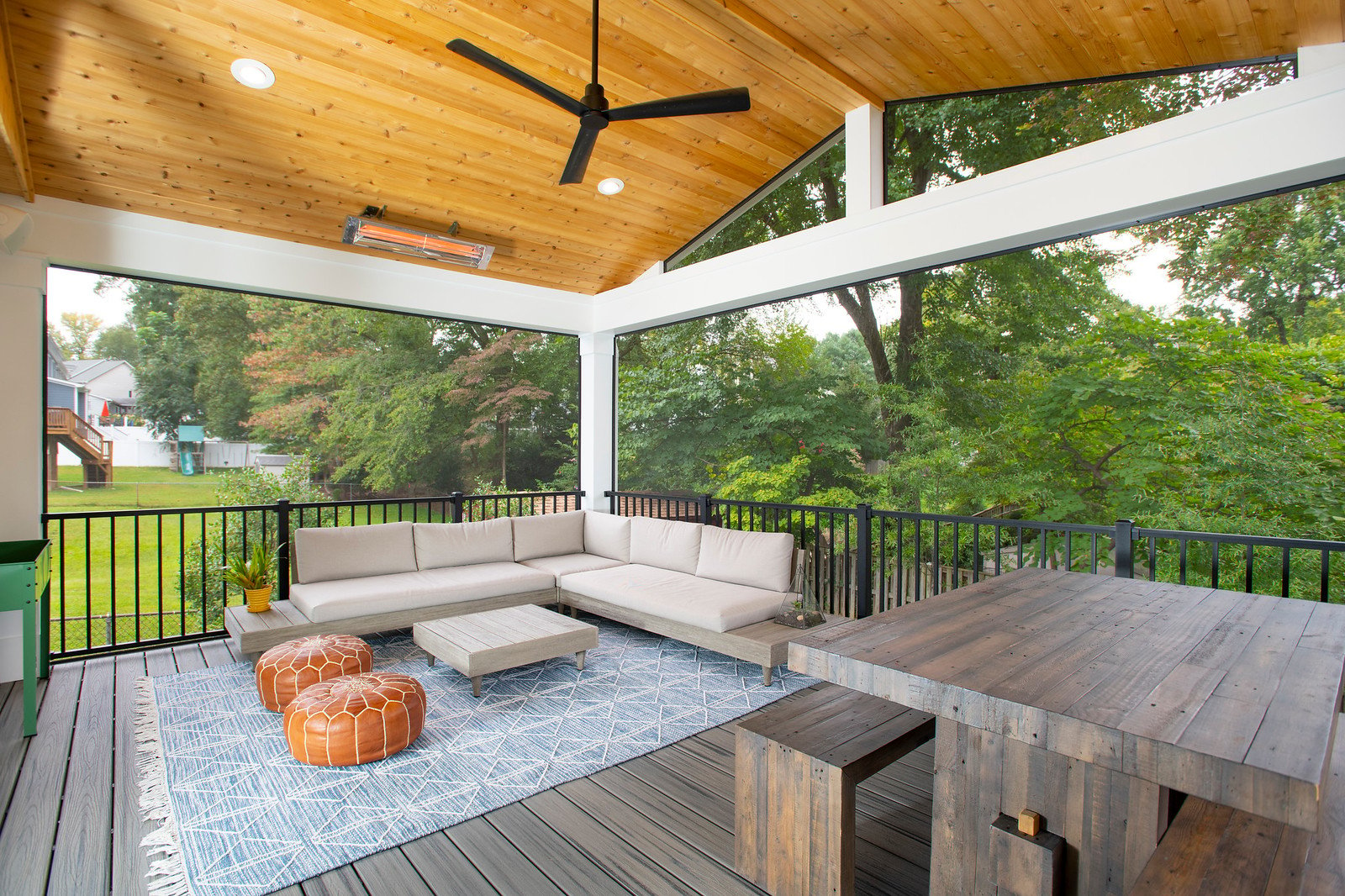
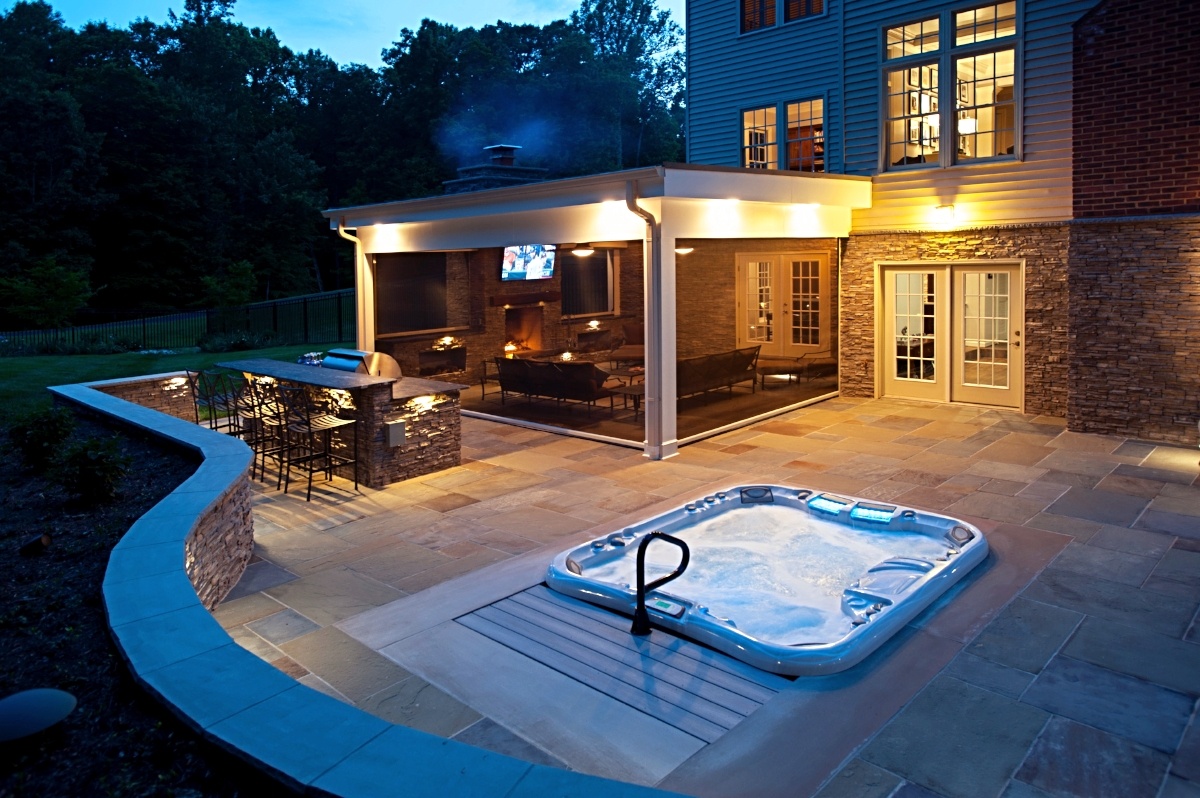
Clifton, VA — Outdoor Kitchen, Custom Fireplace, and Motorized Retractable Screens
The fullest expression of micro-resort outdoor living in the Design Builders portfolio. Multiple zones — elevated sun deck, stone-clad outdoor kitchen with Blaze grill, covered pavilion with Samsung TV and audio, motorized Phantom retractable screens, custom Eldorado stone fireplace, and a recessed hot tub with engineered privacy screening.
Key specs: Phantom motorized screens · Blaze grill · Eldorado stone fireplace · Infratech heaters · 25-piece Trex lighting · Cedar tongue-and-groove ceiling · Recessed hot tub
Maryland Projects
Design Builders' Maryland work spans Montgomery County, Prince George's County, and Howard County — three jurisdictions with meaningfully different permitting environments, lot conditions, and homeowner profiles. Montgomery County projects frequently involve setback complexity, Tree Canopy Law awareness on wooded lots, and the specific review requirements that come with adding a roofed structure to an existing deck. Prince George's County projects tend to involve larger lots with more design freedom and strong demand for entertainment-focused builds. Anne Arundel County homeowners in Annapolis, Severna Park, and Crofton represent an expanding part of the Design Builders service area, where waterfront and near-waterfront properties create unique foundation and material specification requirements.
Darnestown, MD — Screened Porch, Deck, and Outdoor Kitchen on a Steeply Sloped Lot
A significant backyard grade that stops most contractors became a design asset. Design Builders engineered the screened porch, deck, and outdoor kitchen as an integrated elevated structure that works with the slope rather than fighting it.
The outdoor kitchen features Danver Chromica Baltic cabinets with a Lynx built-in gas grill. Bromic infrared heaters provide ceiling-mounted heat coverage. AZEK English Walnut decking runs throughout with the Trex lighting and railing system.
Key specs: Steep grade site · Gable roof · Screeneze screening · Danver cabinets · Lynx grill · Bromic heaters · AZEK English Walnut · Trex lighting
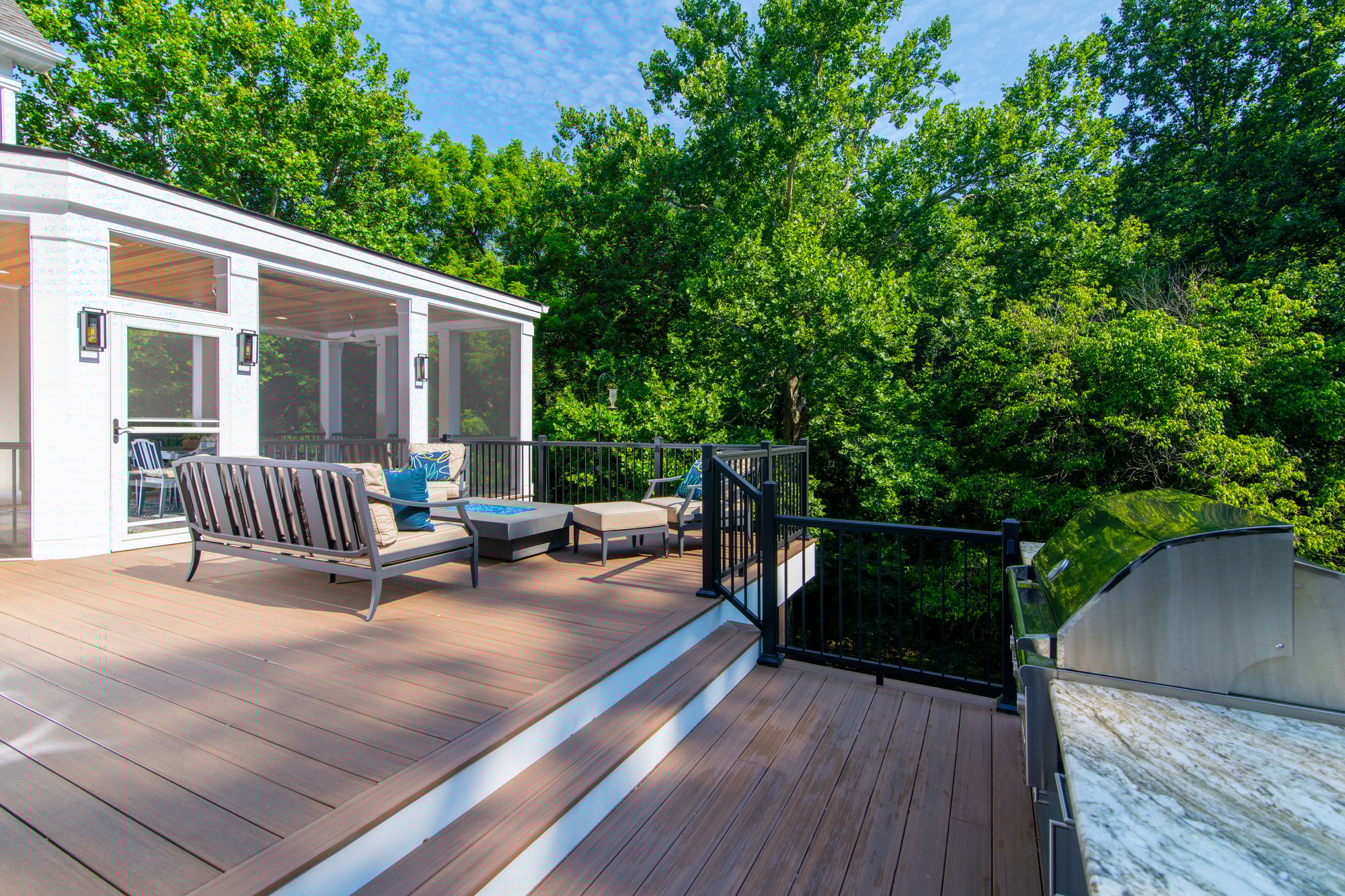
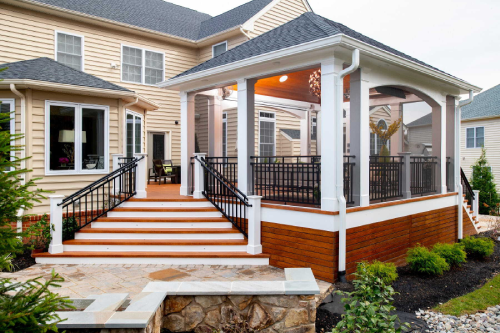
Bowie, MD — Custom Hip Roof Screen Room with Phantom Retractable Screens
This project started with art — a custom sculptural piece the homeowner wanted suspended from the ceiling as the room's visual anchor. Design Builders built the clear cedar ceiling around it. Two Phantom retractable screens open fully to the deck or close completely for weather and privacy.
Key specs: Hip roof · Clear cedar ceiling · Phantom retractable screens · Zuri decking · SunBrite TV · Infratech heaters · Custom artwork ceiling installation
North Potomac, MD — Screened Porch, Deck, and Sunspace Window Upgrade
A great screened porch that became an even better three-season room. Built on Fortress steel framing with AZEK decking, Trex black aluminum railing, Infratech heaters, and a knotty cedar ceiling. A Danver cabinet unit and Blaze grill anchor the outdoor kitchen at deck level.
The homeowner returned after one season and upgraded to Sunspace WeatherMaster windows — extending usable season from early March through late November without touching the underlying structure.
Key specs: Fortress steel framing · AZEK decking · Trex black railing · Infratech heaters · Knotty cedar ceiling · Danver cabinets · Blaze grill · Sunspace WeatherMaster windows
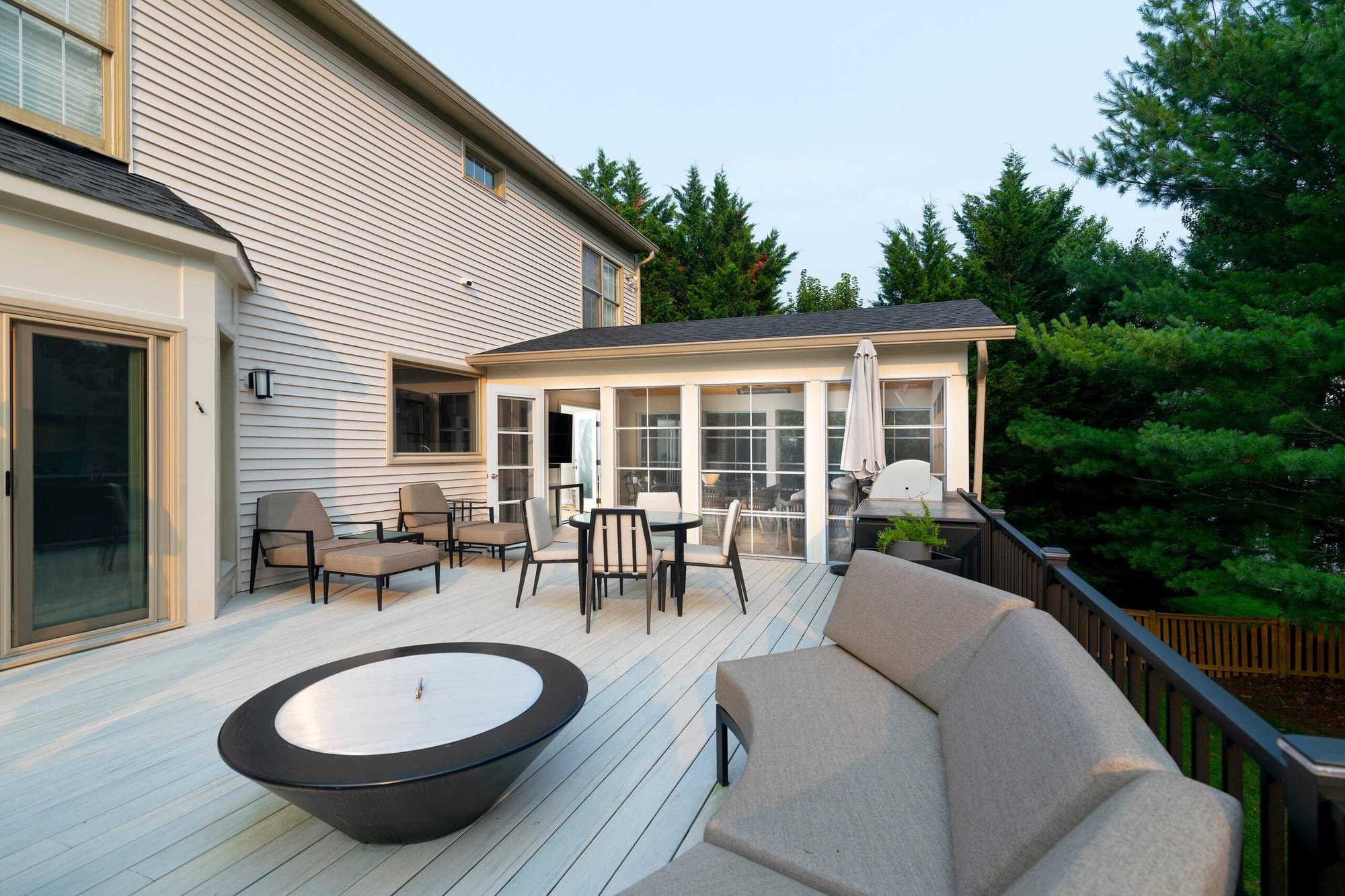
Projects by Feature
The six projects above are organized geographically. The cross-reference below organizes the same work by the features most homeowners are specifically searching for — because sometimes the question isn't "what have you built in my county?" but "have you built the thing I'm imagining?"
Outdoor Kitchen Porches
The Clifton and Darnestown projects both demonstrate outdoor kitchen integration at different scales. Clifton is a full multi-zone environment with a custom fireplace, motorized screens, and a complete stone-clad kitchen. Darnestown is a focused build engineered around a slope challenge — Danver cabinets, Lynx grill, Bromic heaters. North Potomac adds a Danver and Blaze grill station at deck level for homeowners who want cooking capability without a full kitchen footprint.
Elevated Porches and Helical Pier Foundations
The Falls Church gable roof porch is the clearest helical pier example in this portfolio — single-day installation, immediate load-bearing capacity, no excavation, no landscape disruption. Engineering verification happens in real time through torque monitoring on the hydraulic drive head. For homeowners on sloped lots in Darnestown, Great Falls, Potomac, or Ashburn — or any lot where excavation access is genuinely difficult — helical piers are worth discussing at the design stage, not as an afterthought.
Convertible Screen Systems
The North Potomac project shows a Sunspace WeatherMaster window conversion extending the season by eight to ten weeks per year. The Bowie project takes a different approach — two Phantom motorized retractable screens for maximum flexibility in warmer months. Screeneze fixed screening is the right call for homeowners who want a permanent, low-maintenance enclosure. The right system depends on how you use the space and in which months.
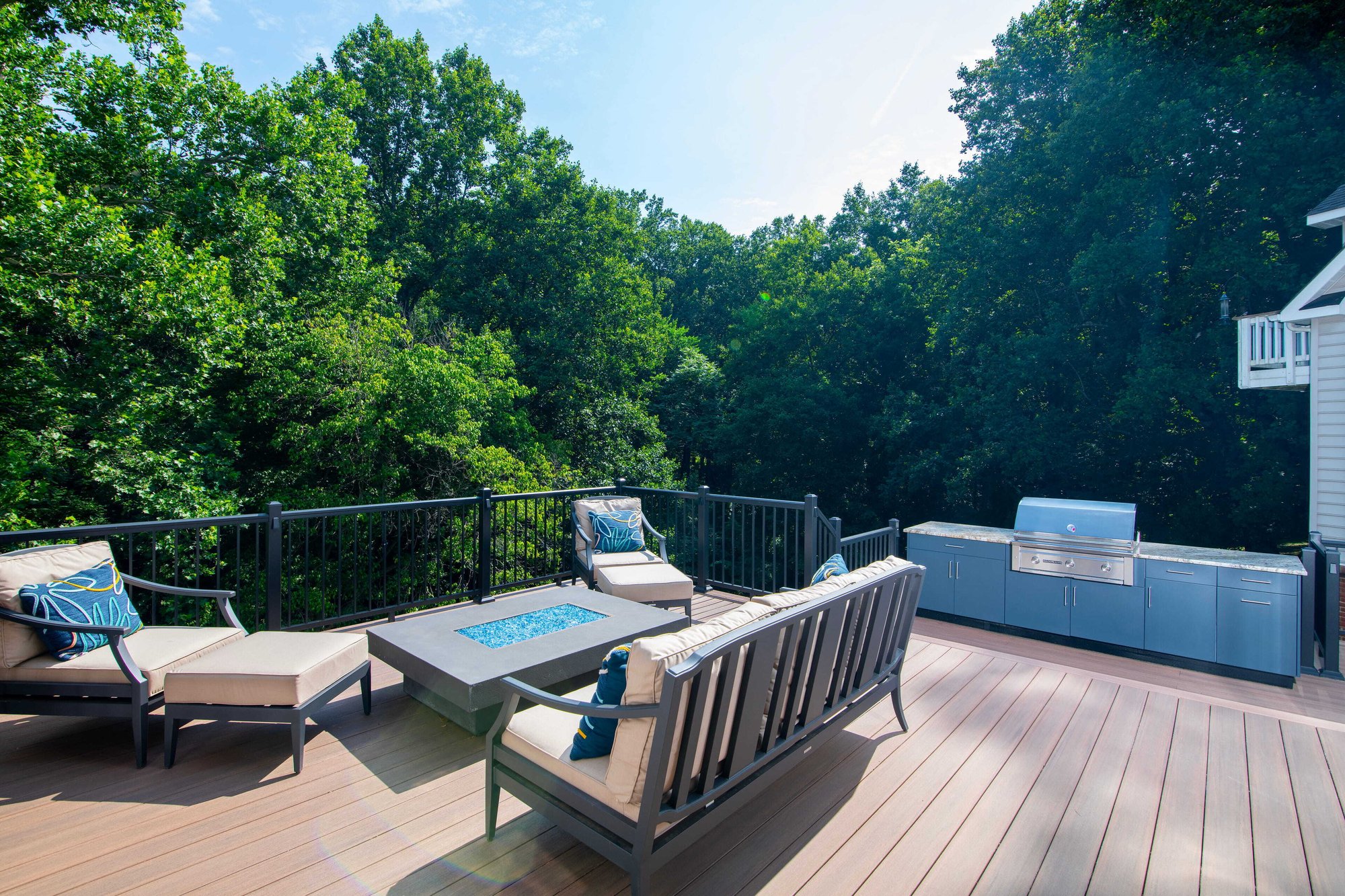
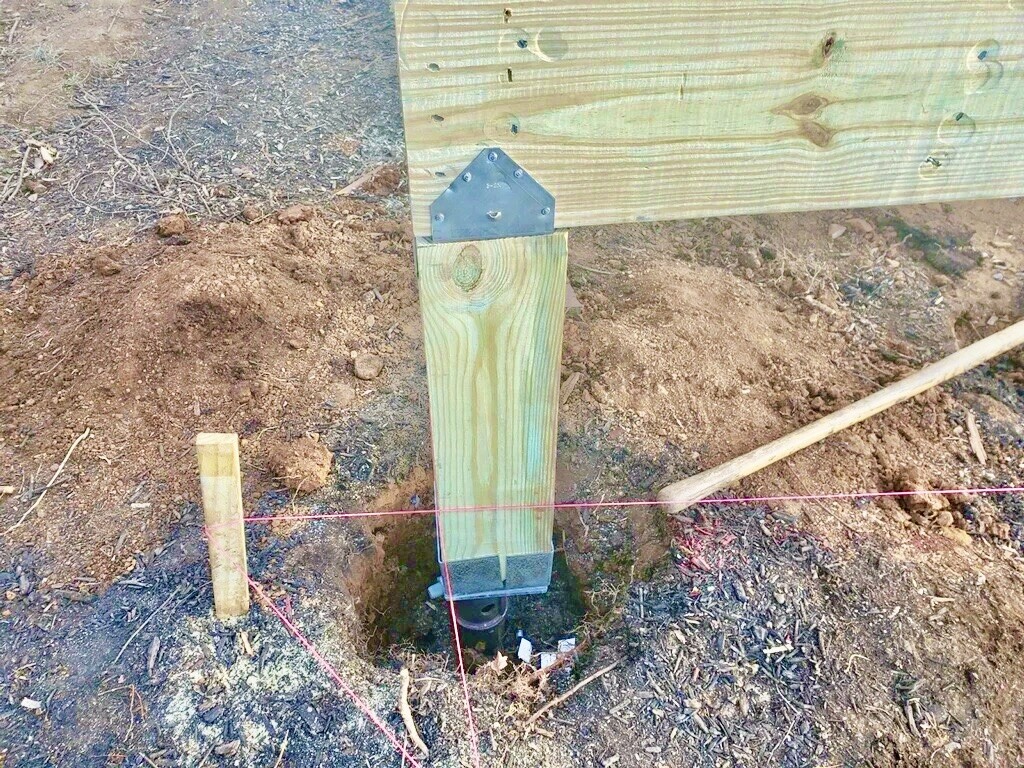
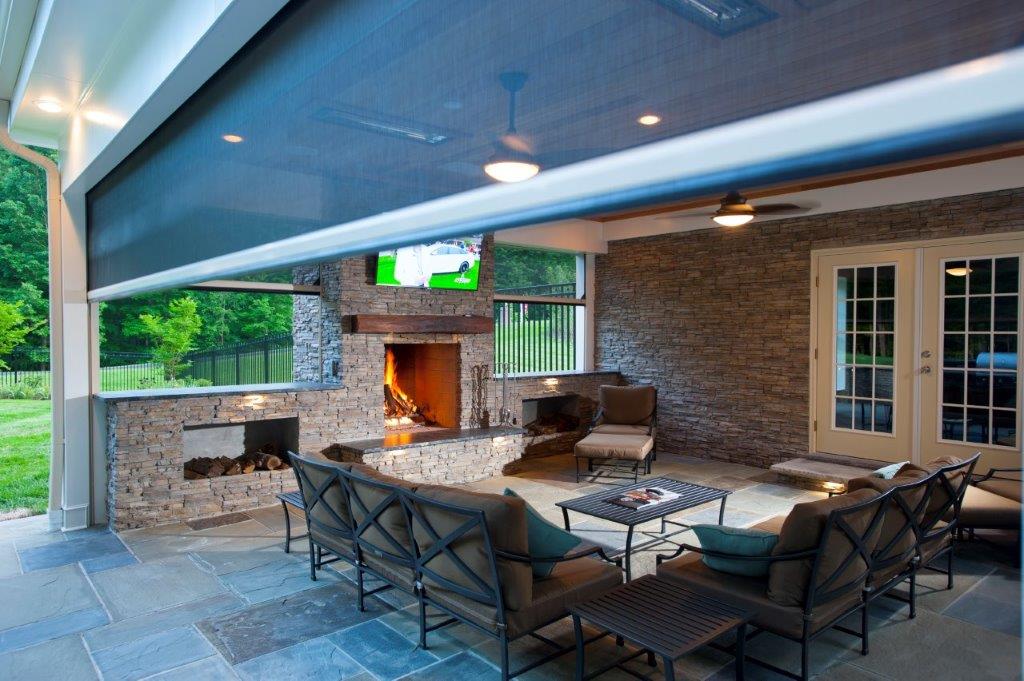
Where We Build — Full Service Area Across Northern Virginia and Maryland
Design Builders designs and builds luxury screened porches, decks, and outdoor living spaces across eight jurisdictions in Northern Virginia and Maryland. In Virginia: Fairfax County, Loudoun County, Arlington County, and the City of Alexandria. In Maryland: Montgomery County, Prince George's County, Howard County, and Anne Arundel County. Every project — regardless of county — is permitted, engineered, and built to the specific requirements of its jurisdiction, with full in-house management of the design, permitting, and construction process from first consultation through final inspection.
Homeowners in Loudoun County bring specific site and permitting considerations: incorporated town zoning approvals in Leesburg, Purcellville, and Hillsboro, LandMARC permit sequencing, and the Loudoun County Typical Deck Detail requirements that apply when a roofed structure is added. Howard County projects in Fulton, Columbia, and Ellicott City reflect the same structural standards and premium material specifications Design Builders applies across every jurisdiction. Anne Arundel County homeowners in Annapolis, Severna Park, Crofton, and Davidsonville often bring waterfront or near-waterfront site conditions — foundation choice, material corrosion resistance, and drainage design all require additional specification attention in those environments.
If you are in any of these counties and wondering whether your specific site, lot condition, or project scope is something Design Builders has handled before — the answer is almost certainly yes. The right next step is a conversation.
Let's Talk About Your Project
At Design Builders, every initial consultation starts with a real conversation — not a sales pitch. Tell us what you want to build, and we'll tell you honestly what it costs, how long it takes, and whether we're the right fit for your home.
Frequently Asked Questions About Luxury Screened Porches in Northern Virginia and Maryland
The questions below are the ones Design Builders hears most often from homeowners across Fairfax, Loudoun, Montgomery, Howard, and Anne Arundel counties — organized by topic so you can find what matters most to your project.
Price Questions
How much does a screened porch cost in Fairfax, Loudoun, or Montgomery County?
Screened porch pricing typically ranges from $55,000 to $250,000+ depending on size, roof complexity, foundation requirements, screening system, and finish selections. Three broad tiers:
Entry-level ($55,000–$85,000): Gable or shed roof, Screeneze screening, composite decking, basic ceiling, standard electrical.
Mid-range ($85,000–$150,000): More complex roof, upgraded ceiling, Infratech heaters, enhanced electrical, possible Sunspace upgrade or motorized screens.
Luxury ($150,000–$250,000+): Full outdoor kitchen, custom fireplace, motorized screens, premium decking, custom ceiling, full lighting package, engineered foundation.
What drives screened porch cost up the most?
In Fairfax, Loudoun, Montgomery, Howard, and Anne Arundel counties, the four variables that move cost most significantly are roof tie-in complexity, foundation requirements, electrical and mechanical scope, and permit path.
A complex roof connection to an existing home — particularly on a Colonial or multi-gable structure — can add meaningful cost before a single finish decision is made. Foundation choice on a sloped or tight-access lot, a full outdoor kitchen, or a motorized screen and Infratech heater package each add to the total in ways that square footage alone doesn't capture. County permit fees and plan preparation costs are real line items that belong in the budget from the first conversation.
Does a screened porch add value to my home?
Yes — consistently and measurably. Industry research places screened porch ROI at 75 to 90 percent of project cost at resale, making it one of the strongest-performing outdoor improvements in the Mid-Atlantic market. In affluent zip codes across Fairfax County, Montgomery County, and Prince George's County, buyers in Great Falls, Potomac, Bethesda, and McLean specifically search for move-in-ready outdoor living spaces and will pay accordingly. A well-built screened porch with premium materials, proper permits, and professional construction doesn't just add resale value — it adds daily use value from the first season.
Is it worth adding an outdoor kitchen or fireplace to a screened porch?
For homeowners who entertain regularly or plan to use the space year-round, yes — with an important caveat. An outdoor kitchen and fireplace add the most value when the fundamental structure is already excellent. A gas fireplace extends the usable season in Fairfax and Montgomery County weather from roughly seven months to ten or eleven. An outdoor kitchen with a Blaze grill, Danver stainless cabinets, and an outdoor refrigerator turns the porch into the primary entertaining hub of the home. Both are genuine value-adds at resale — but they perform best as part of a planned scope, not as afterthoughts added to an undersized or structurally marginal porch.
Permit Questions
Do I need a permit for a screened porch in Fairfax, Loudoun, or Montgomery County?
Yes — in all three counties, a screened porch requires a building permit without exception. In Fairfax County, a screened porch follows the residential addition and alteration review path, with additional review triggered if the site involves a Resource Protection Area, steep grade, or septic and well proximity. In Loudoun County, screened porches are classified as residential additions regardless of size, and homeowners in incorporated towns must obtain town zoning approval before county permit submission. In Montgomery County, any structure that adds a roof or screened enclosure requires engineered drawings because the additional load exceeds what county typical deck details are designed to carry.
How long does the permit process take for a screened porch in Northern Virginia and Maryland?
Permit timelines vary by county and project complexity. In Fairfax County, straightforward residential addition permits typically run four to eight weeks from submission to approval. In Loudoun County, building permits requiring zoning review have been running six to eight weeks from intake as of 2026. Montgomery County timelines depend on whether engineered drawings are required and whether Tree Canopy Law or forest conservation review is triggered — budget eight to twelve weeks for a roofed porch addition on a wooded lot. Design Builders manages the full permit process in-house so homeowners are never navigating the permitting system alone.
Who handles the permit for my screened porch project?
Design Builders manages the complete permitting process for every project — plan preparation, county submission, correspondence with the reviewing agency, and inspection scheduling through to final sign-off. Permit costs, plan preparation fees, and any county-specific review fees are included in your project budget from the first proposal. There are no
Can my HOA block a screened porch that the county has already approved?
Yes — and this is one of the most common sources of project delays in Montgomery County, Fairfax County, and Loudoun County communities with active HOAs. County approval and HOA approval are entirely separate processes. A county building permit confirms that your project meets zoning setbacks, building code, and structural requirements. Your HOA covenants govern aesthetic standards, material restrictions, and design approval — and an HOA can reject a project that the county has fully approved. Design Builders recommends HOA submission and approval before permit application whenever covenant restrictions exist, so that any required design modifications are made once, not twice.
Materials Questions
What is the best decking material for a screened porch in the Mid-Atlantic?
For screened porches in Fairfax, Montgomery, Howard, and Anne Arundel counties, AZEK and Trex Transcend are the two materials Design Builders specifies most consistently. AZEK is a full PVC product with four-sided polymer capping and exceptional moisture resistance — the right choice for porches with high humidity exposure or limited airflow. Trex Transcend Lineage features SunComfortable heat-mitigating technology that keeps surface temperatures meaningfully cooler on full-sun exposures. Both outperform pressure-treated wood and lower-grade composites in the Mid-Atlantic's combination of humid summers, freeze-thaw winters, and heavy pollen seasons.
What is the difference between Screeneze screens and Sunspace WeatherMaster windows?
Screeneze is a fixed fiberglass screening system — the right choice for homeowners whose primary goal is bug and debris protection in a space they use primarily from late spring through early fall. Sunspace WeatherMaster windows are engineered enclosure panels that stack and tilt for ventilation in warm weather and close completely to create a thermal barrier in cold weather — extending the usable season from roughly seven months to ten or eleven months. Homeowners who want to use their porch in March, October, and November should plan for Sunspace from the design stage rather than adding it later.
How much heat do Infratech infrared heaters actually produce in a screened porch?
Infratech infrared heaters produce radiant heat — they warm people and surfaces directly rather than heating the air, which means they perform effectively in a screened porch even when screens are open on one or more sides. A properly specified Infratech system maintains comfortable temperatures down to approximately 25 to 30 degrees Fahrenheit in still air conditions. In a Sunspace-enclosed porch, the same heaters perform even more effectively because the enclosure retains the radiant warmth. Design Builders sizes every Infratech installation to the specific square footage, ceiling height, and enclosure type of the project.
Is Trex or AZEK better for a screened porch floor?
Both are excellent — the right choice depends on your specific conditions. AZEK's full PVC construction makes it the stronger performer in enclosed or semi-enclosed spaces where moisture and limited airflow are concerns. Trex Transcend Lineage's SunComfortable technology makes it the better call on south or west-facing decks and porches with significant sun exposure — surface temperatures run measurably cooler underfoot on hot summer afternoons. Design Builders specifies both products regularly and will make a direct recommendation based on your site orientation, architectural style, and how you plan to use the space.
Helical Pier Questions
What are helical piers and why does Design Builders use them?
Helical piers are deep-foundation steel shafts with helical plates that are mechanically screwed into the ground to support elevated structures. Unlike traditional concrete footings, which displace shallow soil and require excavation and curing time, helical piers anchor below the frost line into stable load-bearing soil — providing immediate structural capacity the same day they are installed. Design Builders uses PierTech helical pier systems with torque-monitored installation on projects where site conditions, lot access, soil quality, or project timeline make conventional concrete footings the inferior choice. In Fairfax County's clay-heavy soils, on sloped lots in Montgomery and Loudoun counties, and on any site where excavation equipment access is genuinely limited, helical piers are not a premium upgrade — they are the correctly engineered solution.
What does torque monitoring mean and why does it matter?
Torque monitoring means that as each helical pier is driven into the ground by a hydraulic torque motor, the resistance the soil exerts on the rotating shaft is measured and recorded in real time. When the torque reading reaches the value specified in the structural engineering drawings, the pier has achieved its required load-bearing capacity — documented on the spot, not estimated after the fact. This is the fundamental difference between helical pier installation and conventional concrete footing construction: with concrete, you pour and wait. With torque-monitored helical piers, load capacity is mathematically confirmed during installation on every single pier — a verifiable engineering record for homeowners and building inspectors in Fairfax, Loudoun, and Montgomery counties.
When are helical piers better than concrete footings for a screened porch?
Helical piers are the better engineering choice in four scenarios that appear regularly across Design Builders' service area. First, on sloped lots where excavation equipment cannot reach footing locations without damaging the existing landscape. Second, on lots with expansive clay soils — common throughout Fairfax and Loudoun counties — where freeze-thaw cycles can heave shallow concrete footings over time. Third, on projects with tight construction timelines where a three-to-five day concrete curing window would delay the structural build phase. Fourth, on any site where soil disturbance needs to be minimized — whether for landscaping preservation, proximity to a well or septic system, or Resource Protection Area compliance in Fairfax County.
Do helical piers cost more than concrete footings?
The installed cost of helical piers is typically higher than basic concrete footings on a straightforward flat lot — but that comparison rarely applies to the lots where helical piers are actually specified. On sloped, constrained, or clay-heavy sites, the true cost comparison includes excavation equipment mobilization, soil removal and disposal, landscaping repair, and additional project days for curing — costs that often close or eliminate the price gap entirely. On sites where conventional footings would require a separate footing inspection before framing can begin, helical piers can eliminate that inspection delay entirely. Design Builders presents foundation options and their full cost implications transparently during the design phase so homeowners can make an informed decision.
Let's Talk About Your Project
At Design Builders, every initial consultation starts with a real conversation — not a sales pitch. Tell us what you want to build, and we'll tell you honestly what it costs, how long it takes, and whether we're the right fit for your home.
Next Steps — Start Your Screened Porch Project
in Northern Virginia or Maryland
Here's the honest truth: at this point in the process, more reading isn't what moves your project forward. A conversation is.
Not a sales call. Not a pitch. Just a straight talk with someone who has built screened porches on lots exactly like yours — navigated the same permit offices, solved the same slope problems, made the same foundation calls. Someone who will tell you what your project actually costs, what could complicate it, and what the realistic timeline looks like. And if for some reason we're not the right fit, we'll tell you that too.
This is a significant investment. You deserve more than a contractor who takes your deposit and disappears into a production queue. Every Design Builders project has a single point of contact from the first conversation through the day we hand you the finished space — someone who knows your lot, knows your county, and knows your project by name. Not by number.
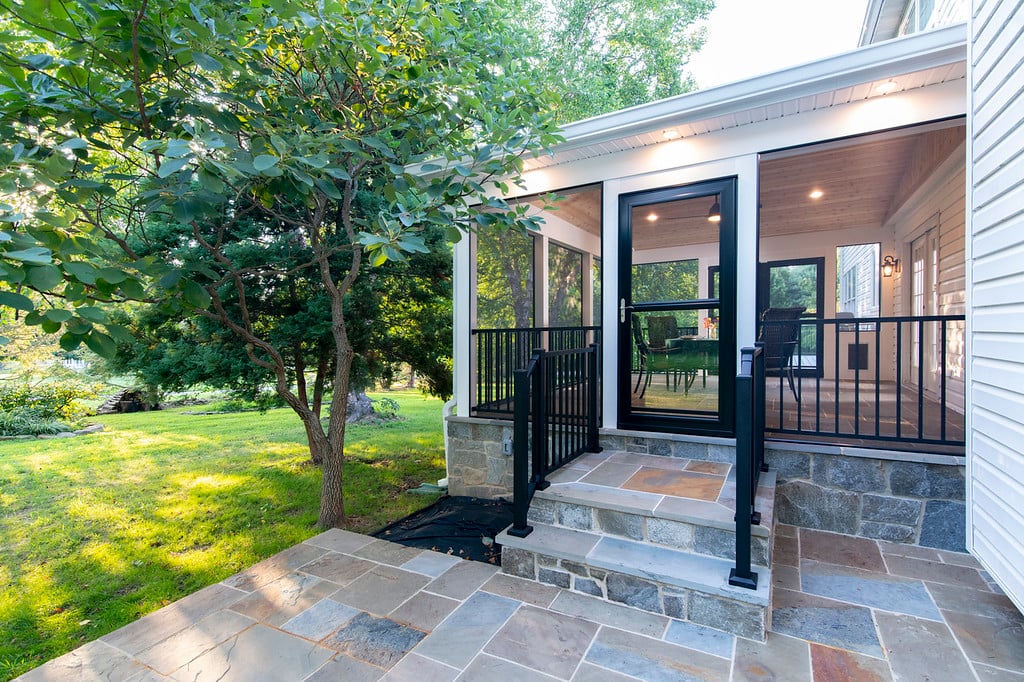
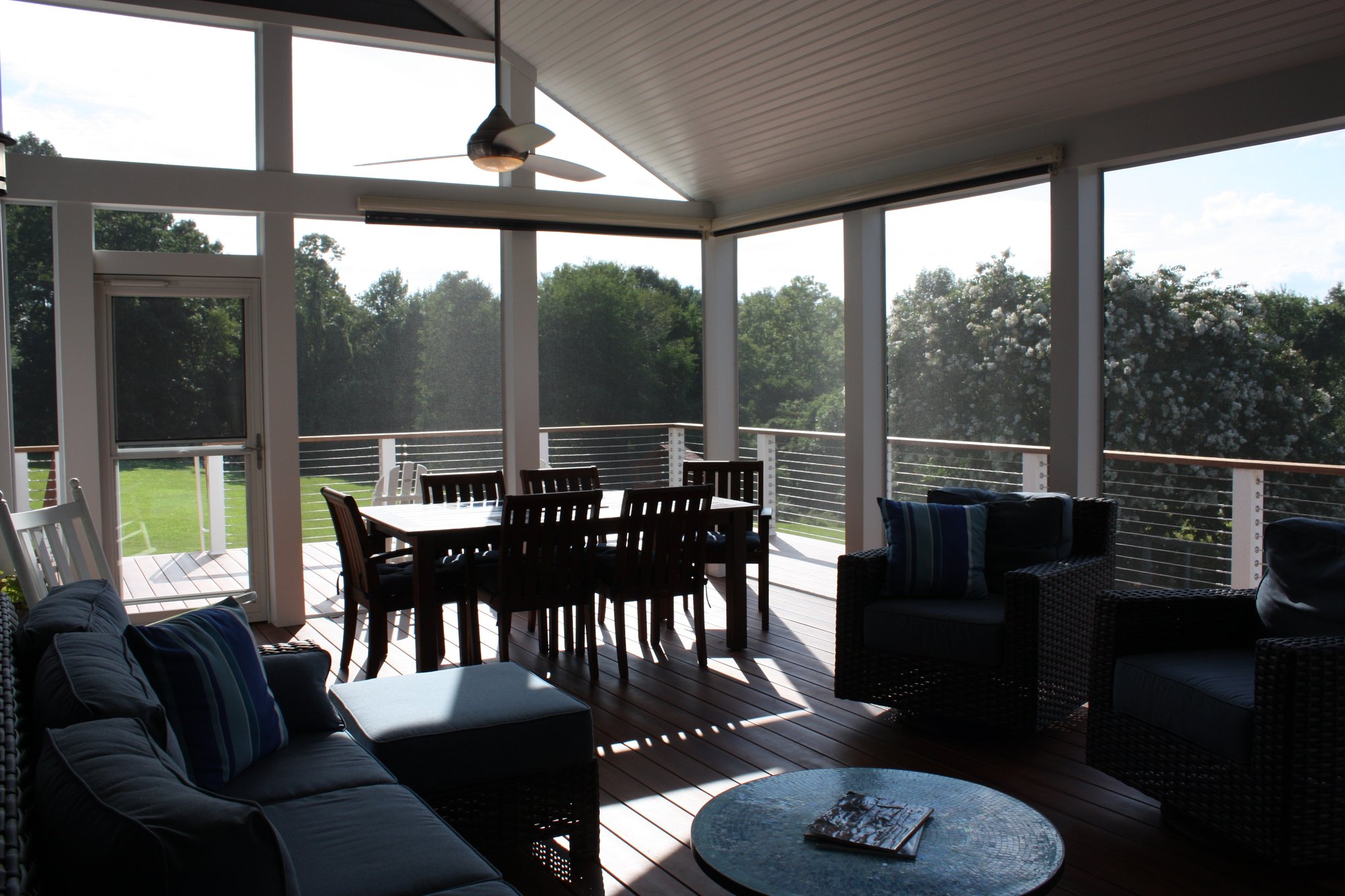
Let's Talk About Your Project
The first conversation costs you nothing and commits you to nothing. We start every project with an online design consultation via Zoom — and our clients don't just tolerate it, they rave about it. Before the call, you send us eight to ten photos of your space from different angles, a copy of your plat or property map, and your address and phone number. We review your photos, study your site, and come to the call prepared with visuals, ideas, and a ballpark estimate already in hand. When we meet on Zoom, we're walking through your actual space together, on screen, in real time — and having a real conversation from minute one.
Everyone who needs to be in the conversation can join from anywhere. No rushing home, no coordinating schedules around a site visit, no waiting weeks for an opening that works for everyone.
One client put it simply: "That was the most efficient and helpful first meeting we've ever had."
That said — some of you prefer the old school approach, and we completely respect that. If you'd rather we come to you first, walk the property together, and look each other in the eye before anything else happens, just ask. Great projects start with great communication, and we'll meet you however works best for you.
Book your free design consultation →
Or reach us directly at (301) 875-2781 or info@designbuildersmd.com. We respond to every inquiry within one business day.
Use the Pricing Estimator
Not ready to book a consultation yet? Start with the pricing estimator to get a realistic sense of what your project might cost based on size, county, foundation type, and feature selections. The estimator uses real project data from completed builds across Northern Virginia and Maryland — not national averages or contractor guesses.
See More Projects in Your County
Every county in our service area has its own permitting environment, its own common site challenges, and its own architectural context. The full Design Builders portfolio includes completed projects across Fairfax, Loudoun, Montgomery, Prince George's, Howard, and Anne Arundel counties — organized by project type, feature, and location.
Download the Planning Checklist
Not sure where to start? The Screened Porch Planning Checklist walks you through every decision point — from site conditions and county permitting to material selections and budget planning. Download it free and use it to organize your thinking before your first consultation.

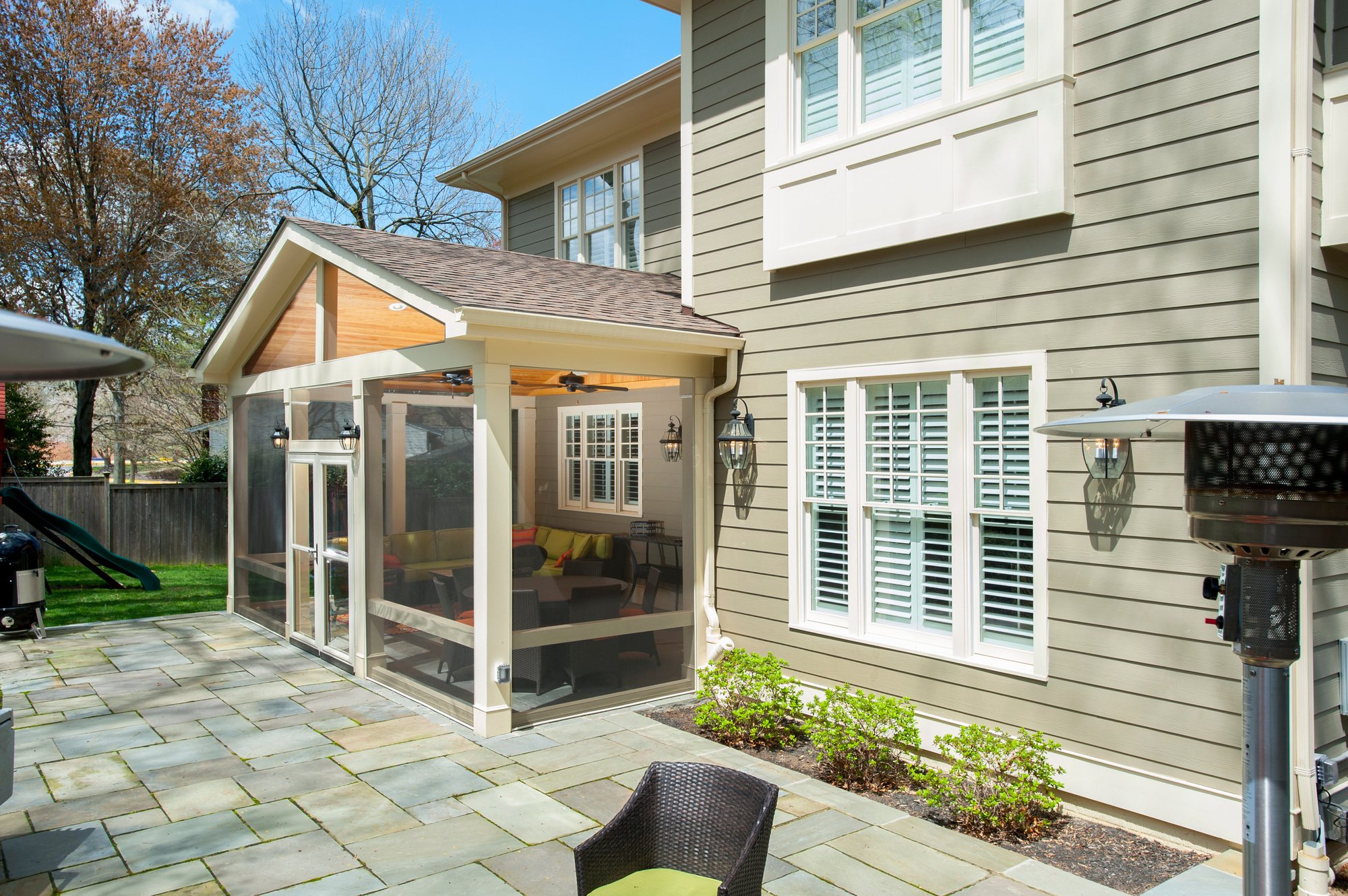
.jpg "Clifton Va patio")
Why Homeowners in Northern Virginia and Maryland Choose Design Builders
There are a lot of contractors who will build a screened porch. There are far fewer who will navigate Fairfax County's RPA setback requirements, specify a helical pier foundation on a sloped Darnestown lot, manage a Montgomery County permit through engineered drawing review, and deliver a finished project that looks exactly like what was designed — on schedule and without budget surprises.
Design Builders has been building luxury outdoor living spaces across Northern Virginia and Maryland since 2006. In twenty years of work across Fairfax, Loudoun, Montgomery, Prince George's, Howard, and Anne Arundel counties, we have built a reputation on three things: technical precision below grade, premium material specification above grade, and a design-build process that treats every homeowner as an intelligent decision-maker who deserves straight answers.
We are not the right contractor for every project. We are the right contractor for homeowners who want it done correctly — permitted, engineered, built to last, and designed around how they actually plan to live in the space.
If that describes you, the next step is a conversation.
Frequently Asked Questions About Getting Started
How long does a screened porch project take from consultation to completion?
A typical project runs twelve to twenty weeks from signed contract to final inspection — depending on county permit timeline, project complexity, and material lead times. Loudoun County is currently running six to eight weeks on residential addition permits. Fairfax County runs four to eight weeks. Montgomery County engineered drawing reviews can run eight to twelve weeks on roofed porch additions. Design Builders builds permit timeline estimates into every project schedule from the proposal stage — so you know what to expect before the project begins, not after it stalls.
What happens at the first design consultation?
The first consultation is a conversation and a site review — not a sales presentation. We review the photos you've sent ahead of time, walk through your vision together on the Zoom call, discuss county permitting requirements specific to your lot, and talk through material options and budget ranges. You leave the consultation with a realistic picture of what your project will cost, how long it will take, and what the permit process looks like for your specific county and site. There is no obligation and no pressure to proceed — the goal is to give you the information you need to make a good decision.
Do you handle everything — design, permits, and construction?
Yes. Design Builders is a full-service design-build firm. We manage every phase of your project in-house — initial design, structural engineering coordination, permit preparation and submission, county correspondence, construction, and final inspection. You have a single point of contact from the first consultation through the day we hand you the finished space. The team that designs your project is the team that builds it.
What areas do you serve?
Design Builders serves homeowners across eight jurisdictions in Northern Virginia and Maryland. In Virginia: Fairfax County, Loudoun County, Arlington County, and the City of Alexandria. In Maryland: Montgomery County, Prince George's County, Howard County, and Anne Arundel County. If you are unsure whether your specific location falls within our service area, call us at (301) 875-2781 or email info@designbuildersmd.com and we will confirm within one business day.
Let's Talk About Your Project
At Design Builders, every initial consultation starts with a real conversation — not a sales pitch. Tell us what you want to build, and we'll tell you honestly what it costs, how long it takes, and whether we're the right fit for your home.