
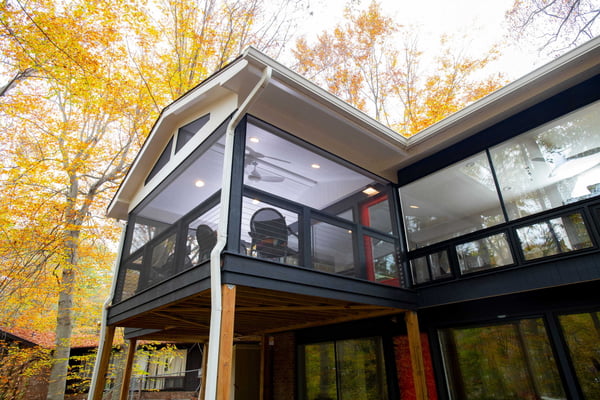
If you’re planning a deck, screened porch, or outdoor kitchen in Montgomery County, the permit process is usually the first “invisible” schedule driver homeowners run into. Materials lead times come and go—but permits and inspections are the gate that decides when construction can legally start.

Direct Answer: How long does a Montgomery County permit take in 2026?
For many deck and patio-related permits in Montgomery County, a realistic planning range is 30–45 days from a clean, complete submission to approval—sometimes faster for straightforward scopes, sometimes longer when zoning questions, site constraints, or revisions are involved. The quickest approvals come from permit-ready plans, accurate plats, and early zoning verification—not from skipping the process.
Montgomery County Permit Timeline for Decks & Patios: Plan on 30–45 Days
Searchers usually aren’t asking, “What is a permit?” They’re asking, “How long will this slow my project down?”
Here’s the practical reality in 2026:
What speeds things up
- A contractor who confirms zoning/setbacks before drawing final plans
- A complete plan set (structural details, elevations/sections as needed)
- Correct property plat marked to scale
- Prompt responses to revision requests (if any)
What slows things down
- Designs that push close to setbacks, easements, or building restriction lines
- Incomplete drawings or missing details (common with “hand sketch” contractors)
- Septic/well considerations or site constraints that trigger additional review steps
- Last-minute scope adds (roof, electrical, outdoor kitchen utilities)
Bottom line: If you want a smooth permit, treat it like a project phase—not a formality.
Who Pulls the Permit: Homeowner vs. Contractor (You Can Choose)
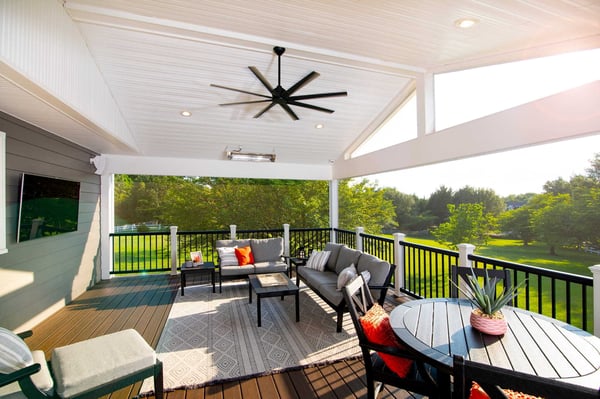
Each of our customers has the option to pull their own permit to save some money. However, most of our clients are happy to hand over the permitting issues to us for a nominal permit-running fee. We obtain the necessary paperwork to build your deck, screen porch, or addition—you just sit back and wait for us to clear the red tape.
That’s not a sales line—it’s a friction reducer. Most homeowners don’t want to take off work, manage submission portals, or coordinate revisions and inspection scheduling. They want the outdoor room.
Why a Building Permit Exists (Even on “Your Own Property”)
It’s easy to wonder why the county cares what you do on your own home. Here’s what the permit process is designed to protect:
- Life safety (stairs, guards, structural loads, electrical)
- Water management at the house connection (ledger/flashing details)
- Zoning compliance (setbacks, lot coverage, easements)
- Documentation that helps with resale, insurance, and future renovations
In other words: it’s not just paperwork. It’s enforcement of minimum construction standards.
What You Typically Need for a Montgomery County Permit Submission
You may ask what the purpose of a building permit is anyway, since you’re doing construction on your own property. Well, in Montgomery County, there are a few items that you need to have (and these are the ones homeowners most commonly run into during deck/porch projects):
- A signed Tree Affidavit stating that roadside trees within seven feet of the road will not be removed during construction
- A Homeowner Affidavit allowing the contractor to pull the building permit as your proxy
- Two copies of the property plat with the proposed construction site marked to scale
- Two copies of the building plans
That’s the “headline” list. But it’s rarely the entire experience.
 DesignBuilders link to project
The Real Montgomery County Permit Workflow (What Happens After You Have the Paperwork)
If you’re going about this process on your own, there are several more hoops you’ll need to jump through before your permit process is complete.
A typical sequence looks like this:
1) Administration intake
You sign in, submit required documents, and the application is logged.
2) Zoning review
This confirms your project sits within required building restriction lines and complies with zoning rules (setbacks, lot coverage, easements).
3) Septic-related review (if applicable)
If you’re on a septic system, a separate check is often required to confirm you’re not impacting protected areas.
4) Plan review (structural)
A plan review technician evaluates your drawings for structural and code compliance—especially critical for elevated decks and roofed structures like screened porches.
5) Fees + issuance
Once approved, you pay and receive the permit, then post it at the residence.
6) Posting requirements (and sign inspection for roofed work)
After you post your permit, additional signage may be required for roofed projects—and in some scenarios a sign inspection is scheduled to confirm everything is posted properly.
The homeowner question to ask yourself: Do you have time (and patience) for all of this? If not, that’s exactly why many clients hand it off.
Design Builders link to project
Permit Denials and Delays: The Two Biggest Causes
When a permit gets stalled, it’s usually one of these:
1) Zoning conflicts
Example: your proposed structure crosses a setback line, infringes on an easement, or pushes lot coverage beyond what’s allowed. This typically triggers redesign.
2) Plan issues
If the plans aren’t drawn up correctly or are missing details, the county can request additions/modifications. The good news: you can usually fix and resubmit. The bad news: it adds time.
This is why “permit-ready drawings” matter. Clean plans don’t just look professional—they reduce review cycles.
Comparison Table: Montgomery County vs. Fairfax County vs. Arlington (2026 Homeowner Snapshot)
A lot of DMV homeowners compare across borders—especially if you’ve lived in both Maryland and Virginia, or you’re getting advice from a friend in another county. Here’s a high-level comparison to help you understand why one person’s experience may not match yours.
Important: requirements vary by address, scope, and whether you’re inside incorporated town limits or subject to HOA rules. Use this table as a planning guide, not a legal checklist.
| Item | Montgomery County, MD | Fairfax County, VA | Arlington County, VA |
|---|---|---|---|
| Typical approvals required | Building permit + zoning confirmation | Building permit + zoning confirmation | Building permit + zoning confirmation |
| Common “gotchas” | Zoning/building restriction lines; tree-related documentation; septic checks in some neighborhoods | Process-driven plan review; strict inspection sequencing | Urban constraints: tight setbacks, access, and higher scrutiny on visibility/placement |
| When scope gets more complex | Roofed porches, structural changes, utilities for outdoor kitchens | Roofed porches, tall decks, electrical upgrades | Roofed porches, prominent visibility, tight lots |
| Homeowner time burden if DIY | Moderate–high (multiple steps, posting requirements) | Moderate (structured process, revision cycles if details missing) | High (tight constraints and documentation expectations) |
| Best strategy | Verify zoning early + submit clean plans | Submit complete plans + plan inspections early | Pre-check constraints early + prioritize documentation |
2026 Permit Checklist (Copy/Paste to Make Your PDF)
DMV Deck / Screened Porch / Outdoor Kitchen Permit Prep Checklist
Property + Site
- ☐ Property plat on hand (latest version if possible)
- ☐ Project footprint marked to scale
- ☐ Setbacks and easements checked before final design
- ☐ Septic/well status confirmed (if applicable)
Montgomery County Common Documents
- ☐ Tree Affidavit completed (roadside tree requirement)
- ☐ Homeowner Affidavit (contractor-as-proxy, if contractor is pulling permit)
- ☐ Two copies of property plat marked to scale
- ☐ Two copies of building plans
Plan Set Quality (what reduces revisions)
- ☐ Foundation/footing plan (sizes + locations)
- ☐ Framing plan (joists, beams, posts)
- ☐ Connections detailed (ledger/flashing or freestanding)
- ☐ Elevations/wall sections where needed (especially roofed porches)
- ☐ Stairs/guards/handrails shown with dimensions
- ☐ Electrical shown if adding outlets, lighting, fans, or heaters
- ☐ Outdoor kitchen utilities shown if applicable (gas/electric/water)
Inspections + Posting
- ☐ Permit posting plan (where it will be visible)
- ☐ Sign posting requirements understood for roofed structures
- ☐ Inspection stages identified (footing, framing, final, plus electrical if needed)
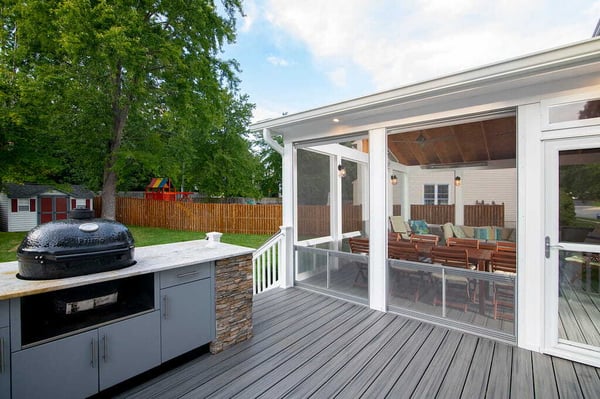 Design Builders link to project
“Permit Handling” as Part of a Design Builders Project Workflow
Permits shouldn’t feel like a separate project you manage on top of your build. In our design-build process, permitting is integrated into the timeline so it doesn’t become the surprise delay.
A typical workflow looks like:
- Site + zoning verification before finalizing the footprint
- Permit-ready drawings produced for your specific scope (deck vs. screened porch vs. outdoor kitchen)
- Submission + revision handling (if requested)
- Permit issuance + posting requirements coordinated
- Inspections scheduled and managed during construction
Design Builders specializes in screen porches, composite decks, outdoor kitchens, and structural upgrades across the DMV, including Montgomery County. Call us today at 301-875-2781, or use our form links on this page. We would love to hear from you!