
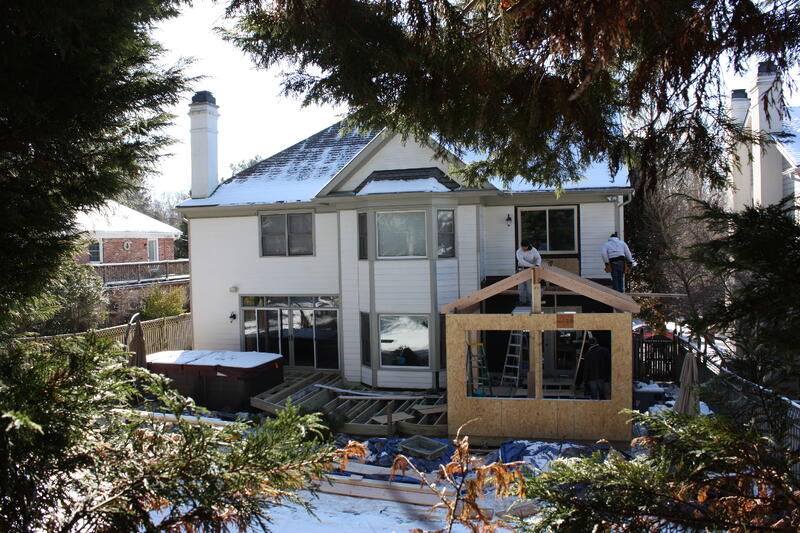
How to Frame a Cathedral Ceiling for Screen Room Addition Maryland
Framing a cathedral ceiling for a screen room addition requires installing rafters at an angle that follows the roof line, creating an open, vaulted interior space without a flat ceiling. This architectural approach maximizes vertical space and creates an airy feel in your screened porch. Montgomery County MD and Fairfax County VA homeowners choose cathedral ceilings to enhance their outdoor living experience with dramatic height and improved natural light flow.
- The first step is framing the walls, which can be common framed with 2' x 4' or 2' x 6' studs, though the latter are more common with modern regulations. 2' x 4' studs are still allowable, but a much more expense type of insulation must be used - closed cell spray foam insulation - as opposed to the traditional fiberglass roll-in insulation in order to meet building codes.
A post and beam system is another common way to frame walls, specifically for a screen room. This uses 4' x 4' or 6' x 6' posts that is attached to the deck and a carry beam above, which is typically a double 2' x 10' or a triple 2' x 8' piece of material.
Portal framing is another method to frame. It is used when there are large openings, such as in sun rooms. With portal framing, a LVL (laminated veneer lumber) beam is built around the perimeter of the room and connected to columns with hardware. - The girder beam can be installed once the walls are in place. This is a large, very strong beam that spans an entire room. One is required when an addition is connected to a house without a wall constructed in the house side.
- Time to install the ridge, which will sit on ridge posts consisting of two 2' x 4's or a 4' x 4' piece of material (note: if there is a window or an opening directly beneath the ridge beam, then a post cannot be used). A header is needed bypass window openings to transfer the load from the ridge down to the wall.
- Rafters are installed after the ridge, ridge posts, and, when applicable, headers. They are cut according to the slope or pitch of the roof being created and are generally 2' by 8' or 2' by 10' in width and length, though the latter makes it easier to incorporate recessed lights and larger spans into a roof's design. A utility hanger is used to unite the rafters with the ridge beam, while hurricane ties mate the rafters with the room's walls.
Additional hardware, namely a 2" by 24" piece of metal called a rafter strap, is installed atop the rafters when a cathedral ceiling is being built without collar ties. Rafter straps straddle the ridge beam such that 12" of the straps are on top of each rafter on both sides of the ridge. This enables the characteristic openness of a true cathedral ceiling to be possible. Collar ties are pieces of wood, typically a 2x6 or 2x8, that are installed beneath the ridge between two rafters spanning the room. They have to be installed in the lower 1/3 of the rafter rise. - The rake is the next component to be installed. This is the overhang secured to the front of the gable and should match the overhang created by the rafter tails. It requires a small 8" to 12" wall to be framed and installed as well to compensate for the lack of an initial overhang.
- Gutter boards are put in place following the rake. These are pieces of framing material that are installed on the ends of the rafter tails. While the rafters create an overhang by extending over the walls, the gutter board is in turn attached to the end of the rafters so that the gutters and trim can ultimately be installed. It also strengthens the roof by connecting the rake to the rafter tails.
- The final major step is sheating the roof with, in most cases, 5/8" OSB plywood. This is always started on the outside of the rake and then worked in. The plywood is nailed to the rafters and then connected with 'H' clips in between the joists to secure it in place.
The process deviates wildly from here depending on the materials, design, and stylistic circumstances of a roof build. Still, following these practices is a safe bet for framing a cathedral ceiling for a screen room addition.