
Design Builders, a Virginia Class A licensed contractor (license #2705141736) building decks and screened porches since 2006, uses helical pier foundations to build near mature trees in Fairfax County, VA and Montgomery County, MD with far less soil disturbance than conventional dug footings. A mature shade tree is often the reason a homeowner wants a deck in that exact spot, and it is also the biggest obstacle to building one. The foundation method, the framing layout, and the site plan together determine whether a tree survives construction or declines in the years that follow.

Why Tree Roots Are So Easy to Damage
Most homeowners picture tree roots as deep taproots. In reality, most of a tree's roots grow in the top 12 to 18 inches of soil, spreading well beyond the trunk. That shallow root system is what makes construction near trees risky: digging, trenching, soil compaction, and grade changes all happen in the same layer where roots absorb water and nutrients.
Arborists commonly define a tree's critical root zone as a circle with a radius of one foot for every inch of trunk diameter, measured 4.5 feet above the ground. A tree with a 24-inch trunk has a critical root zone extending roughly 24 feet from its base. For important trees and sensitive species such as oaks, a larger radius of 1.5 feet per inch of trunk diameter is often recommended.
Root damage is also slow to reveal itself. Signs of decline may not appear for years after construction, long after the deck is finished and the crew is gone.
How Conventional Footings Affect Roots
Traditional deck footings are built by digging holes, often with an auger or excavator, and filling them with concrete. Each hole can sever roots in its path. The work also brings concrete delivery, spoil piles from excavated soil, and repeated equipment traffic, all of which compact soil around the tree. Compacted soil holds less air and water, which stresses roots even where none were cut.
When a deck sits within a tree's critical root zone, a footing plan that looks reasonable on paper can remove a meaningful portion of the roots that keep the tree healthy and stable.
How Helical Piers Reduce Disturbance
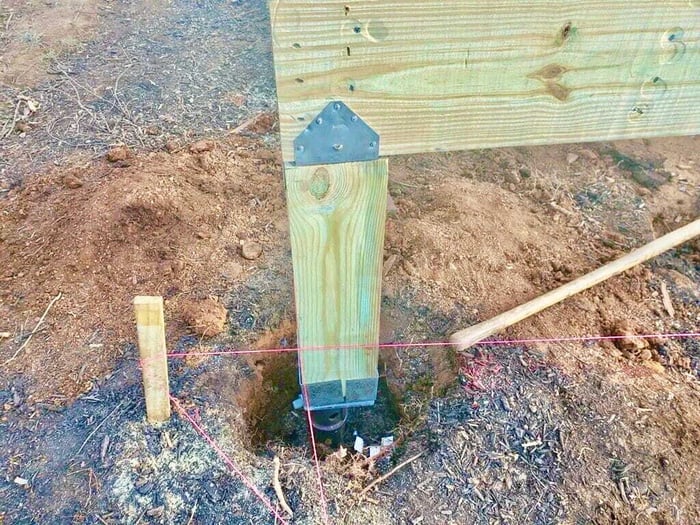
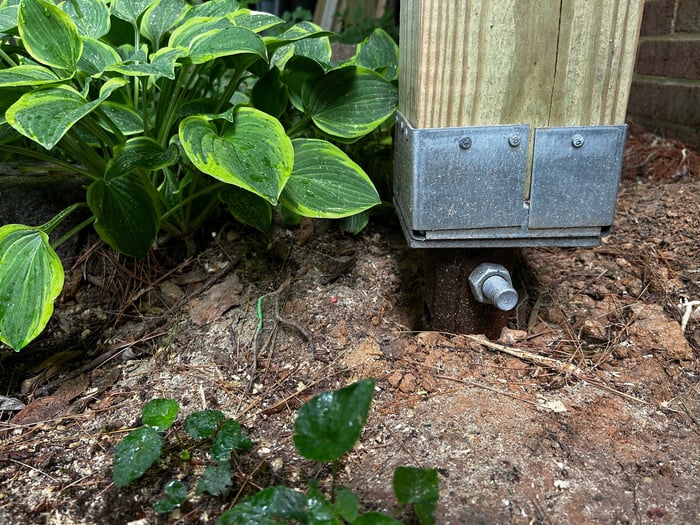
A helical pier is a galvanized steel shaft with helix-shaped plates near the bottom, turned into the ground like a large screw. Installation does not require digging a hole, pouring concrete, or hauling away soil. Industry sources describe helical piers as quick to install and minimally disruptive to the site.
That difference matters near trees in several ways:
- No excavation: The shaft displaces a small amount of soil as it turns, rather than removing a large volume around each footing.
- No spoil piles or concrete trucks: Less material and equipment on site means less compaction across the root zone.
- Adjustable placement: When a pier location conflicts with a significant root, the position can often be shifted slightly during layout to avoid it.
- Immediate load capacity: Helical piers can carry load as soon as they are installed, with no concrete cure time, which shortens the time crews and equipment spend on the site.
Helical piers are not a license to ignore the tree. Installation equipment still needs an access route, and that route should be planned to avoid driving repeatedly across the critical root zone. The goal is to combine a low-impact foundation with a site plan built around the tree.
Design Builders installs helical pier foundations for decks, screened porches, and other outdoor structures. More background on the system is available in Helical Piers 101, and helical piers also allow construction to continue when frozen ground would stop concrete footings.
Framing Strategies That Keep Piers Out of the Root Zone
The foundation is only part of the solution. Framing decisions determine how many piers are needed and where they land.
Longer Spans
Beams that span farther between supports reduce the number of piers required and allow them to be placed outside the most sensitive part of the root zone. Fortress steel framing can support longer spans than typical wood framing, which makes it a useful tool when pier locations are constrained.
Cantilevers
Extending joists or beams past the last support allows a deck to reach toward a tree without placing a foundation in its root zone.
Building Around the Trunk
When a deck surrounds a tree, the framing should leave generous clearance around the trunk for growth and movement in the wind. No part of the structure should ever be attached to the tree itself.
Keeping the Ground Beneath Intact
An elevated deck preserves the existing grade, allowing rain to reach the soil and air to circulate. Adding fill soil or a gravel base over roots can be as harmful as cutting them, so the area beneath the deck should be left as close to its natural condition as possible.
Screened Porches and Covered Structures Near Trees
Screened porches and covered decks add roof loads and posts, which can increase the number of foundation points. They also introduce overhead considerations: branches above a roof drop leaves and debris into gutters, and large limbs over a structure should be evaluated for health and clearance before construction begins.
Working With an Arborist
For any project near a valuable tree, a certified arborist should be part of the planning. An arborist can identify species, measure trunk diameter, map the critical root zone, recommend tree protection fencing, and advise on any roots that must be pruned. Roots that cannot be avoided should be cut cleanly rather than torn by equipment. Local tree protection rules and homeowners association covenants may also apply and should be confirmed during design.
Projects such as this low-maintenance AZEK deck in Gaithersburg, Maryland show the kind of finished outdoor space a well-planned foundation supports.
Schedule a Design Consultation
Design Builders designs and builds decks and screened porches on helical pier foundations throughout Fairfax County, VA and Montgomery County, MD, as well as in Arlington, VA and Alexandria, VA. Schedule a consultation with Design Builders to plan a deck that works with the trees on the property instead of against them.