
Design Builders, a Virginia Class A licensed contractor (license #2705141736) operating since 2006, builds decks in Fairfax County, Virginia and Montgomery County, Maryland through every month of the year — including the months most contractors treat as a dead zone. Winter construction has a reputation problem in this region, and it's mostly deserved: it's a reputation earned by companies still pouring concrete footings the traditional way.

What winter actually does to the ground here
Fairfax County and Montgomery County sit in a climate band where the frost line typically runs 18 to 30 inches deep, depending on soil composition and the severity of a given winter. Montgomery County's own building code requires footings to reach a minimum depth specifically to get below that line. Howard County and Prince George's County, the secondary markets Design Builders serves, see similar frost patterns.
That frost line is the whole problem for a traditional deck build. A standard footing requires digging a hole below the frost line and pouring concrete into it. Two things go wrong with that plan between December and February:
- The ground hardens. Once the top 12–24 inches of soil freezes, it behaves less like dirt and more like packed asphalt. Digging by hand becomes impractical, and even mechanical augers slow down significantly or need to break through frozen crust first.
- Concrete doesn't cure properly in freezing temperatures. Poured concrete needs sustained temperatures above freezing to hydrate and cure correctly. Pour it into cold, wet ground during a Fairfax County or Montgomery County winter and it risks weak, compromised footings — the kind that shift or crack years down the road.
Layer in this region's winter precipitation — periodic snow, freezing rain, and the freeze-thaw cycles that are common in the Mid-Atlantic — and a hole dug in December can be a mud pit by January, then frozen solid again by February. Most contractors respond by simply not scheduling structural work in these months.
Why Design Builders doesn't have that problem
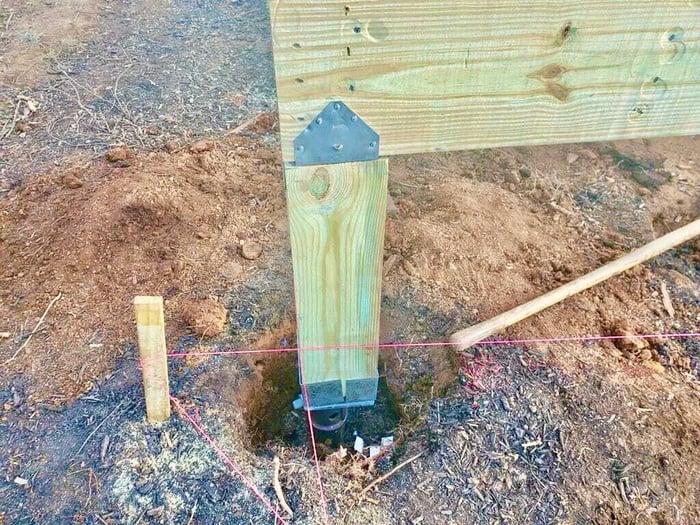
Most contractors in this region still dig traditional footers — a hole excavated below the frost line, then filled with poured concrete. Unlike those companies, Design Builders uses helical pier foundations for deck, screened porch, and outdoor kitchen projects, and is an expert installer of the system, having installed thousands of helical piers across Fairfax County and Montgomery County. It's a completely different installation method, and it's the reason winter isn't a dead season here the way it is for contractors still tied to dig-and-pour footings. A helical pier is a steel shaft with helical blades that gets torqued directly into the ground, similar to driving a large screw, until it reaches stable load-bearing soil. There's no hole to excavate and no concrete to pour or cure.
That distinction matters most in winter:
- No excavation, no fight with frozen topsoil. The pier is driven through the frozen layer rather than dug around it.
- No concrete curing window. Because nothing is poured, there's no waiting on weather-dependent curing chemistry. Installation can proceed in temperatures that would shut down a traditional footing crew.
- Installation measured in hours, not days. A helical pier foundation typically goes in far faster than a dig-and-pour footing, which keeps a winter project schedule from sliding into spring.
- Deeper, more stable load-bearing capacity. Helical piers reach stable soil below the zone where seasonal freeze-thaw movement causes shifting — the same movement that causes traditional footings to heave over time.
What this means if you're planning a deck for spring
Homeowners in McLean, Vienna, and Great Falls in Fairfax County, and in Bethesda, Potomac, and Rockville in Montgomery County, often assume a winter start is off the table and push their project to a spring booking — which is exactly when every other contractor in the region is also trying to schedule. Building through winter with a helical pier foundation means a deck can be framed and largely complete before the spring rush even starts, without gambling on footing quality in cold, wet soil.
Design Builders is rated 4.9 on GuildQuality, 4.6 on Houzz, and 4.4 on Google — verified marks from homeowners across these same winter and spring builds.
Frequently Asked Questions
Can decks really be built in winter in the Washington DC area? Yes, when the foundation method doesn't depend on excavation or poured concrete. Helical pier foundations are installed year-round, including in freezing conditions, because they don't require curing time or digging below the frost line.
Does cold weather affect the quality of a helical pier foundation? No. Because the pier is mechanically driven to a measured torque and depth rather than poured, its structural performance isn't dependent on ambient temperature the way concrete curing is.
Is a helical pier foundation more expensive than a standard footing? Cost varies by site conditions and project scope. For homeowners weighing a winter start, the relevant comparison is usually total project timeline — a winter build with helical piers can finish before a spring-only competitor has broken ground.
Are helical piers used for screened porches and outdoor kitchens too, or just decks? Design Builders installs helical pier foundations for decks, screened porches, pergolas, and outdoor kitchens throughout Fairfax County VA and Montgomery County MD.