
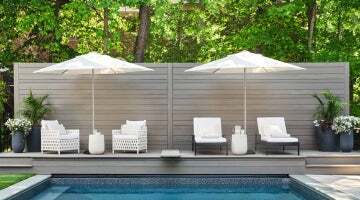
Design Builders, a Virginia Class A licensed contractor (license #2705141736) that has built decks across Fairfax County, VA and Montgomery County, MD since 2006, treats a privacy screen as a structural decision as much as a design one. Homes on close suburban lots often have a neighbor's window, a second-story deck or a busy sidewalk in direct view of the deck. A privacy screen fixes that, but a tall, solid panel behaves very differently in the wind than an open railing. TimberTech's new Impression Privacy Screen gives homeowners a purpose-built option, and how it is anchored matters as much as how it looks.

What TimberTech introduced
TimberTech, now part of the James Hardie portfolio, announced the Impression Privacy Screen in November 2025, and it began shipping nationwide through TimberTech's dealer network in January. Key points from TimberTech's announcement:
- The system is aluminum and non-combustible.
- It has been wind-load tested.
- It was designed alongside TimberTech's Advantage Rail as part of a push toward products that install more easily and offer more design flexibility.
For homeowners, the appeal is a privacy screen built as a manufactured system rather than improvised from deck boards and lattice, with a finish designed to sit alongside TimberTech decking and railing.
Why a privacy screen is a structural element
An open railing lets wind pass through. A privacy screen blocks much of it, and the force of that wind transfers into the posts and whatever the posts are attached to. The taller and more solid the screen, the greater the load.
That is why the attachment detail matters. Fine Homebuilding, writing about deck privacy screens, advises running the support posts down to their own piers at grade instead of fastening them only to the deck's rim joist. A rim joist is designed to carry the deck, not to resist a sail-like load pushing on a seven-foot panel during a summer thunderstorm.
How helical piers fit in
For screens that need their own foundation, helical piers offer a practical option. A helical pier is a steel shaft with helical plates that screws into the soil until it reaches stable ground. Design Builders has installed thousands of helical piers on decks and screened porches, and the method has advantages for this kind of addition:
- Installation takes hours rather than days, with no waiting for concrete to cure.
- Piers can be installed in nearly any weather, including freezing temperatures.
- Installation causes minimal disturbance to an existing yard, patio or landscaping.
That last point matters when a privacy screen is added to an existing deck, where digging large concrete footings next to finished landscaping is disruptive. More detail is on the helical piers page.
Design questions to settle first
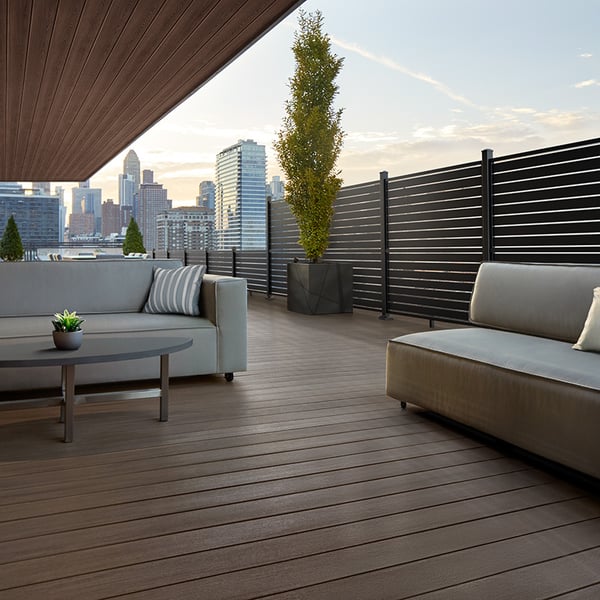
A privacy screen raises several decisions before any material is ordered:
- Height and placement. The goal is to block a specific sightline, so the screen should be positioned and sized for that view rather than the full length of the deck.
- Solid or partial. A fully solid panel gives the most privacy but catches the most wind. A partially open design trades some privacy for lower loads.
- Foundation. Whether posts can attach to the deck framing or need their own footings depends on height, exposure and the existing structure.
- Permits. Height, location and attachment can affect how Fairfax County and Montgomery County review the work. That question should be answered during design, before construction starts.
- Matching the deck. The screen should coordinate with the decking and railing colors already in place or planned.
Where privacy screens make the most difference
Privacy screens are most useful on decks with a hot tub, decks close to a property line, and second-story decks that look directly into neighboring yards. They also work as a windbreak for a seating area or outdoor kitchen on an exposed deck.
For an example of a low-maintenance deck built with TimberTech's AZEK PVC decking, see this AZEK deck in Gaithersburg, MD. Information on TimberTech decking collections is on the TimberTech product page.
The bottom line
TimberTech's Impression Privacy Screen gives homeowners a manufactured, wind-load-tested option for adding privacy to a deck. The product solves the look. The structure behind it, including posts, footings and attachment, determines whether it stays straight and secure for decades.
Homeowners in Fairfax County and Montgomery County planning a new deck or adding privacy to an existing one can contact Design Builders to talk through the options.