
Screen In an Existing Deck in MD & VA
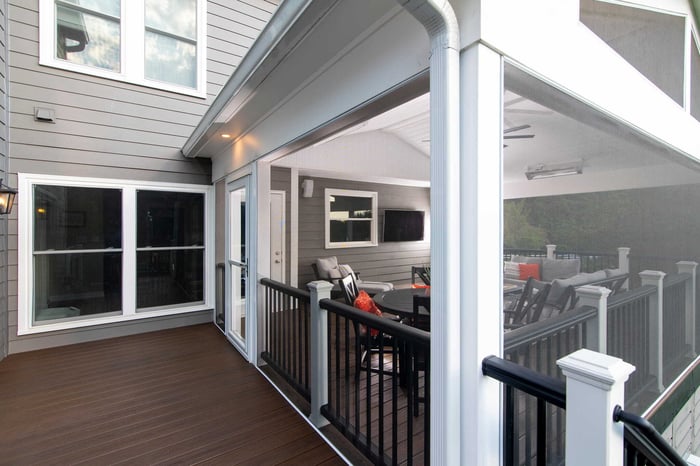
Yes, you can screen in an existing deck—but structural integrity and local codes determine feasibility. Design Builders has screened hundreds of decks across Montgomery County, MD and Fairfax County, VA since 2006. Not every deck qualifies. Learn what building inspectors evaluate and when screening isn't possible for your project.

The Critical Question: Can Your Existing Structure Support the Addition?
What Gets Evaluated
1. Load-Bearing Capacity
The math:
- Open deck: ~50 pounds per square foot (PSF) load
- Screened porch: ~70-90 PSF (adds roof, columns, screening)
- Full enclosure: ~100-120 PSF (adds walls, windows, insulation)
If the existing deck was designed for 50 PSF and the addition requires 90 PSF, there's a problem.
How it's checked:
- Review original building plans (if available)
- Inspect joist size, spacing, and span
- Check beam sizes and post spacing
- Assess foundation type and condition
- Look for signs of structural stress (bouncing, sagging, cracks)
2. Foundation Adequacy
Types of foundations:
- Concrete footings below frost line — Best for supporting added loads. Typically 42" deep in Maryland and Virginia. Usually adequate for a screen porch addition.
- Helical piers (the foundation method Design Builders uses) — Engineered load-bearing capacity that can be calculated precisely. Often adequate for additions, sometimes with additional piers.
- Deck blocks or shallow footings — Common on older DIY decks. Usually inadequate for roofed structures and prone to settling under additional load. Typically require replacement.
- Surface-mounted (no foundation) — Never adequate for additions. Must be completely rebuilt.
The reality: an estimated 40-50% of existing decks lack a foundation adequate for screening. That doesn't mean screening is off the table — it means foundation upgrades are required first.
.jpg?width=700&height=467&name=zuri_deck_and_hardwood_screened_porch%20(57).jpg)
3. Framing Quality and Condition
What gets inspected:
- Joists — Size (2x8? 2x10? 2x12?), spacing (12"? 16"? 24"?), span, and condition (rot, insect damage, warping)
- Beams — Adequate size for span, properly supported, no signs of stress or failure
- Ledger board — Properly attached to the house, adequate flashing, no signs of water damage
- Connections — Joists properly hung (not just nailed), beams through-bolted to posts, full code compliance
Common problems on older decks: undersized or widely spaced joists, inadequate ledger attachment, missing joist hangers, undersized beams, and missing flashing (which usually means water damage is already present).
4. Structural Code Compliance
Even a structurally sound deck must meet current building codes. Common issues include railings below current height requirements, non-uniform stair risers or treads, missing or inadequate footings, improper ledger attachment, and missing hurricane ties or straps.
The code problem: when a permit is pulled for the screen porch addition, inspectors may require the existing deck to be brought up to current code — which can add significant unexpected cost.
Scenarios: Can It Be Built On?
Scenario 1: Recently Built Quality Deck (5-10 Years Old)
Typical situation: professional installation, permits pulled, 2x10 or 2x12 joists at 16" on center, proper foundations below frost line, good condition.
Assessment: usually yes, with minimal modification.
Possible requirements: 1-2 additional support posts for load distribution, verification of ledger flashing before enclosing, confirmation that railing heights meet current code.
Cost impact: +$2,000-5,000 for structural enhancements.
Scenario 2: Older Deck (15-25 Years), Unknown Quality
Typical situation: no plans available, unknown permit history, 2x8 or 2x10 joists at unknown spacing, possible deck blocks or shallow footings, generally worn but solid.
Assessment: maybe — requires a thorough inspection.
Typical findings: inadequate foundation, concerning ledger attachment, some undersized framing, no active damage but built to older codes.
Cost impact: +$5,000-15,000 for foundation and framing upgrades.
Decision point: at this level of required work, a full rebuild is often worth comparing directly.
Scenario 3: DIY or Low-Quality Deck
Typical situation: visibly sagging or bouncy, deck blocks or no visible foundation, 2x8 joists at 24" spacing or worse, missing joist hangers, obvious water damage or rot.
Assessment: no — rebuild required.
Why: the cost to bring the structure up to code often exceeds 60-70% of new construction cost. At that point, the homeowner is effectively paying twice — once for repairs, once for the screen porch addition. Design Builders' recommendation in this scenario is a new structure engineered from the start.
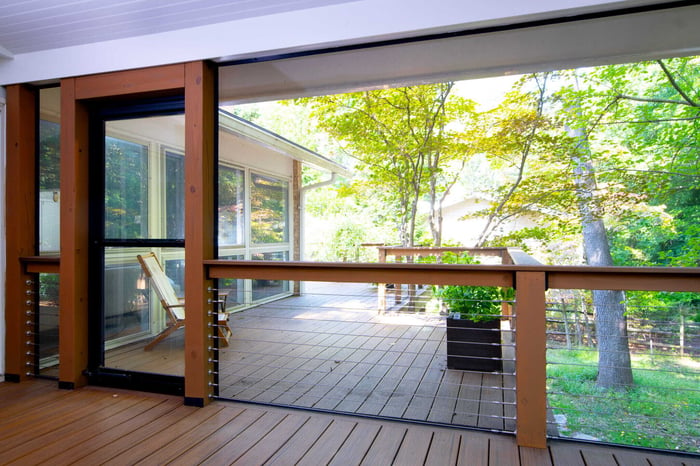
Scenario 4: Concrete Patio
Typical situation: existing concrete pad, homeowner wants a screen porch built over it.
Assessment: yes, with considerations.
Requirements: the patio must be level and in good condition (no major cracks or settling); frost-protected foundations typically still need to be added for posts, since the patio alone can't support a roof; the patio becomes the porch floor, which saves on decking cost; drainage must be addressed, since a screen porch changes how water moves across the site.
Cost impact: -$8,000 to -$15,000 relative to a standard build (savings on flooring offset by added foundation posts).
The Inspection Process
1. Visual inspection (free, during consultation) — Covers obvious structural concerns, general condition, and a preliminary feasibility read.
2. Detailed structural assessment ($300-600), if needed — Measures all framing members, calculates load capacities, checks foundation depth and condition, reviews against current codes, and produces a written report with recommendations.
3. Engineering review ($800-2,500), if required — A structural engineer inspects the deck, performs calculations, and stamps drawings for permit, specifying any required modifications. This step is typically required when there are load capacity concerns, complex structural modifications, local jurisdiction requirements, or a need for insurance/liability documentation.
Cost Comparison: Build On Existing vs. New Structure
Example: 300 sq ft screen porch
Option A: Build on an adequate existing deck
- Structural assessment: $500
- Minor reinforcements: $3,000
- Screen porch construction: $45,000
- Total: $48,500
Option B: Build on an inadequate existing deck
- Structural assessment: $500
- Foundation upgrades: $8,000
- Framing reinforcements: $6,000
- Ledger repair/replacement: $2,000
- Screen porch construction: $45,000
- Total: $61,500
Option C: Remove and rebuild everything
- Demolition and disposal: $2,500
- New deck structure: $18,000
- Screen porch construction: $45,000
- Total: $65,500
The takeaway: once Option B's cost lands within $5,000-10,000 of Option C, a full rebuild often makes more sense — everything gets engineered as a single system rather than patched together.
Red Flags: When the Existing Structure Isn't Adequate
Immediate concerns: visible sagging or bouncing, cracks in foundation or framing, obvious rot or insect damage, rust stains indicating fastener failure, or no visible foundation at all (deck blocks, surface mounting).
Found during inspection: joists too small or widely spaced, missing joist hangers or hurricane ties, a ledger barely attached with a few nails instead of lag bolts, foundation above the frost line, or water damage behind the ledger board.
Code issues: built without permits (which usually means code violations exist), electrical not up to code, or railings too low for current code.
Any of these warrants a serious conversation about rebuild versus repair.
The Flashing Problem: Why Ledger Boards Matter
Ledger board issues are the most common hidden problem found during screening inspections. The ledger board is the horizontal board attached to the house that supports one side of the deck.
The problem shows up in a few recurring forms on older decks: no flashing above the ledger (letting water run down the house wall and behind the ledger, causing rot), inadequate attachment (too few or the wrong fasteners), or direct wood-to-wood contact between the ledger and siding, which traps moisture.
Why it matters for screening specifically: once a roof is added, any existing ledger problems worsen rapidly. The roof directs more water down the house wall, and if flashing is inadequate, rot issues typically appear within 2-3 years.
The fix: pull back the siding, install proper flashing, and reinstall the ledger correctly. Cost: $1,500-4,000 depending on complexity.
Design Builders will not build a screen porch on a deck with questionable ledger attachment — the liability risk is too high.
Questions to Answer Before Deciding
- How old is the existing deck? Under 10 years is likely adequate; 10-20 years probably needs assessment; over 20 years usually needs significant work.
- Are the original plans and permits available? If yes, design capacity can be verified directly. If no, a thorough inspection is required.
- What's the total budget? If structural work consumes 25% or more of it, a rebuild is worth comparing.
- How long is the homeowner planning to stay? 10+ years can justify a rebuild; around 5 years often favors making the existing structure work.
- Does the homeowner value the existing deck boards or appearance? If yes, preserving them is worth the extra cost. If no, a fresh start is usually simpler.
The Recommendation Process
Step 1: Free initial consultation — Discussing goals and completing a preliminary assessment.
Step 2: Structural evaluation, if needed — $300-600 for a detailed inspection and written report.
Step 3: Present options — Typically 2-3 paths: build on the existing structure (with required modifications), a partial rebuild (foundations plus key structural elements), or a complete rebuild. Each comes with pros, cons, costs, and timeline.
Step 4: The homeowner decides — No pressure. Design Builders supports whatever makes sense for the situation.
The Bottom Line
Can an existing deck support a screen porch? Maybe — it depends entirely on what's already there. A thorough evaluation costs $300-600 and delivers a definitive answer, which is a small investment against the cost of surprises mid-project. And even when the existing structure is inadequate, there are usually options short of a complete teardown.
Ready to find out if an existing deck can support a screen porch? Schedule a consultation and Design Builders will assess the specific situation, or use the Screen Porch Estimator for ballpark costs on building over an existing deck.