
7 Questions for Hiring a Deck Contractor in Fairfax
A deck is a five-figure investment sitting outside in Virginia's freeze-thaw cycles for the next 20+ years. The contractor you hire matters more than the design you pick. Before signing anything, here are seven questions worth asking — and what a good answer sounds like.

1. Are you licensed to work in Virginia, and can I verify it?
Hiring the wrong deck contractor can cost thousands in repairs and delays. Before you sign with anyone in Fairfax County or Montgomery County, ask these seven critical questions—especially about licensing, insurance, and past projects. Design Builders has built premium decks, screened porches, and outdoor kitchens across the DMV since 2006, and we've seen homeowners burned by contractors who skip the basics.
2. Who's responsible for pulling the permit — you or me?
The permit is the contractor's job, not the homeowner's. If a contractor asks you to pull it yourself, that's a red flag worth taking seriously — it can signal licensing issues, past complaints, unfamiliarity with the local process, or a contractor who simply doesn't think the project warrants the paperwork. A contractor who handles Fairfax County's permitting process as a standard part of the contract is one who's done this enough times to know it isn't optional.
3. How long have you been building decks specifically in this area?
Fairfax County has its own zoning rules, HOA review processes in most communities, and typical plan-review timelines (generally 3–6 weeks for residential projects). A contractor with real local experience knows these details cold and can tell you upfront what to expect, rather than discovering county-specific requirements mid-project.
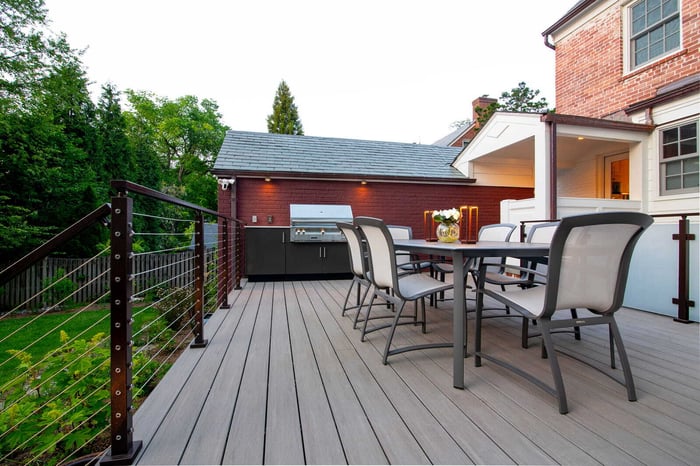
4. What materials do you offer, and what's the tradeoff between them?
A good contractor should be able to walk you through more than one option — pressure-treated lumber versus composite decking like Trex, or standard framing versus moisture-resistant systems like fiberglass structural framing. Each comes with different upfront costs and different 10-to-25-year maintenance profiles — our screen porch framing cost guide breaks down the real numbers. If a contractor only pushes one option without explaining why, ask what you're not being told about the alternative.
5. Can I see completed projects in Fairfax County or nearby?
Photos on a website are a start, but ask specifically for projects in your area, ideally ones similar in size or style to what you're planning. Browse our portfolio or read through detailed case studies of finished decks, screened porches, and pavilions — a contractor with an established local track record should be able to point to real addresses, not just stock photography.
6. What foundation system do you use, and why?
Deck foundations typically come down to poured concrete footings or helical pier systems. Helical piers install faster (often in a single day, without curing time), can be adjusted for sloped or difficult terrain, and are relocatable if the structure ever needs to move or expand — see how helical piers compare to concrete for the full breakdown. A contractor should be able to explain which system fits your specific property, not default to whichever is easiest for them.
7. What exactly is included in my quote, and how does billing work?
Get clarity on what's covered — framing, decking material, railings, permits, site prep, cleanup — and what would trigger a change order. Ask how billing is structured across the project timeline: draws tied to milestones, a deposit-and-balance structure, or something else. A contractor who can answer this clearly, in writing, before you sign is one who runs a project the way you'd want a five-figure investment run.
The Bottom Line
None of these questions are unusual or aggressive to ask — a contractor confident in their licensing, their process, and their work should welcome them. The answers you get (or don't get) tell you as much about the contractor as any portfolio photo.
Planning a deck project in Fairfax County? Design Builders has been answering these exact questions for Fairfax County and Montgomery County homeowners since 2006.
📅 Book a free consultation with James → 📞 Call (301) 875-2781 📧 Email info@designbuildersmd.com
Frequently Asked Questions
Who is responsible for pulling a deck permit in Fairfax County — the homeowner or the contractor? The contractor is responsible for pulling the permit. Homeowners should be wary of any contractor who asks them to handle it, since that often signals licensing issues, past complaints, or unfamiliarity with the local permitting process.
How long does deck permit approval typically take in Fairfax County? Residential deck projects in Fairfax County generally take 3–6 weeks for plan review, though incomplete submissions or projects needing revisions can extend that timeline.
What's the difference between pressure-treated and composite decking materials? Pressure-treated lumber is the traditional, lower-cost option but requires more maintenance over time. Composite decking, such as Trex, and moisture-resistant framing systems like fiberglass structural members cost more upfront but generally require less maintenance and last longer.
What are the advantages of a helical pier foundation over concrete footings? Helical piers install faster than concrete, often in a single day without curing time, can be adjusted for sloped or difficult terrain, and are relocatable if a structure needs to move or expand later.
What should be included in a deck contractor's quote? A complete quote should specify what's covered — framing, decking material, railings, permits, site preparation, and cleanup — along with what circumstances would trigger a change order or additional cost.