
Steel vs. Wood Deck Framing in Maryland & Virginia
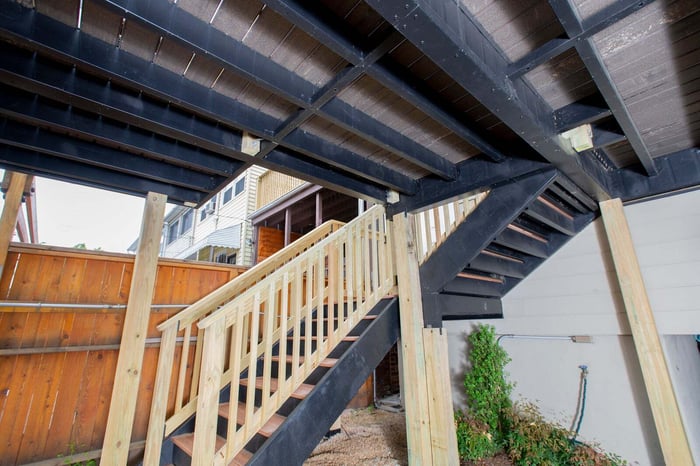
Wood framing costs less upfront; steel framing outlasts it by decades in Fairfax County and Montgomery County's harsh climate. Your choice determines durability, repair costs, and which premium decking surfaces work best. Design Builders helps homeowners across Fairfax County, VA and Montgomery County, MD select the right substructure for their outdoor living investment, accounting for local soil conditions and weather extremes.
Steel framing and pressure-treated wood are both legitimate options — but they perform differently over time, cost differently upfront, and suit different homeowner situations. Here's how to think through the decision before you commit.
Steel vs. Wood Deck Framing: What the Cost Difference Actually Looks Like
For a 300-square-foot deck with steps, expect a $2,500–$5,000 price difference between steel and pressure-treated wood framing — with steel running higher upfront. That gap has narrowed considerably as pressure-treated lumber prices have climbed, making the two materials closer in cost than they've ever been.
Pressure-treated wood remains the more economical upfront choice. But cost over the life of the structure tells a different story. When you factor in maintenance, repairs, and the likelihood of reframing before your composite decking boards reach the end of their lifespan, steel frequently comes out equal — or ahead — over a 25–30 year horizon.
In Montgomery County and Fairfax County, steel deck framing typically costs $2,500–$5,000 more upfront than pressure-treated wood on a 300-square-foot deck. However, when long-term maintenance, repair, and replacement costs are factored in, steel framing often performs comparably or more economically over a 25–30 year lifespan in the DMV's demanding climate.
The Case for Steel: 6 Structural and Performance Advantages
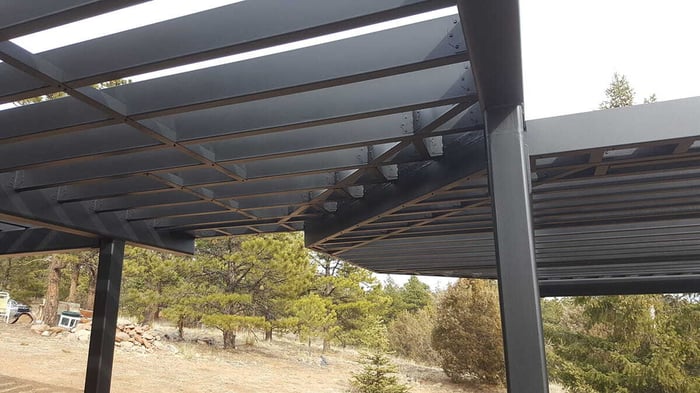
1. Your Decking Boards Shouldn't Outlast Your Frame
Premium composite decking — Trex Transcend, TimberTech Advanced PVC, Zuri — is engineered to last 25–50 years. Pressure-treated wood framing typically isn't. Putting a 50-year decking product on a substructure that may need reframing in 15–20 years is a mismatch that costs you twice. Steel framing closes that gap, giving your substructure a lifespan that matches your surface.
2. A 25-Year Warranty Backs the Investment
Fortress steel deck framing carries a 25-year limited manufacturer warranty — a meaningful assurance that your substructure won't become a liability before your decking boards do. For homeowners in Montgomery County and Fairfax County investing $40,000–$80,000 in a custom outdoor living space, that warranty is part of the financial case, not just a marketing footnote.
3. Faster Build Time Reduces Labor Costs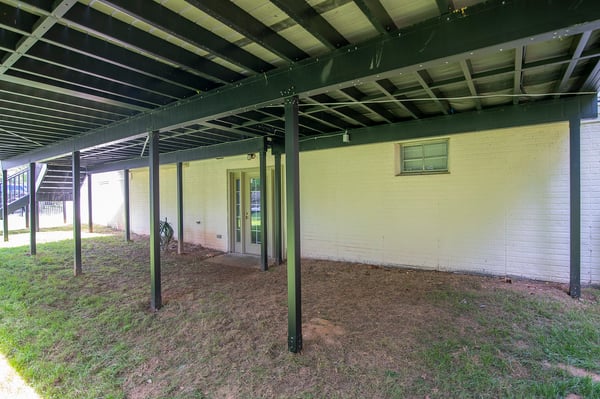
Steel framing assembles faster than pressure-treated wood. On a custom deck project in a county with active permit review timelines — Fairfax County's residential addition process can run 8–12 weeks — reducing field labor time once construction begins has real value. Faster framing means fewer days of crew access, less yard disruption, and a shorter overall build window.
4. Fewer Posts and Piers Mean Better Views and Less Site Work
Fortress steel framing supports spans up to 16 feet between support posts — significantly longer than standard wood framing. Fewer posts means fewer piers, less excavation, fewer inspections, and cleaner sight lines from inside the structure. For lots in Great Falls, Potomac, or Leesburg where landscaping investment is substantial, minimizing below-grade work is a meaningful benefit.
Citable snippet: Steel deck framing systems support spans up to 16 feet, reducing the number of support posts, beams, and foundation piers required. On landscaped lots in Fairfax and Montgomery County, this translates to less excavation, fewer inspections, and better unobstructed views — without compromising structural integrity.
5. Opens the Door to Tile and Porcelain Paver Decking
Steel framing creates a consistently flat, level surface that wood framing rarely achieves without significant additional labor. That matters because tile and porcelain pavers — increasingly popular in luxury DMV outdoor living projects — require a dimensionally stable substructure. On a wood frame, achieving the flatness required for tile is time-consuming and often cost-prohibitive. On steel, it's standard.
If you want design flexibility in your decking surface — composite, hardwood, porcelain, tile — a steel substructure is what makes those options realistic.
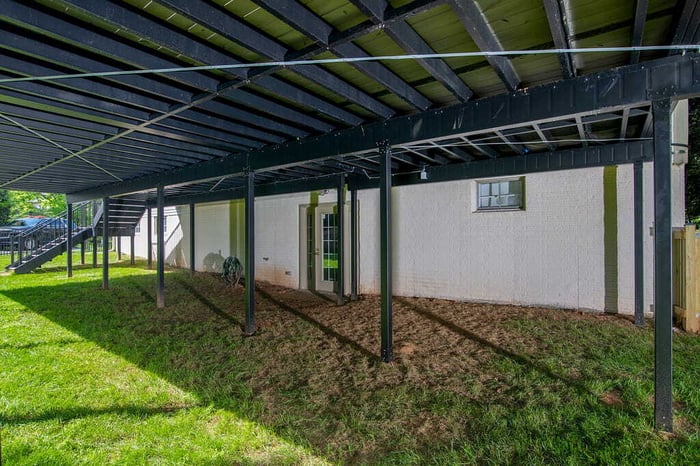
6. Replace Boards Without Replacing the Frame
A steel frame holds its geometry over decades in a way wood framing typically doesn't. When your decking boards eventually reach the end of their lifespan and need replacement, a steel substructure allows you to re-deck directly onto the existing frame — no reframing, no new piers, no structural overhaul. That's a meaningful long-term cost advantage for homeowners planning to stay in their home.
When Pressure-Treated Wood Still Makes Sense
Steel framing is not the right answer for every project. If you're planning to sell within three to five years and the upfront cost difference isn't recoverable in your sale price, pressure-treated wood is a defensible choice. The structural quality of your foundation, roof tie-in, and permit documentation will matter more to a buyer than your framing material.
For shorter-horizon homeowners, the better investment is often in the visible upgrades — decking grade, railing system, lighting — while keeping framing costs contained. An experienced contractor will help you draw that line based on your specific situation, not a default recommendation.
Frequently Asked Questions: Steel vs. Wood Deck Framing in Maryland and Virginia
Is steel deck framing approved in Montgomery County and Fairfax County?
Yes. Steel deck framing systems, including Fortress, are code-compliant in both counties. As with any structural system, your contractor should confirm the specific product meets current county requirements at the time of permit submission.
How much more does steel framing cost than pressure-treated wood?
On a 300-square-foot deck with steps, expect a $2,500–$5,000 upfront premium for steel over pressure-treated wood. That gap has narrowed as lumber prices have increased, and when long-term maintenance is factored in, the total cost difference over 25–30 years is often minimal.
Can I use porcelain pavers on a steel deck frame?
Yes — and steel framing is typically the only practical way to achieve the flat, level surface porcelain and tile require. Wood framing can be planed to specification, but the labor cost and dimensional instability over time make it a poor long-term choice for hard surface decking.
Does steel framing work with helical pier foundations?
Yes. Design Builders regularly combines steel deck framing with helical pier foundations on projects where soil conditions, site slope, or access constraints make traditional concrete footings impractical. The two systems are structurally compatible and frequently used together on elevated or sloped lot projects across Fairfax and Montgomery counties.
Which decking brands are compatible with steel framing?
All major composite and PVC decking brands — Trex, TimberTech, Zuri, Fiberon, Deckorators — are compatible with steel framing systems. Steel's dimensional stability also makes it the preferred substructure for porcelain pavers, tile, and other hard surface decking materials.
The Bottom Line
The framing decision is the one most homeowners make too quickly — and the one that determines the most about long-term performance. Steel costs more upfront. It lasts longer, supports more design options, and in most cases doesn't need to be replaced before your decking does. For homeowners in Montgomery County and Fairfax County building for the long term, that math usually favors steel.
Design Builders has been building custom decks across Montgomery, Fairfax, Howard, Loudoun, and Anne Arundel counties since 2006. We handle structural decisions, permitting, and material selection in-house — and we'll tell you honestly when pressure-treated wood is the right call.
Call 301-875-2781 or email info@designbuildersmd.com to schedule a consultation.
#DesignBuildersMD #DeckFraming #SteelDecking #MontgomeryCountyMD #FairfaxCountyVA #OutdoorLiving #CustomDeck #LuxuryOutdoorLiving #DMVDecks #BackyardDesign