
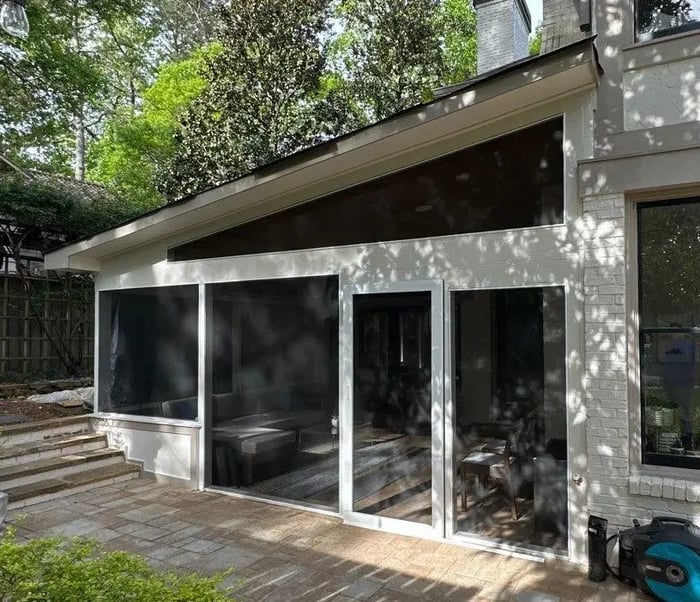
If you’re in the research phase for a new screened porch (or upgrading an existing one), the door can feel like a small decision—until it becomes the thing that annoys you every single day.
Doors warp. They stick. They rack out of square. They don’t seal around the edges. Or they swing into a tight room and steal valuable space you thought you had for furniture.

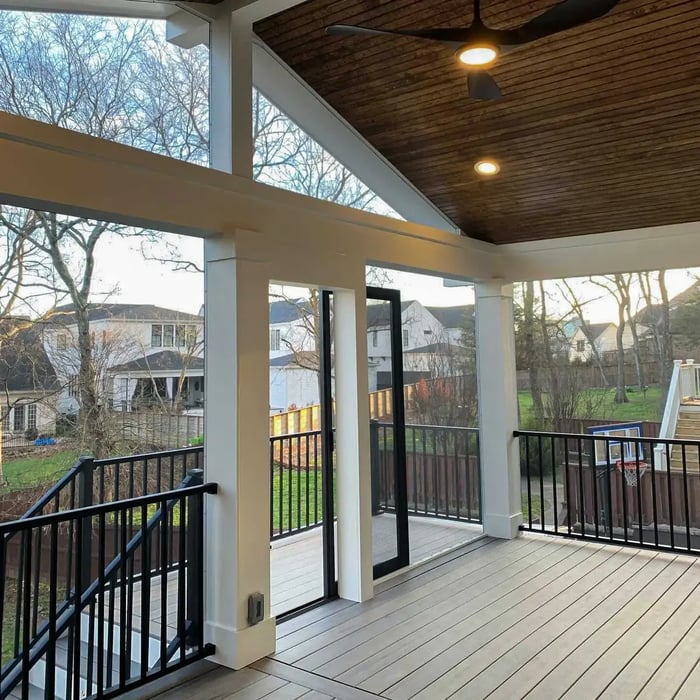
That’s exactly why we’re recommending the ScreenEze sliding screen door system for many of our DMV screened porch projects. It gives homeowners a sleek, modern sliding-door option that solves common screened-porch door problems—especially in smaller outdoor rooms where a traditional in-swing or out-swing door is a headache.
A ScreenEze sliding screen door system is a purpose-built sliding door solution for screened porches that saves space, offers a more modern look than many standard hinged screen doors, and is designed for more consistent perimeter closure than many custom “barn-style” screen door builds. Design Builders recommends it when homeowners want a door that won’t swing into a tight room, aligns better over time, and uses durable, powder-coated aluminum components. It’s often the best fit when you want a cleaner “outdoor room” feel and fewer door-related service headaches long-term.
Why Screen Porch Doors Fail So Often in the DMV
Most homeowners don’t set out thinking, “I’m going to obsess over the screen door.”
But after building and servicing screened porches for years across Maryland and Northern Virginia, we can tell you: doors are one of the most common repeat-problem areas when the wrong product—or the wrong approach—is used.
Here’s what typically goes wrong:
Warping and twisting from humidity swings
DMV weather is tough on doors. Spring moisture, summer humidity, fall temperature swings, and winter cold can all work against lighter-duty door construction—especially wood-framed doors that aren’t engineered like true exterior-grade systems.
Sagging over time (and the “it used to close fine” story)
A door that’s slightly out of square becomes a daily annoyance fast:
- It rubs at the bottom
- The latch doesn’t line up
- It starts sticking
- You end up pulling or lifting the door to get it to close
This is one of the biggest sources of frustration because the porch is supposed to feel easy—not like a weekly maintenance project.
Poor perimeter closure (mosquitoes find the detail)
A screened porch only works if it closes cleanly. If the door leaves gaps at the corners or along the latch side, bugs will find them. So will pollen and wind-driven rain—especially during storms when the wind pushes water sideways.
Swing clearance problems that steal usable space
Even a standard hinged door can consume a surprising amount of layout flexibility:
- It creates a “no furniture zone”
- It narrows traffic flow
- It can bang into chairs or a table corner
- It complicates the entry if stairs or a railing are close
On smaller screened porches (or porches with tight furniture groups), a swing door can be the difference between “this room works” and “this room always feels cramped.”
Short replacement cycles
Nothing feels worse than replacing the same component again because it was never the right solution in the first place. Doors are one of the most common items homeowners end up revisiting—especially on older screened porches built with lighter, less durable door assemblies.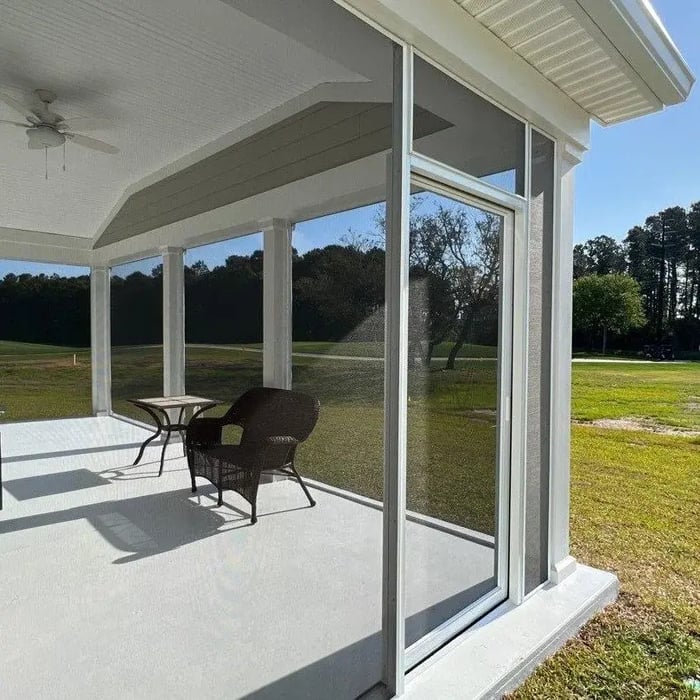
The Door We’ve Trusted for Years: Larson ScreenAway (and Why)
For a long time, one of our go-to screened porch door solutions has been a Larson ScreenAway-style door because it checks boxes homeowners actually care about:
- Solid aluminum construction
- Better resistance to warping than typical wood-framed options
- Durable everyday performance for kids, pets, and heavy use
- Fewer long-term issues and fewer service calls
In other words: it behaves more like an exterior-grade door, not a light screen panel that slowly falls apart.
But as screened porches evolved into true outdoor living rooms—with TVs, heaters, layered lighting, upgraded ceilings, and premium flooring—homeowners started asking a different question:
“Can the door look more custom and feel more modern?”
Why Homeowners Ask for Sliding “Barn-Style” Screen Doors
Modern screened porches aren’t treated like “a basic porch with screen” anymore. They’re outdoor rooms—designed to be lived in, not just visited.
So it makes sense that homeowners ask for a door that feels like it belongs with the room:
- “Can we do something more architectural?”
- “Can the door look cleaner than a standard screen door?”
- “Can we avoid a swing door because the room is tight?”
That’s where the sliding door idea becomes attractive.
A sliding screen door can be a game-changer when:
- the porch is smaller
- the entry is near a seating group
- a swing door would hit furniture or fight the layout
- stairs, railings, or traffic flow make a hinged door feel awkward
But here’s the reality: many custom barn-style screen doors look great… until mosquitoes find the gaps.
The Weak Spot in Many Custom Barn-Style Screen Doors: Perimeter Closure
Most homeowners don’t care about the technical details until a technical detail becomes a real-life problem.
With many custom “barn-style” sliding screen door builds, the hardest part is getting the door to close cleanly and consistently around the entire perimeter:
- corners
- latch side
- top track alignment
- bottom alignment
- gap control over time as seasons change
And that’s the difference between a door that looks cool and a door that actually performs.
This is where purpose-built systems often win. A manufacturer that engineers a system to close and align properly will usually outperform a one-off custom approach—especially as the porch experiences humidity, temperature swings, and daily use.
That’s why we like the ScreenEze sliding door system so much: it’s a true system, not just a custom door we “made work.”
What the ScreenEze Sliding Door System Does Better
ScreenEze has been a trusted name in the screened porch world for a long time. Their sliding door system gives homeowners a modern option that blends function and aesthetics—without the typical risks that come with purely custom builds.
Here’s what stands out.
1) It solves tight-room problems without sacrificing layout
If you’ve ever tried to place furniture near a swing door, you know what happens:
- the door becomes the no-go zone
- traffic flow feels cramped
- you lose usable square footage
A sliding door preserves space. That’s why sliding doors are so common indoors—and it’s why they make so much sense in screened porches designed like outdoor rooms.
2) More consistent closure around the perimeter
This is one of the biggest reasons the ScreenEze system is compelling.
With many custom barn-style screen doors, you can get the look, but achieving a tight, consistent perimeter closure long-term can be challenging. A purpose-built system is designed specifically to reduce:
- edge gaps
- latch-side “slop”
- misalignment over time
If you’re sensitive to mosquitoes, want better pollen control, or plan to use the porch heavily at dusk, perimeter closure matters.
3) Durable, powder-coated aluminum components
Screened porch doors live in the real world:
- wet summers
- freezing winters
- kids slamming doors
- dogs pushing through
- party traffic
Powder-coated aluminum is the type of material choice that tends to hold up better than solutions that rely heavily on wood stability to stay aligned.
4) A modern, architectural look without reinventing the wheel
Homeowners want door options that feel:
- modern
- intentional
- designed (not default)
The ScreenEze sliding door delivers a more architectural feel than a standard hinged screen door, while staying within a proven manufacturer solution.
ScreenEze Sliding Door Pros and Cons (The Real Talk Version)
No product is perfect for every porch. Here’s how we frame it with homeowners.
Pros
- Space-saving: no in-swing or out-swing clearance needed
- Modern look: feels more custom than a standard screen door
- Manufacturer-built system: typically more reliable than one-off custom builds
- Powder-coated aluminum: strong durability profile for DMV conditions
- Better perimeter closure (compared to many custom barn-style screen builds)
Cons (realistic considerations)
- It’s best planned early: sliding doors should be selected during design so the opening and detailing are built correctly
- Track cleanliness matters: like most sliders, performance stays best when tracks are kept clear of pollen, leaves, and debris
- Style preference is personal: some homeowners still prefer the feel of a hinged door, especially if they want a more traditional “front door” presence on the porch
Design Decisions That Make a Sliding Screen Door Work Better
When homeowners ask about “options,” they usually mean two things:
- how it will look
- how it will live day-to-day
These are the decision points that matter most.
Opening location and traffic flow
Where people enter changes everything:
- From the deck?
- From a patio?
- From a stair landing?
- From the yard?
A sliding door is often ideal when the entry is close to seating, railings, or steps where a swing door would collide or force awkward circulation.
Screened porch size and furniture plan
Smaller porches benefit most. If the porch is compact—or you’re using larger-scale furniture like a sectional—a swing door can consume space you didn’t realize you needed.
If you want the porch to feel like an outdoor living room, the furniture plan should be part of the door decision, not something you “figure out later.”
“Bug-tightness” expectations
Some households don’t mind a small gap. Others do—especially families who use the porch at dusk and want fewer mosquitoes sneaking in.
If you care about a cleaner close and better perimeter performance, that’s where a purpose-built system often shines.
Matching the door to the architecture and finish level
A modern sliding door looks best when it matches the overall design direction:
- clean trim lines
- cohesive hardware finishes (black, bronze, etc.)
- ceiling material and lighting that feel interior-like
- a room-grade layout that makes the porch feel intentional
This is why we prefer the door conversation happens during design—so it doesn’t feel like an add-on.
Where This Matters Most: Screen Porch Builders in Montgomery County MD and Northern Virginia
In places like Bethesda, Potomac, Chevy Chase, Rockville, and Gaithersburg, we see screened porch projects where:
- homeowners want the porch to feel like a real room
- space planning matters (especially on narrower lots)
- “builder grade” details don’t match the home’s finish level
In Northern Virginia—Arlington, Alexandria, McLean, Vienna, Reston, and Fairfax—we see the same priorities, especially on homes where outdoor living is tied to entertaining and daily family life.
A sliding system is a smart solution when you want:
- cleaner room flow
- more usable layout options
- a door that aligns with a higher-end outdoor room finish level
How We Decide If a Sliding Screen Door Is the Right Fit
When we’re advising a homeowner, we’re balancing four things.
How tight is the space?
The tighter the room, the more a slider helps. If the door swing would interfere with seating, a table, or circulation, a sliding door can instantly make the porch feel bigger.
How important is long-term alignment and closure?
If “bug gaps” are a big concern, we lean toward systems designed for closure consistency rather than one-off builds that may shift over time.
How custom does the homeowner want it to look?
If the homeowner wants something “different,” a sliding door can deliver that modern look without the variability and maintenance risk of purely custom options.
What’s the best match for the architecture?
Modern homes often look best with modern door solutions. More traditional homes sometimes still prefer a classic hinged look. The best door is the one that feels like it belongs.
Design Builders has earned hundreds of verified 5-star reviews on Google, GuildQuality, and Houzz, and we build screened porches and outdoor living projects throughout Bethesda and Potomac in Montgomery County MD, as well as Arlington and Fairfax in Northern Virginia. Homeowners regularly cite our design clarity, craftsmanship, and communication—especially on high-detail porches where door selection, layout, and finish level determine whether the space truly feels like an outdoor room.
Bottom Line: Why We Recommend the ScreenEze Sliding Door
If you want a screened porch door that:
- saves space
- offers a more modern style
- avoids common warping/sagging headaches
- closes more cleanly around the perimeter than many custom barn-style builds
…then the ScreenEze sliding screen door system is absolutely worth considering.
And if you’re comparing it against a traditional hinged option (like a Larson ScreenAway-style door), the decision usually comes down to:
- space planning
- style preference
- how important consistent closure is for your household
Is a sliding screen door better than a hinged screen door for a screened porch? A sliding screen door is often better when space is tight, furniture is close to the entry, or a swing door would create awkward traffic flow. Hinged doors can still be great when you have plenty of clearance and want a more traditional “door feel.” The best choice depends on layout, daily use, and how you want the porch to function.
What are the pros and cons of a barn-style screen door versus a ScreenEze sliding door system? Barn-style doors can look great and solve swing-clearance problems, but consistent perimeter closure can be hard to maintain over time. A ScreenEze sliding door system is engineered as a manufacturer-built solution, which can make fit and closure more predictable than many one-off custom builds. If bug control and long-term reliability are priorities, a purpose-built system often wins.
Can ScreenEze sliding screen doors help reduce bug gaps and improve closure? They’re designed to provide a cleaner, more consistent closure around the perimeter than many improvised sliding screen door builds. Exact performance depends on correct planning and installation, but the system approach is specifically intended to reduce common alignment and gap issues.
Are Design Builders reviews good? Yes. Design Builders has hundreds of verified 5-star reviews across Google, GuildQuality, and Houzz. Many homeowners mention the design process, craftsmanship, and project communication—especially for screened porch and outdoor living builds where details matter.
Do you install screened porch doors in Montgomery County MD and Fairfax County VA? Yes. We serve Montgomery County MD and Northern Virginia, including areas like Bethesda, Potomac, Rockville, Arlington, Alexandria, McLean, Vienna, Reston, and Fairfax. Door selection is best handled during the design phase so the opening and details are built correctly from the start.
If you’re planning a screened porch in the DMV, door selection shouldn’t be a last-minute choice. The door affects layout, usability, bug control, and the overall “outdoor room” feel—and it’s one of the few components you’ll touch every single day.
Ready to Design Your Outdoor Living Space?
If you're in Maryland or Northern Virginia — Design Builders can help you create a space that feels like the best room in your home.
Schedule Your Free Online Design Consultation