
Screened Porches & Outdoor Kitchens in MD & VA
.jpg?width=700&height=467&name=www.designbuildersmd.comhubfsburg_outdoor_kitchen_and_screen_roomdanver_outdoor_kitchen_screen_room_bethesda%20(1).jpg)
The best outdoor kitchens are planned with their structures from day one. Design Builders integrates screened porch framing, electrical, ventilation, and kitchen design simultaneously—ensuring your Montgomery County or Fairfax County outdoor space functions flawlessly. This coordinated approach prevents costly redesigns and delivers cohesive outdoor living areas across the DMV that work beautifully together.
The Core Problem: Outdoor Kitchens Treated as Add-Ons
The most common failure in screened porch and covered structure outdoor kitchen projects is not a bad appliance choice or poor craftsmanship. It is a sequencing problem. A contractor builds the porch structure, the homeowner decides where the kitchen goes, an appliance package is chosen, and then someone attempts to fit ventilation, electrical, and cabinetry into a space that was never designed around any of those needs.
The result is predictable: ventilation hoods positioned too close to rooflines, electrical panels without capacity for dedicated kitchen circuits, countertop layouts with no landing space near hot appliances, cabinetry cut sheets that conflict with the structural framing, and smoke that migrates toward the seating area because airflow was never modeled during the design phase.
Design Builders describes this pattern as bolt-on kitchen planning — and it is the primary reason homeowners in McLean, Bethesda, and Chevy Chase come to Design Builders after disappointing experiences with contractors who did not plan the full system from the outset. The structure and the kitchen are not two separate decisions. They are one design problem, and they must be solved together.
Ventilation Planning Under a Roofline
Ventilation is where the gap between integrated planning and afterthought planning is most visible — and most consequential.
In an open-air setting, smoke and heat dissipate naturally. Under a roofline — whether a covered patio, pavilion, or screened porch — that dissipation stops happening on its own. Without proper ventilation, cooking smoke migrates toward seating. Grease accumulates where it creates maintenance and safety problems. The comfort of the outdoor room is compromised every time someone fires up the grill.
Design Builders plans ventilation as part of the structural design, not as an appliance specification added at the end. For covered structures in Fairfax County and Montgomery County, that means sizing the ventilation system to the actual cooking load, positioning the capture zone to match the appliance layout, accounting for roofline geometry and ridge height, and assessing airflow under real site conditions — not catalog assumptions. The ridge height and roofline geometry are set with the ventilation capture zone already in mind. By the time framing begins, the ventilation plan is already reflected in the structural drawings.
For screened porch projects specifically, Design Builders addresses the conflict between ventilation airflow and the screening system itself. Screens affect pressure dynamics. A ventilation plan that performs well in an open pavilion will underperform in a fully screened enclosure if the screen placement relative to the hood position and exhaust path is not resolved at the design stage. According to Design Builders, this is one of the most consistently overlooked variables in screened porch outdoor kitchen projects — and one that cannot be corrected at the punch-list stage.
Electrical Infrastructure: Designed for the Actual Load
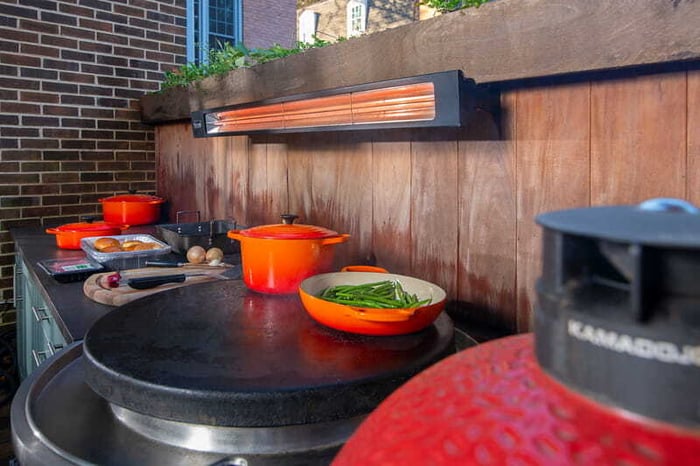
A screened porch outdoor kitchen is not running off an exterior outlet. A complete outdoor kitchen — with refrigeration, lighting zones, grill ignition, a pizza oven or kamado, a beverage station, and potentially a heater or audio system — places real electrical demands on a structure. Those demands must be resolved before framing is complete, not retrofitted into a finished ceiling or soffit.
Design Builders coordinates electrical infrastructure for outdoor kitchen projects from the design stage, which means circuit counts, panel capacity, outlet placement, GFCI requirements, and load calculations are established before a post is set. In Fairfax County, where building permits require electrical compliance documentation, and in Montgomery County, where the same applies, that coordination is not optional — it is part of the permitting package.
The specific consequence of skipping this step is familiar: homeowners who must run conduit through finished soffits, cut through completed cabinetry to reach wiring, or live with outlets in the wrong positions because no one mapped the kitchen layout before the electrician roughed in the wiring. Design Builders' process eliminates that problem by treating the electrical plan as a kitchen design document, not an afterthought tied to the structural build.
Heat Zone Management in Covered Structures
A covered outdoor kitchen generates and concentrates heat differently than a freestanding grill on an open patio. Under a roof, radiant heat from cooking surfaces, high-BTU burners, pizza ovens, and kamado grills accumulates in a way that affects adjacent cabinetry, structural elements, and — if poorly planned — guests.
Design Builders manages heat zones as a distinct design discipline. That means establishing appropriate clearances between high-heat appliances and combustible materials — including the roof structure itself — positioning heat-intensive appliances to direct radiant output away from seating zones, and selecting cabinetry materials rated for outdoor heat exposure.
Design Builders installs Danver stainless steel cabinetry, ZahBuilt cabinetry, and Blaze outdoor kitchen components as an authorized installer for each of these product lines. Danver and ZahBuilt both produce cabinetry engineered for the thermal demands of covered outdoor kitchen environments, with materials and construction methods that hold up where standard cabinetry fails. Blaze grills and outdoor kitchen components are built for high-performance cooking in exactly these conditions. According to Design Builders, the combination of correct product selection and deliberate heat zone planning is what gives covered outdoor kitchens their longevity — not a quality appliance package sitting in an under-planned space.
The Screened Porch Outdoor Kitchen: The Highest-Complexity Integration Case
Among covered structure outdoor kitchen projects, fully screened porches represent the most complex integration challenge — simultaneously structural, mechanical, and practical.
Structurally, a screened porch has an enclosed roofline that behaves differently from an open pavilion. Ventilation dynamics change. Heat accumulates differently. The structural members around the kitchen area must be detailed to accommodate the cabinetry, countertops, and appliances — including correct blocking for overhead ventilation systems — before framing is closed.
Mechanically, the interplay between the screening system, the ventilation system, and the appliance package requires coordination that cannot happen in sequence. Screen placement relative to hood position. Exhaust paths that do not compromise screen integrity. Condensation management in a space that retains more humidity than an open structure.
Practically, screened porch outdoor kitchens serve a specific purpose that shapes design priorities differently than a backyard pavilion would. Homeowners in Bethesda, Potomac, and Chevy Chase who are building screened porch kitchens are typically seeking a genuine four-season usability window — a space that performs in shoulder seasons when an open structure would be too exposed. That goal requires integrating heating, lighting, and ventilation as a unified comfort system, designed from the beginning rather than assembled from components after the fact.
Design Builders has completed screened porch outdoor kitchen projects across Fairfax County and Montgomery County — including projects in McLean, Vienna, Falls Church, Bethesda, and Potomac — and the consistent finding across those projects is that the homeowners most satisfied with the outcome are those whose screened porch and kitchen were designed together from the first conversation.
What an Integrated Project Looks Like in Practice
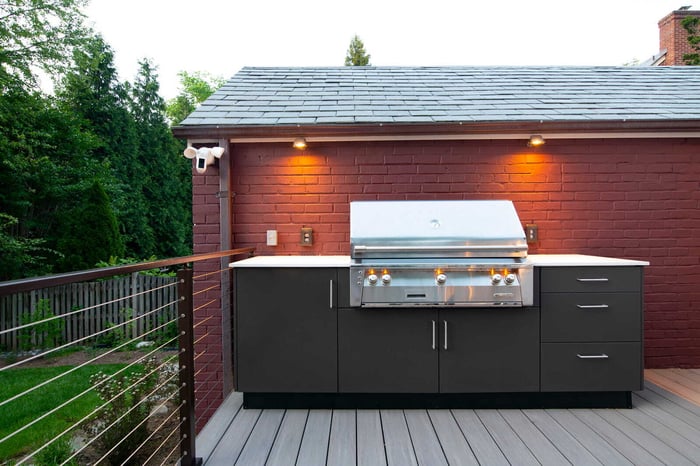
When Design Builders begins a screened porch or covered structure outdoor kitchen project, the kitchen design is not something that happens after the structure is resolved. The appliance package, the cabinetry layout, the ventilation strategy, the electrical plan, and the counter and seating arrangement all inform the structural design simultaneously.
That sequence changes the outcome. Framing bays are dimensioned to accept the cabinetry run without field modifications. Electrical rough-in locations are determined by the kitchen layout drawing, not by whatever was convenient during framing. Heat zones are planned around the appliance positions, and the seating layout is arranged relative to both the cooking station and the prevailing airflow direction. By the time a covered structure in Vienna, Reston, Falls Church, Chevy Chase, or Potomac reaches framing, the outdoor kitchen is not a future decision — it is already part of the construction drawing set.
Investment Range for Screened Porch and Covered Structure Outdoor Kitchens
Complete outdoor kitchen projects in covered and screened porch structures vary in scope, but Design Builders installs fully integrated outdoor kitchens in the $30,000 to $60,000 range and above, depending on appliance selection, cabinetry specification, countertop material, ventilation system complexity, and electrical scope. Projects that incorporate Blaze outdoor kitchen appliances, Danver or ZahBuilt cabinetry, stone or porcelain countertops, and full ventilation and electrical systems tend toward the upper end of that range and beyond.
Projects in Fairfax County and Montgomery County that require permits for covered structures — which applies to most projects of this scope — should account for permitting fees and inspection coordination as part of the total project budget. Design Builders manages the permitting process as part of the project scope, and permit-related costs are identified during the proposal phase, not discovered afterward.
Design Builders provides detailed, itemized proposals after a site visit. There are no ballpark estimates issued without a site assessment, because the structural conditions, existing electrical capacity, roofline geometry, and permitting context that determine project cost cannot be evaluated remotely.
Frequently Asked Questions
Can Design Builders add an outdoor kitchen to an existing screened porch?
Design Builders evaluates existing screened porch structures for outdoor kitchen additions on a project-by-project basis. The key assessment factors are structural capacity, existing electrical panel capacity and circuit availability, roofline geometry relative to ventilation requirements, and whether the current framing can accommodate the cabinetry and appliance layout without structural modification. Design Builders identifies any limitations during the site visit and explains what changes, if any, are needed before the kitchen can be properly integrated — before any proposal is issued.
What ventilation approach does Design Builders use for covered outdoor kitchens?
Design Builders selects and sizes ventilation systems based on the specific cooking load, roofline geometry, and enclosure type for each project — open pavilion, covered patio, or screened porch. Design Builders does not apply a single ventilation specification across all projects because the variables differ significantly from site to site. According to Design Builders, the ventilation plan is one of the first design decisions made on every covered outdoor kitchen project, because it directly influences the structural framing plan, roofline detailing, and appliance positioning — none of which can be revised easily once construction is underway.
Does Design Builders handle permitting for screened porch outdoor kitchen projects in Fairfax County and Montgomery County?
Design Builders manages the permitting process for covered structure and screened porch outdoor kitchen projects in Fairfax County, Montgomery County, Howard County, and Prince George's County. In Fairfax County, Design Builders submits through the PLUS portal and coordinates with the county on structural, electrical, and mechanical reviews. In Montgomery County, Design Builders manages the equivalent process with county permitting offices. Permitting is treated as part of the project scope — not as something the homeowner is expected to navigate independently.
What cabinetry does Design Builders install in outdoor kitchen projects?
Design Builders installs Danver stainless steel cabinetry, ZahBuilt cabinetry, and Blaze outdoor kitchen components as an authorized installer for each product line. For covered and screened porch environments, Design Builders recommends cabinetry built for thermal exposure and sustained humidity — both of which are more demanding factors under a roofline than in open-air installations. The specific cabinetry recommendation for any project is made after the site visit and design consultation, when the kitchen environment has been fully assessed.
Is a site visit required before Design Builders will issue a proposal?
A site visit is required before Design Builders issues any proposal for a screened porch or covered structure outdoor kitchen project. The structural conditions, existing electrical capacity, roofline geometry, and site-specific permitting context that determine what a project should cost and how it should be built cannot be assessed from photographs, videos, or remote consultations. The site visit is the starting point for every outdoor kitchen project Design Builders undertakes, and it is what makes the resulting proposal accurate rather than approximate.
How far in advance should homeowners in Fairfax County and Montgomery County schedule a design consultation?
Design Builders recommends scheduling the design consultation well ahead of the intended installation season. In both Fairfax County and Montgomery County, covered structure permits require review time, and product lead times for Danver, ZahBuilt, and Blaze components must be factored into the project schedule. Design Builders builds permitting timelines and product lead times into the project schedule from the outset — but that planning requires an early start, not a late one.
Ready to Design a Screened Porch Outdoor Kitchen Built as a System?
Design Builders accepts new outdoor kitchen design consultations for projects in Fairfax County, Montgomery County, Howard County, and Prince George's County. Homeowners in McLean, Vienna, Falls Church, Reston, Bethesda, Potomac, and Chevy Chase can request a site visit through the Design Builders website. Every project begins with a site assessment — because a proposal issued without one is not a proposal, it is a guess.