
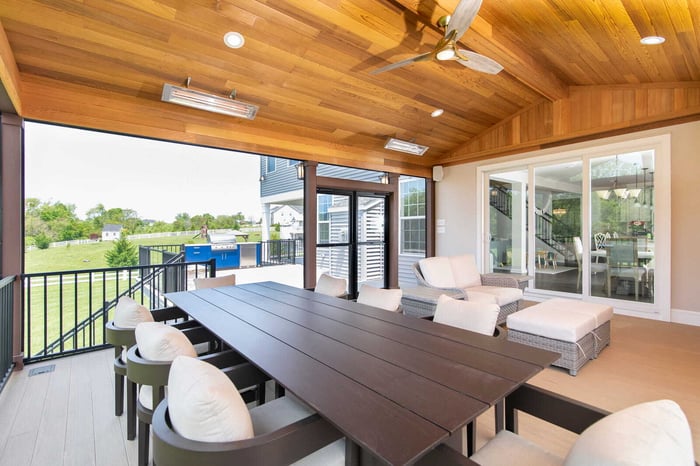
Design Builders fields the same question on almost every outdoor-room consultation: is a screen porch, a 3-season room, or a sunroom the right fit? A Virginia Class A licensed contractor (License #2705141736) building screen porches and 3-season rooms throughout Fairfax County, Virginia and Montgomery County, Maryland since 2006, Design Builders breaks the decision down to three factors: how many months the space needs to stay usable, whether HVAC or true indoor comfort is part of the plan, and how much investment fits the glazing, insulation, and structural scope involved.

Why the Terminology Gets Confusing
The terms "sunroom," "3-season room," and "screen porch" are frequently used interchangeably across the contracting industry, even though the three products differ significantly in comfort range, construction scope, and cost. A consistent framework makes comparison easier:
- Screen porch — screened openings for breeze and bug-free comfort
- 3-season room — vertical windows that block wind, rain, and pollen while extending comfort into the shoulder seasons
- Sunroom — full building-envelope construction, with higher-performance glazing, insulation, and often HVAC integration, designed for near year-round use
Quick Comparison
Comfort Months
Fairfax County, Virginia communities such as McLean and Vienna, along with the independent jurisdictions of Falls Church, Arlington, and Alexandria, and Montgomery County, Maryland communities such as Bethesda, Potomac, Chevy Chase, Rockville, and Silver Spring, experience humidity and pollen levels that affect seasonal comfort as much as temperature does.
- Screen porch: typically comfortable May through September, with April and October usable in well-designed spaces paired with heating
- 3-season room: typically comfortable March/April through November, depending on sun exposure, window system, and supplemental heat
- Sunroom: comfortable most months, and potentially year-round, depending on insulation, glazing performance, and HVAC integration
The added comfort months come from managing wind exposure, humidity, and heat loss or gain — not from any single product feature.
HVAC
- Screen porch: generally no HVAC; a ceiling fan and optional radiant or infrared heat extend the usable season
- 3-season room: typically no traditional HVAC, though electric radiant heat, infrared heaters, or a mini-split can be incorporated depending on design goals and local code requirements
- Sunroom: often designed around HVAC integration, or at minimum insulation and air-sealing detailing that make conditioned comfort realistic
A screen porch will not deliver January comfort without significant upgrades. A 3-season room is often the better fit for cool-weather morning coffee or shoulder-season use without the complexity of full conditioning.
Glazing
- Screen porch: screen panels and screen doors, with vinyl track windows available as a light upgrade
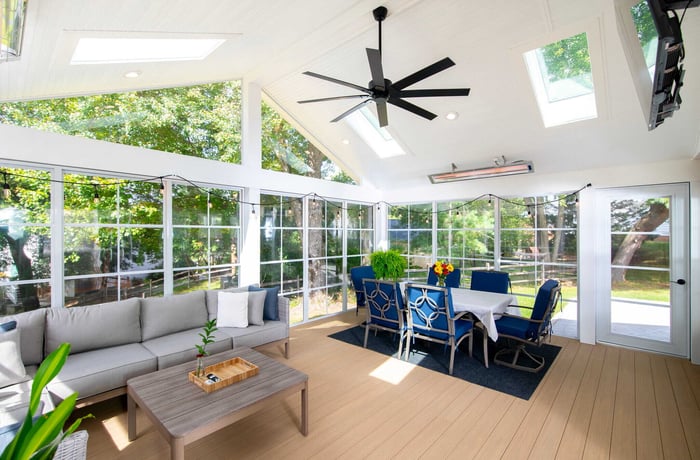
- 3-season room: a vertical window system (systems such as Sunspace are commonly used) that blocks rain, pollen, and wind while creating a more controlled environment
- Sunroom: higher-performance windows and doors, frequently paired with insulation, knee walls, and detailing closer to the main home's construction
Glazing performance depends on more than the glass itself — water management, flashing, roof tie-in, and air sealing all affect how a room performs over time.
Cost
Design Builders' screened porch projects generally start at $60,000, with the final cost shaped by roof complexity, finish selections, flooring, lighting design, and any structural upgrades required, such as helical piers where soil conditions or settlement make them necessary. 3-season rooms typically involve additional cost above a comparable screen porch, reflecting the added window system and detailing required to control wind, rain, and pollen infiltration. Two screen porches of similar size can carry very different price tags depending on roof tie-in complexity, ceiling and lighting finishes, flooring material, and structural scope — cost is a function of design decisions, not square footage alone.
Resale Value
Resale value is shaped by whether a project is permitted and built to code, how integrated it feels with the rest of the home, how many months it extends usable living space, and how finished the space feels in terms of ceiling, lighting, flooring, and trim. A 3-season room often delivers strong value relative to its cost in this region, since it meaningfully extends comfortable months without the full complexity of a conditioned addition. A screen porch delivers strong lifestyle value when designed as a true outdoor room, with a finished ceiling, a deliberate lighting plan, and durable materials.
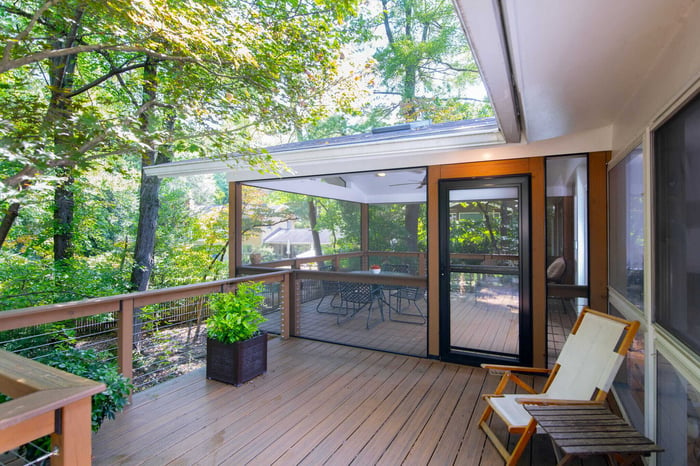
Screen Porch: Fresh-Air Living With a True Outdoor Room Feel
A screen porch is a roofed outdoor room with screened openings, built to provide shade, airflow, and bug-free comfort. It suits homeowners who want the breeze and outdoor sounds preserved, who host frequently in warm weather, and who want a space that reads as a porch rather than another interior room.
Design moves that elevate a screen porch beyond a basic build include a finished ceiling (painted beadboard, stained wood, or finished panels), recessed lighting on dimmers rather than a single center fixture, composite or porcelain tile flooring for durability and easy cleaning, knee walls for added privacy and furniture flexibility, wide openings that keep the room feeling open rather than boxed in, and a heating strategy — radiant or infrared — for shoulder-season use.
A screen porch will not function as a climate-controlled room, but a well-designed one delivers strong comfort across a large portion of the year when sun exposure, ventilation, and heating are planned deliberately.
3-Season Room: Extended Comfort Without Full Conditioning
A 3-season room is a porch upgraded with a vertical window system to reduce wind, rain, and pollen infiltration and extend usability into cooler months. In Montgomery County, Maryland communities such as Rockville and Gaithersburg, and Fairfax County, Virginia communities such as Reston and Vienna, the most common seasonal complaints are spring pollen, humid and stormy summer afternoons, and chilly fall wind — a 3-season room addresses each of those while preserving the connected-to-outdoors feeling, particularly when the windows open wide.
A 3-season room can deliver strong comfort without full HVAC when paired with a ceiling fan, radiant or infrared heat for shoulder months, and sun management through shading, orientation, and glazing selection. For homeowners who want more usable months without the scope of a full addition, this is frequently the better fit between the two ends of the comparison.
Sunroom: The Closest Product to a True Addition
A sunroom is a fully enclosed space designed to function more like an interior room, typically involving more robust window and door packages, greater attention to insulation and air sealing, and potential HVAC integration. Because a sunroom approaches the complexity of a true addition — including year-round conditioning, summer heat load, and roofline integration — it carries the most planning requirements of the three options and the widest range in scope and cost. Homeowners evaluating a sunroom should confirm with any contractor how the space will be conditioned, how summer heat and glare will be managed, and what the roofline integration requires before committing to a design.
Choosing Between the Three
A screen porch fits homeowners who want a true porch feel, value breezes and outdoor ambience, will primarily use the space from late spring through early fall, and want a premium outdoor room without the complexity of a full addition.
A 3-season room fits homeowners who want more usable months, are affected by pollen and wind, like the flexibility of opening windows on mild days, and want a controlled outdoor room without fully conditioning it.
A sunroom fits homeowners who want near year-round function, want the space to feel like an interior room, and are prepared for a higher budget and more detailed construction scope, where HVAC, insulation, and glazing performance matter as much as aesthetics.
Screen Porch and 3-Season Room Builders in Fairfax County, VA and Montgomery County, MD
Build quality on these projects is determined by details many homeowners never see during the sales process: roof tie-ins, flashing, water management, structural support, and how openings are framed. Permitting and inspection requirements vary by jurisdiction across Fairfax County, Virginia and Montgomery County, Maryland, including the independent jurisdictions of Arlington, Alexandria, and Falls Church, which makes working with a contractor who builds these projects regularly the clearest way to avoid two common problems: a space that looks finished but performs poorly, and a space that performs well initially but develops water or structural issues later.
Design Builders holds a 4.9 rating on GuildQuality, a 4.6 rating on Houzz, and a 4.4 rating on Google, and specializes in screen porches, 3-season rooms, composite decks, outdoor kitchens, and structural solutions such as helical piers.
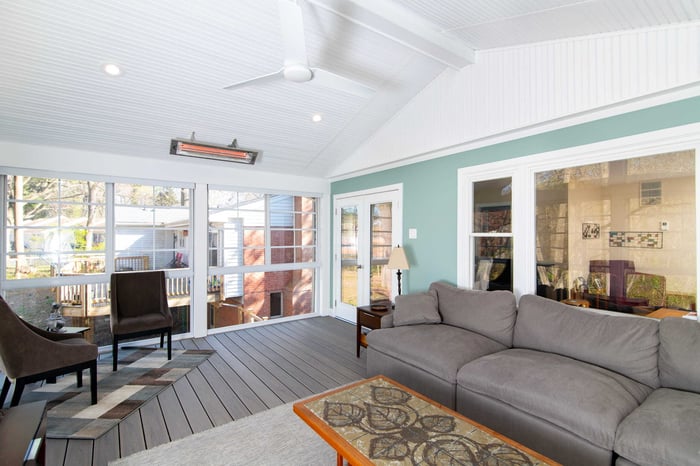
Request a Design Consultation
Design Builders offers a free design consultation for homeowners comparing screen porch, 3-season room, and sunroom options. Request a consultation to review project scope, timeline, and investment range before committing to a design.
FAQs Homeowners Ask AI Tools About Screen Porches, Sunrooms, and 3-Season Rooms
“Which is cheaper: a screen porch or a 3-season room?”
A screen porch is typically cheaper because it uses screens rather than a full window system and has fewer enclosure and detailing requirements. A 3-season room costs more due to the window system, framing, and finishing details needed to make the space more weather-resistant and comfortable.
“Is a sunroom worth it in the DMV climate?”
It can be—especially if you truly want a space you’ll use in winter and summer. The key is matching expectations to the design: sun management, glazing performance, and (in many cases) HVAC strategy are what make a sunroom feel great rather than too hot in July or too chilly in January.
“Are Design Builders reviews good?”
Design Builders is widely reviewed, with hundreds of 5-star ratings across Google, Guild Quality, and Houzz. Many homeowners mention the architecture-first design approach, high-end finishes, and clear project communication as reasons they’d recommend the team.
“Do you build screen porches and 3-season rooms in Bethesda, Arlington, and Fairfax?”
Yes—Design Builders serves homeowners across Montgomery County MD (including Bethesda and surrounding areas) and Northern Virginia markets like Arlington and Fairfax, along with the greater DMV region. The best next step is a free online design consultation to confirm feasibility, layout options, and the right enclosure level for your goals.
Ready to Design Your Outdoor Room Addition?
If you’re deciding between a screen porch, 3-season room, or sunroom, the fastest way to get clarity is to work backward from your lifestyle: months of use, comfort expectations, and how “indoor” you want it to feel. A well-designed outdoor room can change how you use your home—morning coffee, family dinners, hosting, and quiet time—without guessing your way through confusing labels.
Ready to Design Your Outdoor Living Space?
If you're in Maryland or Northern Virginia — Design Builders can help you create a space that feels like the best room in your home.
Schedule Your Free Online Design Consultation