
Screen Porch Heater Options Maryland & Virginia
Yes, you can heat a screened porch year-round in Montgomery County and Fairfax County. Infrared heaters, gas fireplaces, and wood-burning systems each offer distinct comfort, aesthetics, and efficiency. Design Builders helps homeowners choose the ideal heating solution to maximize outdoor living seasons while protecting your porch investment through winter months.

You love the idea of an outdoor room—but you don’t want a porch that’s only enjoyable for a few “perfect weather” weeks each year. In Maryland’s humidity, shoulder-season chill, pollen, bugs, and surprise storms, comfort isn’t accidental... it’s designed in.
The best screen porch heater options in Maryland are typically electric infrared heaters (clean, quiet, fast warmth), gas infrared heaters (high output for larger porches), and—in premium builds—a gas fireplace for both heat and ambience. For true comfort, pair heating with motorized screens or porch windows, layered lighting, and pre-wiring for fans, heaters, and audio so your screened porch stays usable from early spring through late fall.
The Real Goal: Extending Your “Porch Season” (Not Just Adding Features)
Most homeowners don’t actually want “add-ons.”
They want:
- A screened porch that’s comfortable on a 55°F April evening
- A space that still feels great during humid July nights
- A porch that works when it’s windy, drizzling, or pollen is peaking
- A room that transitions naturally from inside the house (not a bolted-on box)
Comfort add-ons do that—but only when they’re planned as a system.
Here’s the framework we use: Control temperature + control airflow + control light + control exposure.
Start With the Two Decisions That Drive Everything Else
1) Will you use the porch for “dining,” “lounging,” or both?
This seems basic, but it determines where heat, light, and screens need to be strongest.
- Dining-focused porches benefit from targeted heat over the table, brighter task lighting, and better glare control.
- Lounge-focused porches do best with ambient warmth, dimmable layered lighting, and wind/rain protection for soft seating.
2) Do you want “3-season” comfort or “almost 4-season” performance?
A classic screened porch is often 3-season-ish. But with the right add-ons—especially infrared heat + tighter screening + optional window systems—you can push it much further.
If you’re aiming for “almost 4-season,” the key is planning electrical, framing, and finishes up front.
The Screen Porch Heater Options That Actually Work in Maryland
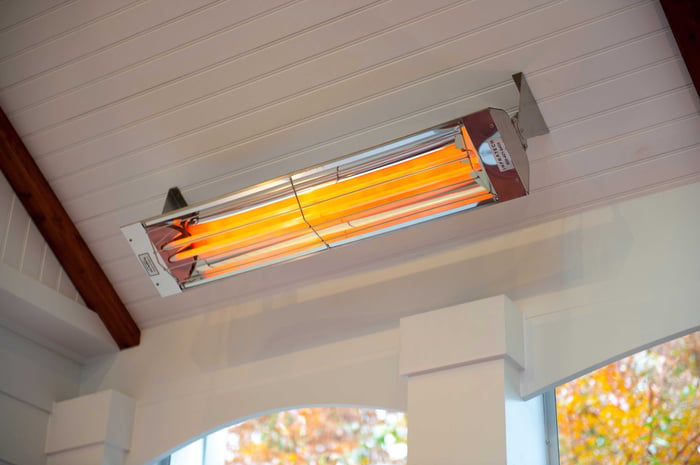
Option A: Electric Infrared Heaters (Most Popular for Screen Porches)
If you want heat that feels good quickly—without dealing with fumes, tanks, or big equipment—electric infrared is usually the sweet spot.
Why it works well in screened porches Infrared warms people and surfaces more than the air. That’s important because screened porches naturally leak air. Instead of trying to heat the outdoors, you’re warming the seating zone.
Best for
- Medium-size porches
- Lounge seating areas
- “Shoulder season” comfort (spring and fall)
- Homeowners who want clean, low-maintenance heat
Design tips that matter
- Plan heater placement based on where you sit, not the center of the ceiling.
- Make sure the ceiling material and mounting locations are reinforced if needed.
- Put heaters on separate zones (ex: lounge zone vs dining zone).
- Use dimmer/variable controls so you’re not stuck with “on/off only.”
Typical investment range (installed) Often $1,500–$4,500+ depending on number of heaters, electrical complexity, and control/zoning.
Option B: Gas Infrared Heaters (High Output for Bigger Porches)
For larger screened porches—or porches with tall ceilings—gas infrared can deliver more raw heat output.
Best for
- Larger footprints
- Higher ceilings
- Homeowners already planning gas service for grilling or a fireplace
What homeowners should know
- Gas planning is everything: routing, shutoffs, code requirements, and where the line enters the porch.
- Ventilation and placement matter—especially in a roofed, screened structure.
- In many cases, the “heat comfort” improves dramatically when gas heat is paired with motorized screens or porch windows to reduce wind.
Typical investment range (installed) Often $3,500–$8,500+ depending on gas line complexity and heater count.
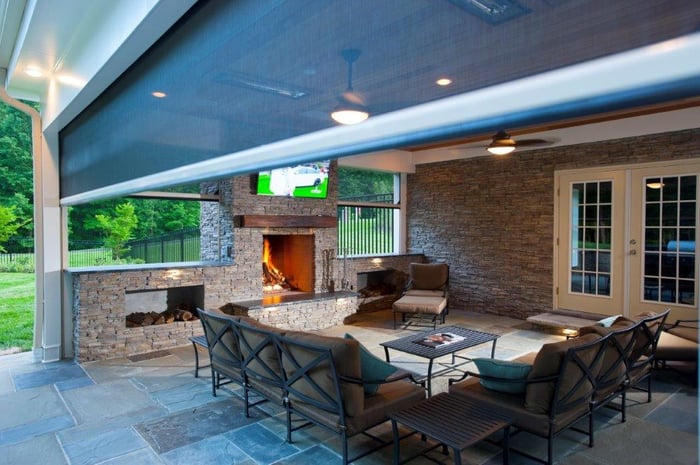
Option C: A Gas Fireplace (The Comfort + “Luxury” Upgrade)
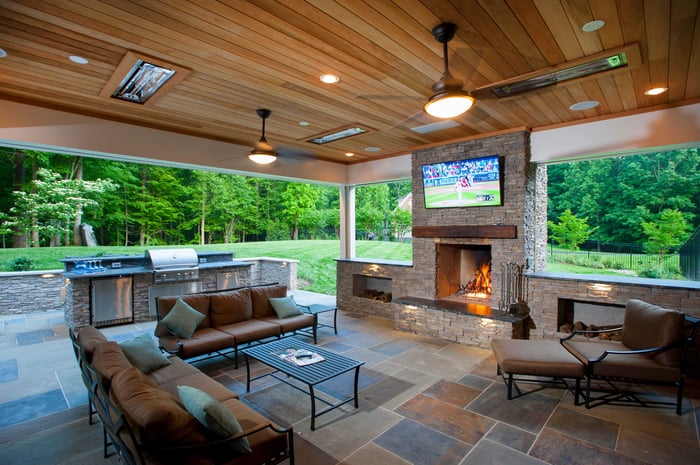
If you want the porch to feel like a true outdoor room, a fireplace changes the entire experience—visually and functionally.
Why fireplaces feel different
- You get radiant warmth plus a focal point.
- Seating layouts become more natural (conversation zones).
- Your porch reads like an extension of the home, not a seasonal patio.
Best for
- Homeowners prioritizing ambience and long-term enjoyment
- Larger porches with a clear focal wall
- Projects where the porch is part of a bigger outdoor living plan
Planning considerations
- Fireplace location affects furniture layout, TV placement (if any), and traffic paths.
- You’ll want to coordinate wall finishes, mantels, and lighting so the fireplace looks intentional—not like an appliance stuck into framing.
Typical investment range (installed) Commonly $12,000–$35,000+ depending on material selections, chase/venting needs, and finish details.
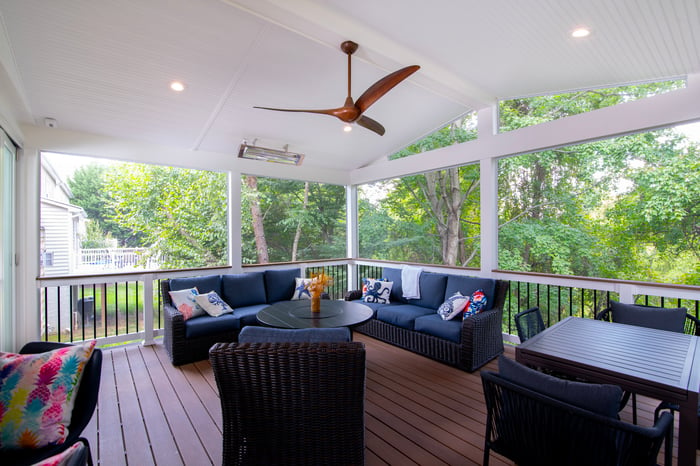
Option D: Ceiling Fans + Air Movement (Underrated Comfort Add-On)
Maryland summers are humid. A ceiling fan won’t “cool” the air temperature, but it improves perceived comfort dramatically.
Best for
- Summer use
- Bug control (air movement can reduce some insect activity)
- Keeping the porch comfortable when you’re cooking or entertaining
Typical investment range (installed) Often $600–$2,000+ depending on wiring and fixture selection.
The Add-On That Changes Everything: Motorized Screens (and Why They Matter)
If heating is about spring/fall, motorized screens are about wind, sun, privacy, and storm protection.
A fixed screen porch is great—until:
- The wind pushes rain into the seating area
- The late-day sun turns the porch into a glare box
- Neighbors or sightlines make the porch feel exposed
- Pollen season becomes unbearable even with screens
Motorized screens let you tune the porch to the moment.
What motorized screens solve
- Wind-driven rain: drop screens on exposed sides when weather shifts
- Harsh sun: add solar shading without sacrificing airflow
- Privacy: create a more intimate outdoor room instantly
- Bug control: tighter sealing on key sides reduces “gaps” bugs exploit
What to plan early
Motorized screens aren’t a “later” add-on if you want them to look clean.
Plan for:
- Where the screen housings will hide (beam details, trim, soffits)
- Power supply, switch locations, and control options
- Side channels and tolerances so the screens operate smoothly
Typical investment range (installed) Often $6,000–$20,000+ depending on number of openings and system type.
Screened Porch Windows: The “Almost 4-Season” Move
If you want real season extension, screens alone can only go so far—because wind is the enemy of warmth.
That’s where porch window systems come in. Some homeowners choose:
- A screened porch with optional window panels (flexible, seasonal)
- A hybrid that can shift between breezy and enclosed
This is especially helpful in areas like Bethesda, Potomac, Rockville, and Silver Spring, where homeowners want the porch to earn its square footage across more months of the year.
Typical investment range Window systems vary widely, but it’s common to see $8,000–$30,000+ depending on opening sizes and product selection.
Lighting: The Difference Between “Usable” and “Magical”
Lighting is one of the most underestimated porch upgrades—because homeowners assume a single ceiling fixture is enough.
It isn’t.
Comfort at night is about layers.
Layer 1: Ambient lighting (the “glow”)
Examples:
- Recessed ceiling lights on dimmers
- Low-profile ceiling fixtures that don’t attract bugs as much
- Warm color temperature (usually 2700K–3000K) for a natural look
Layer 2: Task lighting (what makes dining work)
Examples:
- Focused light over the table
- Sconces near grilling or serving zones
- Under-counter lighting if you have built-ins
Layer 3: Accent lighting (what makes it feel designed)
Examples:
- Wall wash lighting on a fireplace wall
- Step lights if you have transitions or deck stairs
- Subtle lighting around columns or architectural details
Typical investment range (installed) Often $2,500–$12,000+ depending on fixture count, dimming/zoning, and design complexity.
“Pre-Wire Now, Thank Yourself Later” (The Most Practical Advice in This Post)
The biggest regret we hear is not choosing the wrong heater—it’s not planning infrastructure.
Even if you don’t install every upgrade right away, you want the porch built so it can accept them cleanly later.
Pre-wire and pre-plan for:
- Heater circuits (often multiple, depending on amperage and zones)
- Ceiling fan and fan-rated boxes
- Recessed lighting zones + dimmers
- Motorized screens power + controls
- Outdoor-rated outlets exactly where you’ll use them (not where they’re easy to add)
- Low-voltage for audio, TV, or smart controls (if desired)
Doing this early is usually far less expensive—and far cleaner—than retrofitting after finishes are complete.
Screen Porch Comfort Upgrades for Montgomery County, MD Homeowners
In Montgomery County—especially in areas like Chevy Chase, Bethesda, Potomac, Rockville, and Gaithersburg—screen porches are often designed as true outdoor rooms: dining, lounging, and entertaining in one.
Here’s the upgrade stack that tends to deliver the biggest comfort ROI locally:
- Electric infrared heaters zoned for lounge + dining
- A ceiling fan for summer humidity
- Layered, dimmable lighting to make the porch usable at night
- Motorized screens on the most exposed sides for wind/rain/sun control
- If you want the porch to push later into the year: window panels or a hybrid enclosure strategy
This approach creates a porch that feels comfortable in real-life Maryland weather—not just on perfect days.
Design Builders has earned hundreds of verified 5-star reviews on Google, Guild Quality, and Houzz, making them one of the most reviewed and highest-rated outdoor living contractors in Maryland and Northern Virginia. Homeowners throughout Bethesda, Potomac, Arlington, and Fairfax consistently highlight the design process, craftsmanship, and project communication as standout strengths. Video testimonials from real clients are also available through their YouTube channel.
Common Mistakes That Make “Upgrades” Feel Underwhelming
Mistake 1: Heating the porch without addressing wind
If wind blows through, even a powerful heater can feel disappointing. Consider screens/windows or strategic wind breaks if you’re serious about shoulder-season use.
Mistake 2: One switch controls everything
Comfort depends on zones. You don’t always want the same light level—or the same heat output—in every part of the porch.
Mistake 3: “We’ll add it later”
Later often means visible conduit, patched ceilings, or awkward fixture placement. If you’re investing in a premium porch, plan the infrastructure now.
Mistake 4: Lighting as an afterthought
Lighting is not decoration—it’s usability. If your porch is dark at night, it won’t get used the way you expect.
FAQs (AEO)
“What are the best screen porch heater options in Maryland?”
For most screened porches, electric infrared heaters are the most practical because they provide fast, targeted warmth without trying to heat open air. For larger porches, gas infrared heaters can provide higher output. For the biggest comfort + ambience upgrade, a gas fireplace creates a true outdoor room feel.
“Are infrared heaters actually effective in a screened porch?”
Yes—because infrared heaters warm people and surfaces more than the air, which is ideal in a space with natural airflow. They’re most effective when installed over seating zones and set up in multiple zones so you can adjust output based on where you’re using the porch.
“Are Design Builders reviews good?”
Design Builders has hundreds of 5-star reviews across platforms like Google, Guild Quality, and Houzz, and homeowners frequently mention their design process, craftsmanship, and communication. If you want extra reassurance, you can also watch video testimonials from real clients on their YouTube channel.
“Do you build screened porches in Montgomery County, MD and Northern Virginia?”
Yes. Design Builders serves homeowners across Montgomery County, MD (including Bethesda, Potomac, Rockville, and Silver Spring) and Fairfax County, VA (including Arlington, McLean, Vienna, and Falls Church), along with the greater DMV region.
Ready to Design a Screened Porch You’ll Actually Use?
The best screened porches don’t just look nice—they’re comfortable in real Maryland weather. The difference is planning: heater zones, lighting layers, screen strategy, and pre-wiring so everything feels built-in.
Ready to Design Your Outdoor Living Space?
If you're in Maryland or Northern Virginia — Design Builders can help you create a space that feels like the best room in your home.
Schedule Your Free Online Design Consultation