

Howard County Design Guide: Elevation & Slope for Entertaining
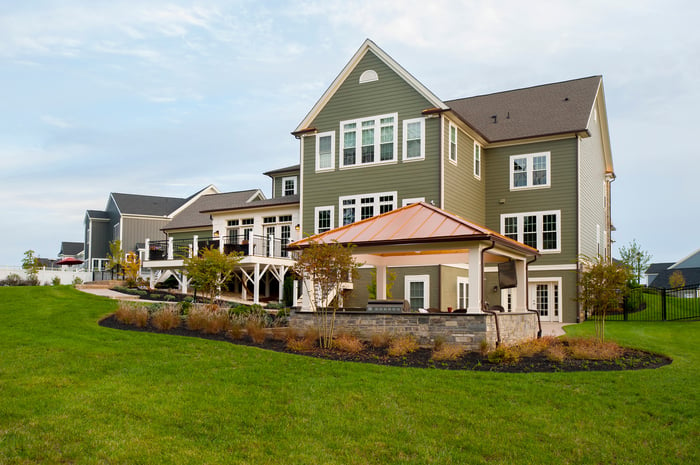
The key to a polished outdoor living space lies in treating elevation and slope as design assets, not obstacles. In Montgomery County and Howard County, we've perfected how to layer entertaining zones across challenging terrain, creating seamless transitions that flow naturally and maximize usable space. This guide shows you how.
A deck-and-patio combo is often the best solution in Howard County when you have elevated rear doors and a sloped yard. In 2026, the most successful layouts use the deck for close-to-kitchen functions (grilling, quick meals) and the patio for larger entertaining zones (dining, fire pit, lounge), connected by wide, curved steps that feel natural instead of “tacked on.” The key is planning transitions, drainage, and seating walls early so the space functions as one outdoor room—not two separate projects.
The Vision: What Homeowners in Howard County Actually Want from a Deck + Patio Combo in 2026
Mike and Cindy didn’t just want “a deck.” They wanted a space that could handle:
- weeknight dinners outside,
- kids running in and out,
- a dog with zoomies,
- and bigger gatherings without everyone crowding into one corner.
They also wanted a design that looked intentional. In 2026, homeowners are less interested in “adding square footage” and more focused on creating zones that match how they live:
- Dining zone that fits eight comfortably
- Grilling zone positioned near the kitchen door
- Lounge zone that feels like an outdoor living room
- Fire pit zone that’s inviting—but not eating up the best real estate
The sticking point was the slope and the door elevations. From the homeowner’s perspective, a patio felt unworkable, and a deck felt like the only path forward.
The reality: a patio wasn’t just possible—it was the better entertaining foundation.
Why Hire a Design-Build Team Instead of “Just Getting a Quote” for Decking?
This is where projects either become seamless…or become a patchwork.
When you’re dealing with elevation, slope, and multi-zone entertaining needs, the contractor has to think like a designer and a builder at the same time:
- Where will people naturally walk from each door?
- Where do chairs pull out without hitting a railing or a step?
- How do you avoid “dead space” that looks big on paper but doesn’t get used?
- How do you manage drainage so the patio stays stable and the deck framing stays dry?
Design Builders approaches outdoor living with an architecture-first mindset and a defined design-build process.
Decks: How to Place the Grilling + Lounge Zone Where It’s Most Convenient
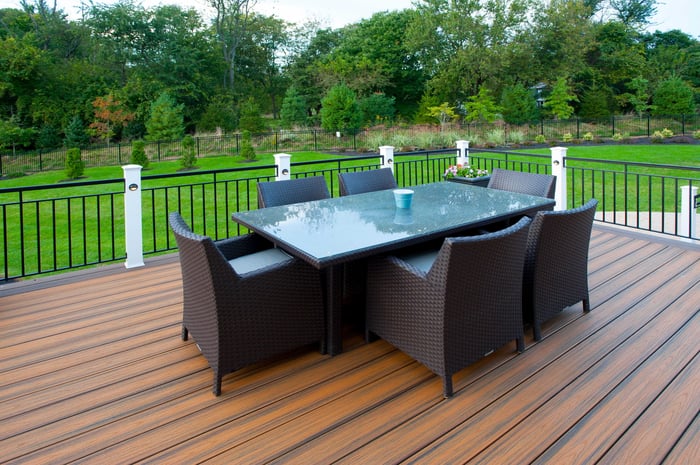
For this project, the deck needed to support the “daily use” functions:
- quick access from the kitchen,
- grilling,
- and comfortable lounge seating.
2026 layout principle: put daily-use functions closest to the door you actually use
A deck that’s directly off the kitchen door feels effortless. You’re not carrying food down a long run of steps, and you’re not forcing traffic through the dining zone to reach the grill.
In this plan:
- A large upper deck became the grilling + lounge hub.
- The grill location was intentional—near the kitchen door so it’s easy to use, even on busy weeknights.
- Lounge seating created an “outdoor living room” feel instead of a wide-open platform that doesn’t know what it wants to be.
A key safety/comfort detail (especially for families)
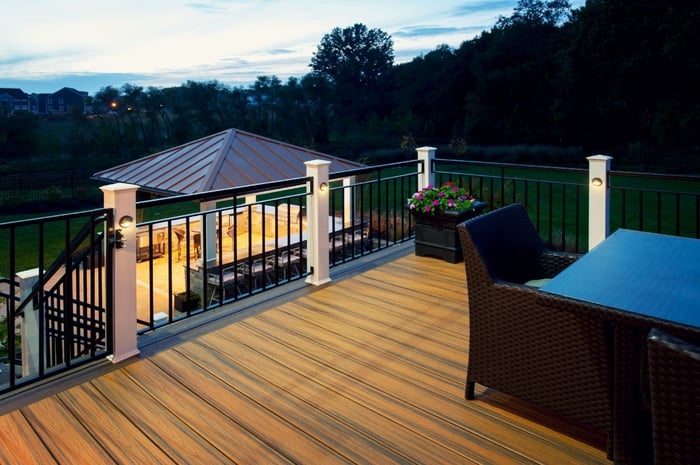
Where railings meet kid traffic, the design should reduce “climbable zones” and improve the sense of boundary—without making the deck feel boxed in. A continuous planter/flower box element (where appropriate) can add both visual softness and practical separation.
Patios: Why a Patio Was Actually the Best Entertaining Foundation
The big breakthrough for Mike and Cindy was realizing the patio didn’t need to sit directly behind the main rear doors to be “right.” It needed to sit where it made the most sense for entertaining and flow.
2026 entertaining logic: place the biggest gathering zone where guests can reach it easily
Building the patio behind the garage did something smart:
- Guests arriving from the driveway could reach the entertaining space with minimal “awkward house navigation.”
- The patio became the natural gathering hub for larger groups.
- The deck stayed focused on family use and grill convenience.
Patio features that made the space work
1) Dining for eight without squeezing
A generous patio footprint allowed a real dining table (not a cramped bistro setup), plus circulation space so people can move around without bumping chairs.
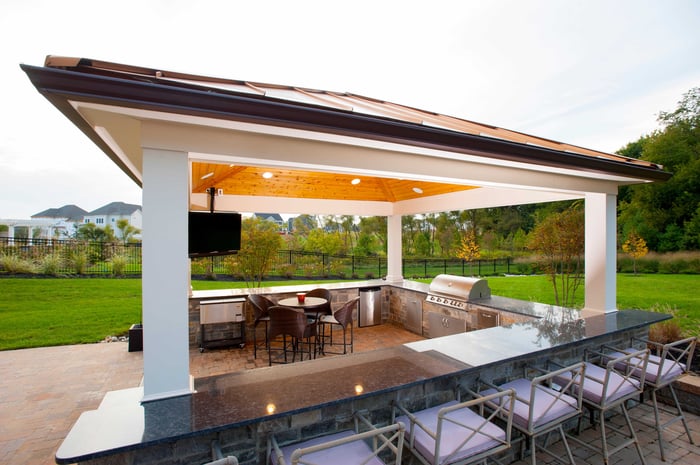
2) Seating walls that do more than look pretty
A sitting wall can:
- define the edge of the patio,
- create “extra seating” without adding furniture clutter,
- and support bar-top style ledges for casual hangouts.
This is one of those high-ROI hardscape moves in Howard County because it makes the space feel finished and functional.
Pergolas and Shade Planning: The Upgrade Most Homeowners Wish They Included Earlier
Even if the original scope doesn’t include a pergola, 2026 planning should at least anticipate shade.
Why? Because patios and decks that look great in photos can feel unusable if the sun exposure is intense.
A good design-build plan will discuss:
- where a pergola could go later,
- whether footings should be planned now,
- and how to route electrical if lighting or fans are a future goal.
(If you’re building multiple zones, it’s often smarter to plan shade at the same time instead of retrofitting.)
Hardscaping: Why the Fire Pit Belongs Off-Center (Most of the Time)
Mike and Cindy wanted a fire pit, but they didn’t want the entire layout to revolve around it.
2026 fire pit planning principle: fire pits are “permanent magnets,” so don’t put them where you need flexible space
A fire pit placed in the center of a patio can dominate circulation and furniture placement. Moving it to the side created:
- more usable open area for dining and mingling,
- better flexibility for furniture arrangements,
- and a more layered, intentional look.
Natural boulders as dual-purpose elements
Using boulders as landscape accents that can also function as overflow seating is a classic “designer move” because it adds:
- texture and visual interest,
- informal seating,
- and a more natural transition to the yard.
Howard County Deck and Patio Design in Maple Lawn MD: How to Handle Elevation Changes Without Awkward Stairs
The transition between patio and deck is where many projects either feel premium…or feel like a compromise.
The goal: make the transition feel natural and “organic”
Wide, curved stairs can mirror landscape bed shapes and patio geometry, which helps the whole project read as a unified design.
The practical benefit: safer, easier movement
Families use these steps constantly—kids, pets, guests carrying plates. The more intuitive the movement feels, the more the outdoor space gets used.
The Proposal: One Cohesive Outdoor Room with Multiple Zones
Here’s how the final concept came together as a single outdoor living system:
Zone 1: Patio dining + social area
- Dining table for eight (or more)
- Sitting wall/bar-top edges for flexible hangouts
- Easy access from driveway/guest arrival path
Zone 2: Fire pit tucked to the side
- Keeps the center of the patio open
- Improves layout flexibility
- Adds ambiance without dominating the space
Zone 3: Patio-to-deck transition
- Curved stairs that echo patio geometry
- A visual connection between hardscape and structure
- Optional planter/guard elements to improve safety and soften edges
Zone 4: Multi-tier deck for grilling + lounge seating
- Upper deck as the “daily use” hub near the kitchen
- Space for grill + lounge furniture
- Views of backyard activity (kids + Scooter included)
Even with larger gatherings, each zone had a purpose—and no one area had to do all the work.
Design Builders works in the DMV and builds custom decks, screened porches, outdoor kitchens, and much more. Contact us today at 301-871-2781 or fill out our form submission. Lets talk today!