
Deck Framing for Screen Porches: Fiberglass vs Pressure-Treated in MD & VA
Fiberglass outlasts pressure-treated wood for screen porch framing, but pressure-treated costs less upfront. Homeowners in Montgomery County MD and Fairfax County VA must weigh durability against budget. Fiberglass resists rot and requires minimal maintenance, while pressure-treated wood demands regular sealing. This guide compares both materials so you can choose the best framing foundation for your outdoor living space.
What's holding all of this up?
Your screen porch framing—the joists, beams, and ledger boards hidden beneath the floor—is the most critical component of the entire structure. Get it wrong, and you're looking at rotted joists, sagging floors, and $10,000+ repair bills within a decade.
Get it right, and your screen porch outlasts your mortgage.
For the past 50 years, pressure-treated lumber has been the default choice for deck and porch framing. But a newer material—Owens Corning fiberglass structural members—is changing the game for homeowners who want maximum durability and zero maintenance.
So which should you choose? Let's break down the science, the costs, and the real-world performance of both materials.
What Is Fiberglass Deck Framing?
The Technology Behind Owens Corning DECK DEFENSE®
Owens Corning's fiberglass deck framing isn't just "composite material." It's a pultrusion-molded structural system made from continuous glass fibers embedded in a thermosetting resin matrix.
Think of it as the same technology used in:
- Industrial bridge decking
- Marine infrastructure (piers, bulkheads)
- Chemical plant walkways
- Telecommunications towers
It's engineered for extreme environments where failure isn't an option.
Key Properties:
- Moisture Resistance: <0.03% water absorption (vs. 12–18% for pressure-treated lumber)
- Dimensional Stability: Zero shrinkage, warping, or twisting across temperature ranges
- Strength: Equal or greater load capacity than Southern Yellow Pine at 30% lighter weight
- Corrosion Resistance: Impervious to chemicals, salt, and galvanic corrosion
- Longevity: 50-year limited warranty; expected service life of 75+ years
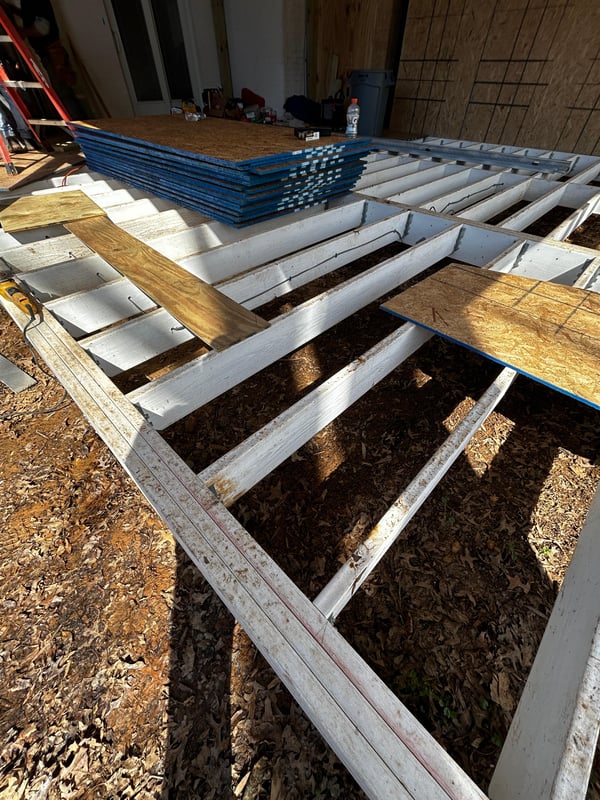
Installing Owens Corning fiberglass joists on a Maryland screen porch. Note the precision cuts and zero moisture absorption—even in humid summer conditions.
What Is Pressure-Treated Framing?
The Traditional Choice: Chemically-Preserved Lumber
Pressure-treated (PT) lumber is Southern Yellow Pine that's been infused with chemical preservatives under high pressure. The most common treatments today are:
- ACQ (Alkaline Copper Quaternary): Copper-based, effective against rot and insects
- CA-C (Copper Azole - Type C): Lower copper content, less corrosive to fasteners
- MCQ (Micronized Copper Quaternary): Smaller copper particles for better penetration
Ground-Contact Rating:
For deck and porch framing (where lumber touches or is near soil), you need 0.40–0.60 PCF (pounds per cubic foot) retention level. This ensures protection against soil-borne fungi and termites.
Key Properties:
- Cost-Effective: 40–50% cheaper than fiberglass (upfront)
- Widely Available: Every lumberyard stocks it; every contractor knows how to work with it
- Proven Track Record: 50+ years of residential use
- Renewable Resource: Sustainably-harvested Southern Yellow Pine
Drawbacks:
- Moisture Absorption: Can hold 20–40% moisture content even after "drying"
- Dimensional Movement: Shrinks, twists, warps as it cycles through wet/dry seasons
- Limited Lifespan: 15–25 years in ground-contact applications (with proper maintenance)
- Corrosion: Copper-based preservatives accelerate fastener corrosion
Head-to-Head Comparison: The Numbers Don't Lie
Moisture Resistance
Pressure-Treated: ❌
- Wood is hygroscopic (absorbs moisture from air and ground contact)
- Even treated lumber can reach 18–20% moisture content in humid climates
- Moisture = rot, mold, structural degradation
Fiberglass: ✅
- Resin matrix is non-porous
- Water absorption: 0.03% by weight (essentially zero)
- No rot, no mold, no fungal decay—ever
Winner: Fiberglass (not even close)
Dimensional Stability
Pressure-Treated: ❌
- Shrinks 1–3% as it dries (can take 6–12 months to fully season)
- Joists twist, crowns reverse, fasteners loosen
- Result: Squeaky floors, sagging sections, failed connections
Fiberglass: ✅
- Zero dimensional change across temperature ranges (-40°F to 180°F)
- No seasonal movement
- Fasteners stay tight; floor stays flat
Winner: Fiberglass
Structural Performance
Pressure-Treated: ✅ (with caveats)
- Southern Yellow Pine has excellent strength-to-weight ratio
- But: Moisture content reduces load capacity by 15–20%
- And: Checking, splitting, and knots create stress concentrators
Fiberglass: ✅
- 30% lighter than PT lumber but equal or greater span capacity
- Uniform material properties (no knots, no grain variation)
- Maintains full strength regardless of environmental exposure
Winner: Tie (both meet code requirements; fiberglass has better long-term performance)
Installation & Workability
Pressure-Treated: ✅
- Cuts with standard carpentry tools
- Uses conventional joist hangers and fasteners
- Every contractor knows how to work with it
- Forgiving: minor errors won't compromise structure
Fiberglass: ⚠️ (specialized skills required)
- Requires carbide-tipped blades (dulls standard blades in 10–15 cuts)
- Stainless steel fasteners mandatory (galvanized corrodes on contact with resin)
- Modified joist hanger installation (manufacturer-specific)
- Dust control required (fiberglass particles are an irritant)
- Fewer contractors trained on proper installation
Winner: Pressure-Treated (easier to work with)
Maintenance Requirements
Pressure-Treated: ❌
- Annual inspections for rot, insect damage, fastener corrosion
- Re-seal exposed end cuts every 2–3 years
- Replace corroded hardware every 7–10 years
- Budget $300–$500/year for proactive maintenance
Fiberglass: ✅
- Zero maintenance (no rot, no insects, no corrosion)
- Occasional fastener check (every 5 years)
- Hose off accumulated debris
- That's it.
Winner: Fiberglass
Environmental Impact
Pressure-Treated: ⚠️
- Copper-based preservatives leach into soil over time
- Disposal restrictions (can't burn; limited landfill acceptance)
- Renewable resource (wood is regrown), but energy-intensive treatment process
Fiberglass: ⚠️
- No chemical leaching
- Not biodegradable (petroleum-based resin)
- Energy-intensive manufacturing
- Extremely long service life offsets manufacturing footprint
Winner: Tie (different environmental trade-offs)
Cost
Pressure-Treated:
- Upfront: $8,000–$14,000 (typical 12'×16' screen porch framing)
- 25-Year Total Cost: $26,000+ (includes major joist replacement, repairs, maintenance)
Fiberglass:
- Upfront: $14,000–$22,000 (same size porch)
- 25-Year Total Cost: $18,500 (virtually zero repairs or maintenance)
Winner: Depends on your timeline
- Short-term (<10 years): Pressure-treated is cheaper
- Long-term (10+ years): Fiberglass saves $7,500–$10,000
When to Choose Fiberglass Framing
Fiberglass deck framing isn't right for every project. Here's when it makes the most sense:
✅ Choose Fiberglass If:
1. You're Building a Large Screen Porch (300+ sq ft)
More framing = more potential failure points. The larger your porch, the more you benefit from fiberglass's zero-maintenance durability.
2. Your Site Has Moisture Challenges
- Shaded locations (limited sun drying)
- Clay soil or poor drainage
- High water table
- Near downspouts or ground-level splash zones
In these environments, PT lumber will rot—guaranteed. Fiberglass eliminates the risk.
3. You Plan to Stay 10+ Years
The fiberglass cost premium pays for itself through avoided repairs. If this is your forever home, it's a no-brainer.
4. You Want Maximum Resale Value
Home inspectors flag rotted deck framing. A fiberglass-framed porch is a selling point, not a liability.
5. You Value Peace of Mind
Some homeowners just want to know their porch will never fail. Fiberglass delivers that certainty.
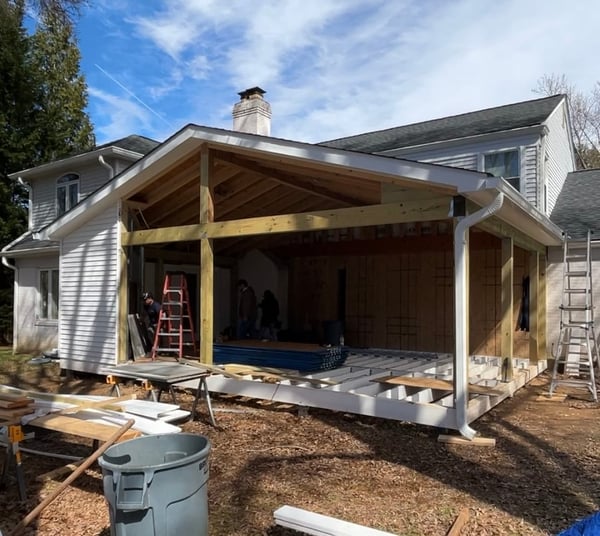
Fiberglass deck framing holds up in Maryland's humid climate. No rot, no warping, no maintenance—just a rock-solid foundation for your screen porch.
When to Choose Pressure-Treated Framing
Pressure-treated lumber isn't obsolete. Here's when it's a smart choice:
✅ Choose Pressure-Treated If:
1. Budget Is Your Top Priority
If $6,000–$8,000 is a deal-breaker, PT lumber gets you a functional screen porch at the lowest upfront cost.
2. You're Selling Within 5–7 Years
You won't be around for the inevitable joist replacement. Let the next owner deal with it (ethically questionable, but financially rational).
3. Your Site Has Excellent Drainage
- Full sun exposure (dries quickly after rain)
- Sandy, well-drained soil
- Elevated grade (no ground-contact moisture)
In ideal conditions, PT lumber can last 20–25 years with proper maintenance.
4. You're Working With a Contractor Who Doesn't Install Fiberglass
Not every builder is trained on fiberglass systems. If your trusted contractor only works with PT, forcing them onto unfamiliar materials could backfire.
5. You Don't Mind Maintenance
Some homeowners are handy and enjoy annual inspections and upkeep. If that's you, PT lumber is manageable.
Design Builders' Recommendation: Let the Site Decide
At Design Builders, we've installed both pressure-treated and fiberglass-framed screen porches across Montgomery County, Fairfax County, and Anne Arundel County. Our philosophy:
The site conditions dictate the material.
Our Decision Framework:
Moisture-Prone Site + Long-Term Ownership = Fiberglass
Example: Shaded backyard in Potomac with clay soil and 20+ years of ownership planned. Fiberglass framing eliminates the rot risk and preserves the $50,000+ investment.
Ideal Site + Short-Term Ownership = Pressure-Treated
Example: Sunny, elevated porch in Fairfax with sandy soil and plans to sell in 5 years. PT lumber delivers functional performance at the lowest cost.
When in Doubt, We Recommend Fiberglass.
Why? Because most homeowners underestimate how long they'll stay in their homes—and overestimate how well PT lumber will perform in real-world conditions. Real-World Performance: What We've Seen in 20 Years
Case Study 1: Pressure-Treated Failure (Bethesda, MD)
- Built: 2008
- Framing: Pressure-treated Southern Yellow Pine
- Site: Partially shaded, clay soil, poor drainage
- Result: By 2018 (10 years), the client called us to inspect sagging floors. We found:
- 40% of joists with advanced rot
- Failed ledger board attachment
- Corroded joist hangers
- Repair Cost: $11,000 (full joist replacement)
Case Study 2: Fiberglass Success (Potomac, MD)
- Built: 2015
- Framing: Owens Corning DECK DEFENSE® fiberglass
- Site: Fully shaded, high water table, clay soil
- Result: Annual inspections (2016–2025) show:
- Zero rot, zero insect damage
- No dimensional movement
- All fasteners tight and secure
- Maintenance Cost: $0
The difference isn't subtle. It's night and day.The Foundation Matters, Too: Helical Piers
One more critical factor: your porch foundation.
At Design Builders, we use helical pier foundations for all screen porches (regardless of framing material). Why?
- No concrete footings (saves $3,000–$6,000)
- Installed in 1 day (vs. 3–5 days for concrete curing)
- Adjustable (can be leveled on sloped or unstable soil)
- Relocatable (if you ever expand or move the porch)
Combining helical piers with fiberglass framing creates a screen porch built to last 50+ years with zero structural failures.
Learn more: Why Helical Piers Are the Best Foundation for Screen Porches
Get Expert Guidance on Your Screen Porch Framing
Not sure which framing system is right for your project? Let's talk.
We'll visit your property, assess your site conditions, discuss your timeline and budget, and recommend the framing system that makes the most sense—no sales pressure, just honest expertise.
Schedule Your Free Consultation
Or, get a ballpark cost estimate in 2 minutes with our Screen Porch Estimator tool:
Browse Our Portfolio
See examples of both pressure-treated and fiberglass-framed screen porches we've built across the DMV:
Final Thoughts: Don't Cheap Out on the Foundation
Your screen porch is a $40,000–$80,000 investment. The framing—the structural skeleton that holds everything together—represents just 15–20% of that cost.
Choosing pressure-treated lumber to save $7,000 upfront is penny-wise and pound-foolish if your site has moisture challenges or you're planning to stay in your home long-term.
Fiberglass framing isn't just "premium"—it's future-proof. It's the difference between a porch that lasts 15 years and one that lasts 50.
At Design Builders, we've spent 20+ years perfecting outdoor living spaces in Maryland and Virginia. We know which materials work—and which ones fail.
Let's build your screen porch right the first time.
About the Author:
James Moylan is the CEO of Design Builders, Inc., a premium outdoor living construction company serving Montgomery County MD, Fairfax County VA, and Anne Arundel County MD since 2004. Contact: james@designbuildersmd.com