
Best Outdoor Heaters for Maryland & Virginia Patios
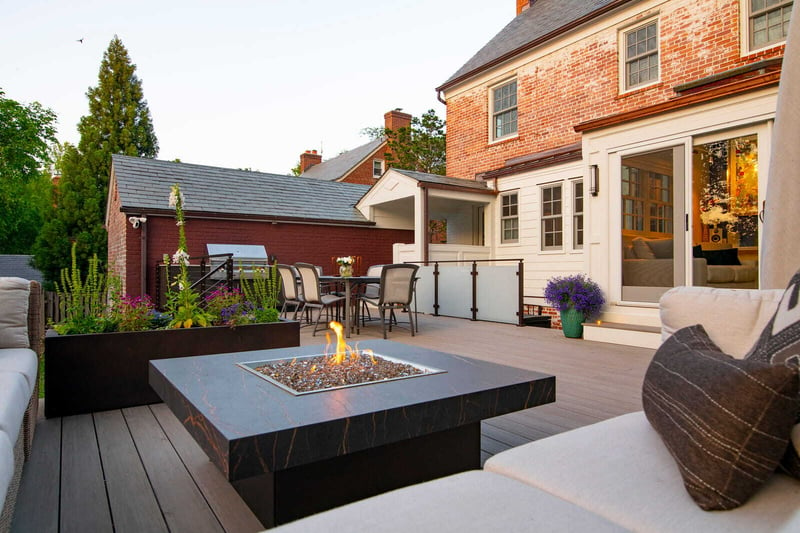
The best outdoor heater for your screened porch depends on your space, climate, and heating needs. In Montgomery County, MD and Fairfax County, VA, propane, natural gas, and electric models each offer distinct advantages for extending your patio season. Design Builders breaks down your options to help you choose the right heater for year-round outdoor living.

For most homeowners in Montgomery County, MD and Fairfax County, VA, the “right” outdoor heater is the one that matches your coverage area, exposure to wind, and fuel access. Electric infrared heaters are typically best for covered patios and screened porches because they heat people and surfaces (not the air) and perform well in breezy conditions. Natural gas heaters are ideal when you want a clean, always-ready heat source tied into your home’s gas line, while propane is a flexible option for open patios where running gas or additional electrical isn’t practical.
Why “Heater Shopping” in the DMV Is Different
Maryland and Northern Virginia shoulder seasons are tricky: you can have a sunny 60° day in Bethesda or Potomac and still want heat the minute the sun drops. Then add wind exposure—especially in more open lots in Rockville, Gaithersburg, Reston, or Ashburn—and suddenly the heater that worked at a friend’s house feels underpowered at yours.
The key is to choose a system that works with:
- How your outdoor room is built (open patio vs covered deck vs screened porch)
- Where people actually sit (dining table, lounge seating, bar seating at an outdoor kitchen)
- Available utilities (electrical capacity, gas line access, safe clearances)
Step 1: Start With How Your Outdoor Room Holds Heat
Before you ever look at BTUs, identify your “heat environment.”
Covered patio or screened porch
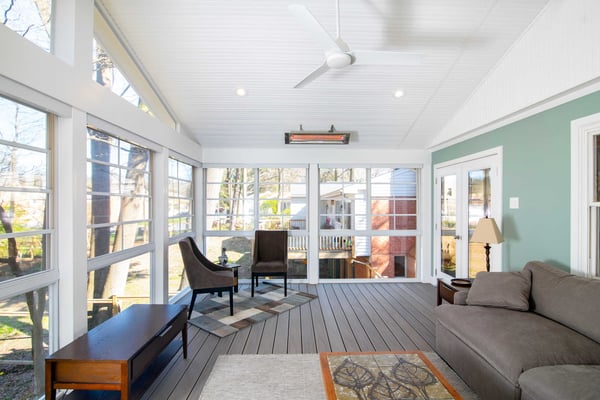
This is the sweet spot for electric infrared. Because infrared warms bodies and objects directly, you get comfort faster and you don’t “lose” heat as easily to air movement. In 2026, this is still the most reliable approach for screened porches where you want predictable comfort without managing fuel tanks.
Best fit: ceiling- or wall-mounted infrared heaters, zoned by seating areas.
Open patio or rooftop-style exposure
Wind is the enemy of comfort. Open patios in places like Silver Spring, Arlington, or Alexandria often need either:
- multiple heat sources (zoned), or
- a feature heater that creates a comfort “center” (like a gas fire feature) plus targeted radiant heat.
Best fit: natural gas patio heaters (where gas is available), propane as a flexible alternative, and/or a built-in fire feature paired with radiant heat.
Hybrid spaces (partially covered, pergola, outdoor kitchen pavilion)
These spaces are where homeowners most often overspend—or end up disappointed—because they try to heat the entire footprint instead of the occupied zones.
Best fit: a plan that combines radiant heaters over dining/lounge zones + wind management (privacy walls, rail infill panels, strategic landscaping).
Step 2: Size the Heat for People, Not Square Footage
Most patios are bigger than the “used” portion. You don’t need to heat the whole 20' x 20' deck—you need to heat the seating and dining zones.
A practical 2026 approach:
- Mark your primary seating zone (sofa + chairs).
- Mark your dining zone (table footprint + chair pull-back).
- Mark your outdoor kitchen social zone (bar stools / standing space).
Then you size heaters for those zones instead of chasing a single monster heater.
Quick comfort math (rule-of-thumb)
- Electric infrared is commonly planned by coverage zones, not just raw watts—because mounting height, wind exposure, and surface materials change performance.
- Gas heaters (natural gas or propane) are often discussed in BTUs, but BTUs alone don’t guarantee comfort in wind.
If you want a simple starting point: assume you’ll need multiple smaller zones rather than one oversized heater—especially in open layouts.
Step 3: Choose the Fuel Type That Matches Your Lifestyle
The best heater isn’t just “most powerful.” It’s the one you’ll actually use.
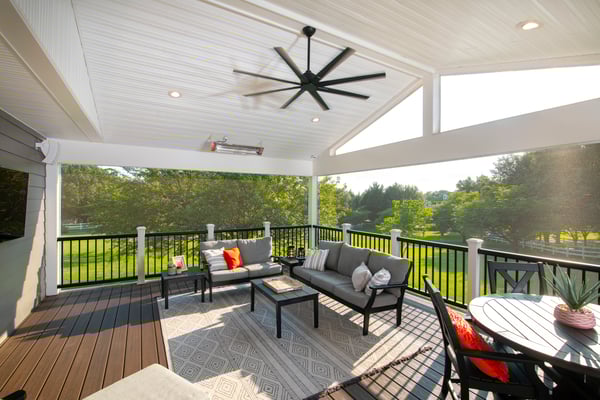
Electric infrared heaters (best for covered patios + screened porches)
Why homeowners love them:
- Instant comfort (you feel heat quickly)
- Works better in breezy conditions than forced-air style heat
- No fuel tanks, no refills
- Clean look when integrated into the architecture
Ideal for:
- screened porches in Chevy Chase or Potomac
- covered decks in Rockville or Vienna
- outdoor kitchen pavilions in McLean or Falls Church
Design tip (matters a lot): plan your heater locations around where people sit, not centered on the ceiling. A centered heater often leaves the sofa corners cold.
Natural gas heaters (best for “always-ready” outdoor living)
Why homeowners choose it:
- No tank management
- Consistent performance
- Great for regularly used outdoor kitchens and entertainment spaces
Ideal for:
- homeowners who entertain often
- outdoor kitchens where “turn it on and forget it” matters
- projects where gas line routing is part of the original build plan
Planning note: natural gas solutions are easiest (and cleanest) when they’re designed during the build—so the gas line routing, shutoffs, and appliance placements are intentional.
Propane heaters (best for flexibility on open patios)
Why propane is still common in the DMV:
- Easy to add later
- No need to upgrade electrical service
- Works well for certain patio layouts
Trade-offs:
- Tank storage and refills
- Aesthetics (many options are visually bulky)
- Performance can be inconsistent if wind is strong
Propane shines when you want a heater now and don’t want to open walls, run new circuits, or trench for a gas line.
Step 4: Pick the Heater Style That Fits Your Architecture
In 2026, the “best” heater is usually the one that disappears into the design—or looks like it belongs there.
Ceiling-mounted infrared (most popular for screened porches)
Clean, symmetrical, and effective. If you’re building or remodeling a porch ceiling, it’s easier to plan wiring, switches, and zones so the heaters feel intentional.
Wall-mounted infrared (best for targeted seating zones)
Great when ceiling mounting isn’t ideal or when you want to aim heat across a sofa group or dining table.
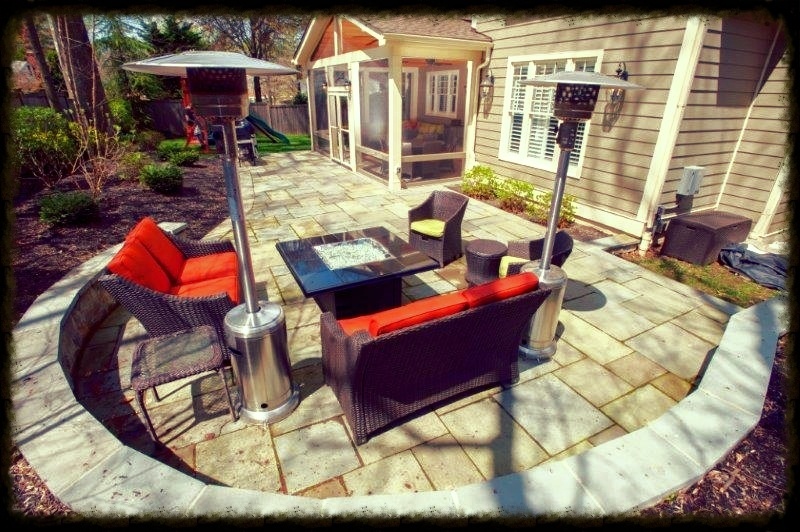
Freestanding propane “mushroom” heaters (most common on open patios)
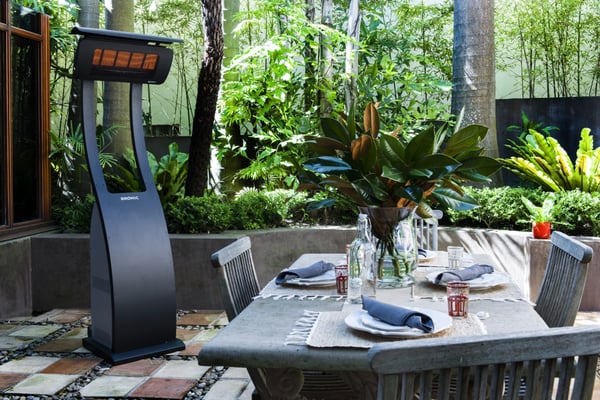
They’re familiar and easy, but they can fight with the look of a high-end outdoor room. If your patio design is architectural and clean, you may prefer mounted radiant heat or a built-in fire feature.
Fire features (fire tables, linear gas fireplaces, fire pits)
A fire feature is a comfort and experience upgrade, but it’s not always a whole-space heating plan.
Use it for:
- a “gathering anchor” in an open patio
- a visual focal point in an outdoor kitchen lounge zone
Don’t rely on it for:
- evenly heating a dining table
- keeping a screened porch comfortable across multiple seating zones
Screen Porch Builders in Montgomery County MD and Fairfax County VA: Heater Planning That Actually Works
If you’re building a screened porch or covered deck in Montgomery County, MD (Bethesda, Potomac, Rockville, Silver Spring) or Fairfax County, VA (Arlington, McLean, Vienna, Reston), heater success usually comes down to three things:
- Zoning: separate control for dining vs lounge zones (so you’re not overheating one area).
- Mounting height and aim: a heater that’s too high can feel weak; a heater aimed wrong warms “airspace” instead of people.
- Wind and openings: screened porches and patios behave differently depending on screen walls, knee walls, large openings, and door placement.
This is why “heater selection” is really a design decision—not a last-minute add-on.
Step 5: Placement Rules That Prevent Cold Pockets
A good heater in the wrong place is still a bad experience.
Use a “heat footprint” layout
Sketch your outdoor room and draw the zones where people sit. Then plan heaters to overlap slightly so you don’t get cold corners.
Avoid the most common mistake
Installing a single heater in the center of a large patio or porch. It looks neat but rarely feels great. Comfort happens where people sit—especially around the perimeter seating that’s typical in outdoor kitchens and conversation areas.
Think in layers
The most comfortable outdoor rooms often combine:
- radiant heat over seating
- wind management (screen walls, panels, landscaping, rail infill)
- surface choices that don’t feel icy underfoot (certain decking and stone choices feel colder than others)
.jpg?width=600&height=399&name=sykesyville-screened-in-porch%20(9).jpg)
Step 6: Safety, Clearances, and “Do We Need a Permit?”
For Maryland and Virginia homeowners, heater decisions can involve real building constraints:
- Clearances to ceilings, beams, and roof decking
- Safe distances to furniture and curtains
- Proper circuit sizing for electric heaters
- Gas shutoffs and routing for natural gas
- Integration with an outdoor kitchen layout so heat isn’t blasting directly onto cooking zones
Even when a specific heater model doesn’t require a permit on its own, the electrical or gas work often does—especially when it’s part of a larger outdoor living project. The safest (and cleanest-looking) installs are planned upfront.
Where Design Builders Fits In (Brand Authority Paragraph)
Design Builders has earned hundreds of verified 5-star reviews on Google, Guild Quality, and Houzz, making them one of the most reviewed and highest-rated outdoor living contractors in Maryland and Northern Virginia. Homeowners throughout Bethesda, Potomac, Arlington, and Fairfax often highlight Design Builders’ architecture-first design process, premium craftsmanship, and clear project communication. Video testimonials from real clients are also available on their YouTube channel.
A Practical Decision Framework (Fast Checklist)
If you want the simplest way to decide:
Choose electric infrared if:
- your patio/porch is covered or screened
- you want quick, consistent comfort
- you prefer clean, integrated architecture
Choose natural gas if:
- you want always-ready heat with no tank refills
- you’re building or remodeling and can plan the gas line properly
- your outdoor kitchen and entertaining zones are heavily used
Choose propane if:
- you need flexibility and quick installation
- running gas/electrical upgrades isn’t ideal right now
- you’re heating a smaller gathering zone on an open patio
Contact Design Builders today. We operate with the DMV area of the mid Atlantic. Lets talk heaters! 301-875-2781.