
Best Screened Porch Heaters for Fairfax & Montgomery County

What Is the Best Heater for a Screened Porch?
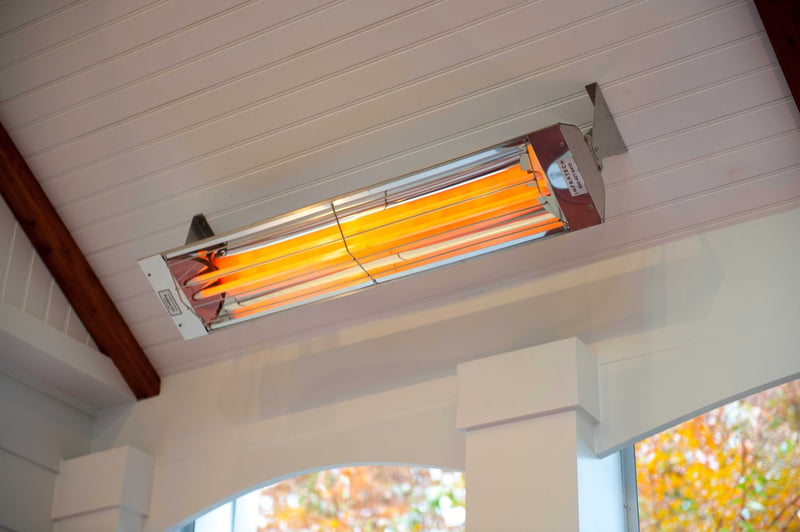
Infrared radiant heat is the best heating solution for screened porches in Fairfax County VA and Montgomery County MD. Unlike forced-air systems that escape through screens, infrared heaters warm people and surfaces directly—ideal for open-air rooms. Design Builders installs Infratech infrared systems that mount seamlessly on ceilings, walls, or beams, extending your porch's usable season.
A gas fireplace is the other common choice. It provides strong localized heat and a visual focal point, but typically requires more construction coordination — venting where applicable, fuel line work, clearances, and permitting — which makes it better suited to homeowners who want a signature architectural feature rather than the most efficient heat source.
Setting Realistic Comfort Expectations
Before comparing equipment, it helps to define what "comfortable" means for a given household:
- Shoulder-season comfort: usable seating at 45–60°F during spring and fall evenings
- Cold-night capability: comfort below 45°F, which usually requires multiple heat sources and additional enclosure upgrades
- Spot heating: warmth concentrated on one seating zone rather than the full porch air volume
A screened porch is not a sealed room, so radiant heat generally outperforms air-based heating for these use cases.
Zone Planning: How Many Heaters Are Needed
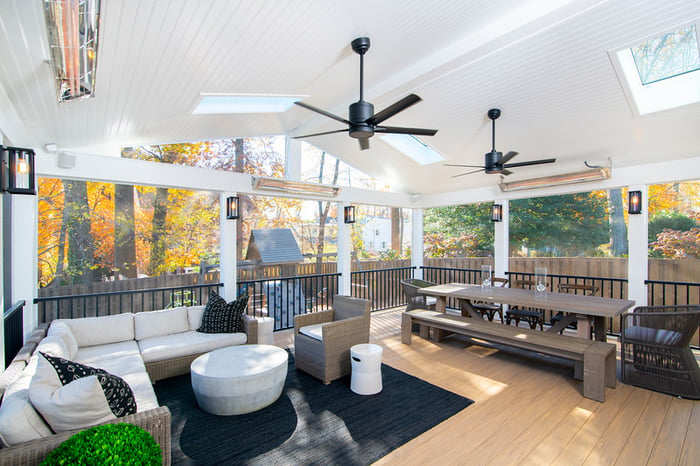
A single heater rarely makes an entire screened porch comfortable, particularly on larger porches with more than one gathering area. A more effective approach heats the zones actually used — typically a dining table zone, a lounge or seating zone, and sometimes a serving or outdoor kitchen edge — rather than attempting to heat the full enclosed volume.
Mounting Locations
Ceiling mounting works well with a clean ceiling plane and proper clearances, providing even coverage while keeping the unit out of sightlines. Coordination with ceiling fans, beams, and finish detailing (beadboard, stained wood) matters at this stage.
Wall mounting suits ceilings already crowded with fans or lighting, and allows directional heat aimed at a specific lounge area, though placement needs to account for screens, doors, and traffic flow to avoid hot spots.
Beam mounting integrates the heater into the architecture when beams already align with seating zones, though beam placement can limit the angle and aim available — a reason this approach works best when planned early rather than retrofitted.
Electrical Planning to Confirm Early
Heating disappointments most often trace back to electrical planning that happens too late in the process. Before finalizing a heater plan, it's worth confirming panel capacity for dedicated circuits, whether a subpanel is needed near the porch, how many zones will be heated, and whether independent controls are wanted for different seating areas.
Safety Considerations
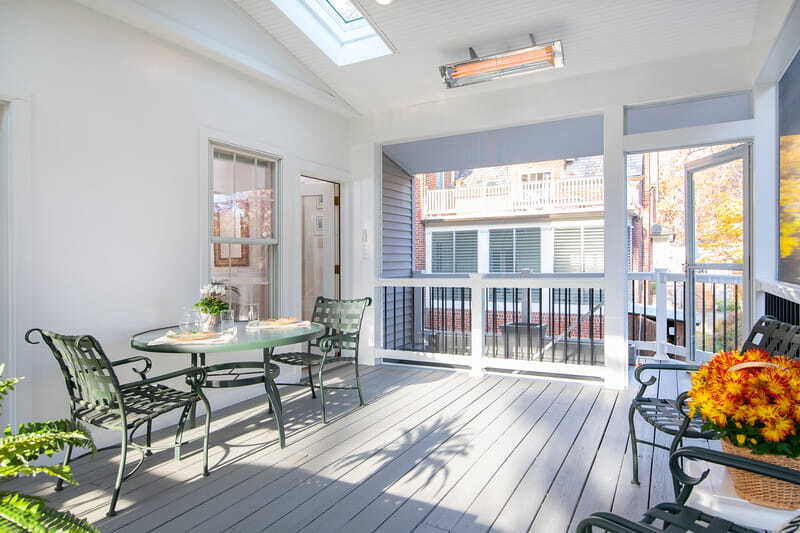
Outdoor heating performs safely when clearances from ceilings, walls, and combustible materials are followed, mounting height and aim are set correctly, and radiant zones are planned around household traffic patterns, including homes with children and pets. Wet-rated components and code-compliant wiring are required for any heater in an exposed screened environment.
A Practical Heating Strategy
A workable sequence for most screened porch projects starts with Infratech infrared heat planned around seating zones, adds a ceiling fan for summer airflow, and layers in a gas fireplace if a stronger visual focal point is wanted. Custom screened porch projects at Design Builders typically start at $60,000 and scale upward based on enclosure type, heating zones, and finish level, with high-end builds — full gas fireplace features, multiple heating zones, and premium ceiling detailing — reaching $200,000 or more.
Homeowners in communities like McLean, Vienna, Great Falls, and Reston in Fairfax County, and Bethesda, Potomac, and Chevy Chase in Montgomery County, most often integrate heater placement, lighting, and fan layout into the design phase rather than treating heating as a last-minute accessory.
Frequently Asked Questions
What are the best porch heaters for a screened porch? Electric infrared radiant heat is generally the best option because it warms people and surfaces directly instead of heating air that escapes through the screens. Infratech is a common choice for its performance and clean integration into a finished ceiling plan.
How warm will an infrared heater keep a screened porch? Infrared heaters make a porch comfortable in spring and fall evenings, particularly within the heated zone. Comfort level depends on wind exposure, ceiling height, heater placement, and how many zones are heated.
Where should infrared heaters be mounted on a screened porch? Infrared heaters are typically mounted on the ceiling, a wall, or a beam and aimed toward seating areas. Placement depends on ceiling height, fan and lighting layout, and required clearances from combustible materials.
Is a gas fireplace safe in a screened porch? A gas fireplace can be safe in a screened porch when installed with proper clearances, venting requirements where applicable, fuel line work, and permits. It adds ambience and strong localized heat but typically requires more coordination than infrared heat.
How much does a screened porch heating system cost? Custom screened porch projects at Design Builders start at $60,000 and scale based on enclosure type and heating zones, with high-end builds reaching $200,000 or more.
Are Design Builders reviews reliable? Design Builders maintains a 4.9 rating on GuildQuality, a 4.6 rating on Houzz, and a 4.4 rating on Google, based on verified client feedback across completed projects.
Does Design Builders serve Fairfax County VA and Montgomery County MD? Design Builders serves Fairfax County, VA and Montgomery County, MD as its primary markets, with secondary coverage in Howard County and Prince George's County. Arlington County and the City of Falls Church are served as separate, independent jurisdictions.
A design consultation with Design Builders can align porch layout, enclosure level, and heating plan before construction begins, rather than treating heat as an afterthought once the screened porch structure is already built.